
Kenya minister stops construction of US-backed Ebola quarantine facility

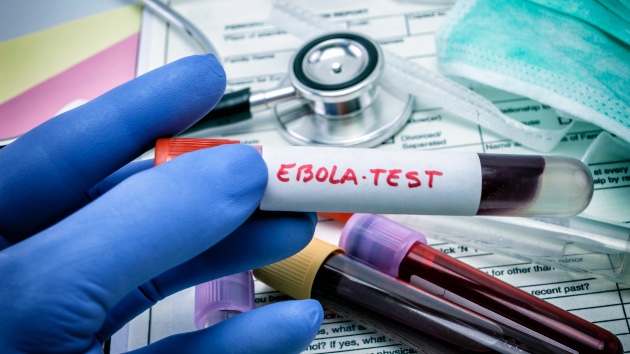
Ebola virus test, conceptual image. (DIGICOMPHOTO/SCIENCE PHOTO LIBRARY/Getty Images)

(NEW YORK) — Kenya’s Health Cabinet Secretary Aden Duale has halted construction of the U.S.-backed Ebola quarantine facility at Laikipia Air Base after being found in contempt of court for allowing work to continue despite a court order.

Duale appeared before the High Court in Nairobi on Tuesday and said he directed “the immediate and complete cessation of any intended construction, site preparations or related activities” concerning the facility.

“It was never the intention of the ministry or myself as the Cabinet Secretary to disregard, undermine, or act in defiance of the orders,” he said.

Duale also told the court he would be “the last person to disregard a court order” and “the last person to violate any constitutional order given by any court.”

Last month, the White House confirmed the U.S. was setting up a health facility in Kenya to receive Americans who were exposed to Ebola in regions affected by the outgoing outbreak.

In the Democratic Republic of the Congo, there are at least 1,048 confirmed cases of Ebola, of which 267 have died, according to the country’s health ministry. In Uganda, there are 20 confirmed cases, of which two have died, according to UNICEF.

An administration official said at the time that the U.S. was establishing a “state-of-the-art facility” in Kenya “through a coordinated effort with the Departments of State, Health and Human Services and War.”

The official said the purpose of the 50-bed facility would be to “provide access to high-quality care for Americans who would need to quickly get out” of the Democratic Republic of Congo (DRC) to quarantine, and argued that it would cut down on the “risks of a lengthy transport back to the U.S.” The proposal was support by Kenya’s President William Ruto.

Secretary of State Marco Rubio had previously said that no Ebola cases would be allowed into the U.S.

The proposal led to protests with hundreds taking to the streets. During one demonstration, at least two people died and others were injured.

Just days after the White House confirmed the plans, a Kenyan court temporarily halted the proposal with Kenyan High Court Judge Patricia Nyaundi upholding that decision and ordering the Kenyan government to cease all building and operations at the base while the case is resolved.

ABC News obtained high-resolution satellite photos showing the construction project was underway despite the court orders. 

On Monday, Duale was found in contempt of court for failing to halt the construction of the facility.

The court accepted Duale’s apology on Tuesday and discharged him with a warning, saying that he would face sentencing if there was any indication he disobeyed its orders again. The injunction stopping the construction was extended until a hearing on July 23.

“Today was an important moment for justice in Kenya,” Nora Mbagathi, executive director of Kenya’s Katiba Institute, an organization that is challenging the U.S. facility plan, told ABC News.

“By appearing in court and confirming that construction of the quarantine facility has been halted, Duale has affirmed the government’s recognition that they are not above the Constitution,” the message continued. “His apology to the Court and the people of Kenya is an important moment not just for our courts but for our democracy and rule of law.”

ABC News’ Camila Alcini, Emily Chang, Nicholas Kerr, Christopher Looft, Luis Martinez and Zoe Magee contributed to this report.

Copyright © 2026, ABC Audio. All rights reserved.

Rare condition made mom feel like she was ‘walking on a hot bed of Legos’

When Amber Meade twisted her ankle and broke a bone in her foot, she expected recovery to be easy. She needed surgery to shave down the damaged bone and make sure the nerves and tendons in her foot were where they should be.The procedure seemed to go smoothly, but in the weeks that followed, she began to feel debilitating pain. A second surgery found that a screw placed in her foot had been pressing on the head of one of her nerves. That screw was moved, and a nerve decompression was performed but the pain didn't stop. "It would just turn black and blue, swell up really big, and I just was unable to put any weight on it," 41-year-old Meade said. The pain upended everything. She left her job as a surgical assistant since she could no longer stand for long periods. She was unable to take part in family activities with her two young sons. Even light breezes could trigger the pain. Resting under a blanket was unbearable, making sleep difficult. Meade compared the sensation to "walking on a hot bed of Legos constantly, while getting stabbed with a pencil." Meade spent months seeing different specialists. Finally, after nearly a year, a doctor suggested Meade might have something called complex regional pain syndrome. It was the first time Meade had heard of it. It would take even longer before she could find a treatment that helped her pain. Amber Meade in 2023. Amber Meade What is complex regional pain syndrome? Complex regional pain syndrome, or CRPS, is a chronic disorder with no cure, said Dr. Rohan Jotwani, an interventional pain specialist and anesthesiologist at NewYork-Presbyterian and Weill Cornell Medicine. Jotwani was not involved in Meade's care. CRPS can occur after surgery, like Meade's, or from other injuries to the nerve. "For some patients, they'll have an injury to a nerve and it will get better with time. For some patients, that injury will actually develop into its own chronic pain disorder," Jotwani said. Diagnosing the condition is difficult, Jotwani said. No test or scan can definitively identify it, and because it is a rare condition, many doctors may not be familiar with it, he added.Physicians have to rely on clinical criteria. Telltale hallmarks for the condition are extreme levels of pain at the source, even when nothing should be causing it - like when a bedsheet causes pain, as Meade experienced. CRPS patients may also experience swelling, changes in temperature and skin color or texture changes. They may even begin to lose function in the affected area. Diagnosing complex regional pain syndrome is only the start, Jotwani said. Actually treating the condition requires a "multi-pronged approach" that can vary from person to person. Treatment typically starts with physical therapy. Patients may also take medication to decrease nerve signals in the area, so they feel less pain, or try interventional techniques like a nerve block. Meade tried multiple options, but nothing was improving her pain. "Doing regular therapies was not working. I even heard, at 33, that I was getting older and that 'sometimes we just hurt more.' I thought that was comical," Meade said.  Treating complex regional pain syndrome In 2022, long after Meade's pain started, a doctor suggested she see physical therapist Dr. Anita Davis, who specializes in treating the condition and leads the comprehensive pain rehabilitation program at Brooks Rehabilitation in Florida. The pair worked to develop a physical therapy routine that would work for Meade. "Before me, she had all of the traditional exercises ... and those things were just not possible with that much pain in her foot," Davis said. "As healthcare providers, we ask patients to rate the pain from zero to 10. These folks are typically going to be at the top of the scale, even on a good day. When I ask her to do something that's painful on top of her existing pain, it's just crazy to think about doing that." They also worked on relaxation and emotional exercises to cope with the mental load of the constant pain. Dr. Anita Davis, left, and Amber Meade, right.
Read Next Story