
A dog trainer had no symptoms. An X-ray found a terminal disease

When Christopher Kennedy went to have an X-ray before a routine surgery, he thought he would be in and out. Then a technician spotted scarring in his lungs. 

Kennedy, 68 at the time, had never noticed any warning signs. He was a retired Air Force technician who exercised regularly and spent his time landscaping his backyard and training Bernese Mountain dogs to be hospital therapy animals. 

After several tests, a pulmonologist gave him an alarming diagnosis: Idiopathic pulmonary fibrosis, or IPF. It’s a type of lung disease with no known cause where scar tissue grows in the lungs and prevents oxygen from reaching the bloodstream, according to Dr. Panagis Galiatsatos, a medical spokesperson for the American Lung Association and pulmonologist at Johns Hopkins, who was not involved in Kennedy’s care. The condition is progressive with a “high mortality rate,” Galiatsatos said. 

At first, Kennedy thought he could “beat” the disease. But as his lung function degraded, he realized that was “baloney.” Medications meant to slow the progressive fibrosis weren’t working, and he was starting to need oxygen in his daily life. Even walking to the kitchen was leaving him winded. In 2024, Cleveland Clinic pulmonologist Dr. Aman Pande confirmed Kennedy’s worst fear: He had less than a year to live.
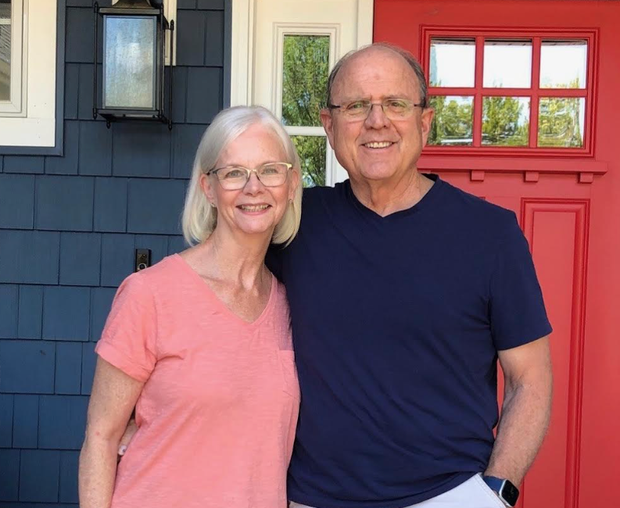
screenshot-2025-07-24-at-11-11-29-am.png
Christopher Kennedy and his wife on their anniversary in 2021. 

Christopher Kennedy / Cleveland Clinic

“We all wonder, as human beings, how we’re going to go,” Kennedy said. “And you never know. It’s a great mystery. Well, for the first time in my life, I was told ‘This is how you’re going to go.'” 

“You come out one of two ways”    

Pande did have one option for Kennedy: They could see if he was eligible for a double-lung transplant. Kennedy, at 74, was older than most patients who undergo the operation, but he was otherwise a promising candidate, Pande said. Lung transplants are usually the final option offered to IPF patients, Pande said, and are usually curative, though a small percentage of patients can see the condition recur. 

Kennedy was initially resistant to the idea, because his younger brother had died after the same procedure. But after more convincing from Pande, he agreed to undergo testing to see if he would be eligible. Cleveland Clinic doctors “scoured everything,” Kennedy said. Finally, he was approved as a candidate. He was registered on the national transplant list, and waited for a pair of suitable lungs to become available. 

As the months passed, Kennedy’s lung function continued to degrade. He went from using two liters of oxygen a day to 10. He had a mild case of COVID-19. He lost more than 40 pounds. In October 2024, he was admitted to the hospital. 

“Dr. (Jason) Turowski, (a transplant pulmonologist at Cleveland Clinic) said ‘OK, we’re going to admit you and you come out one of two ways: With a set of lungs, or we’re going to carry you out,'” Kennedy recalled. 
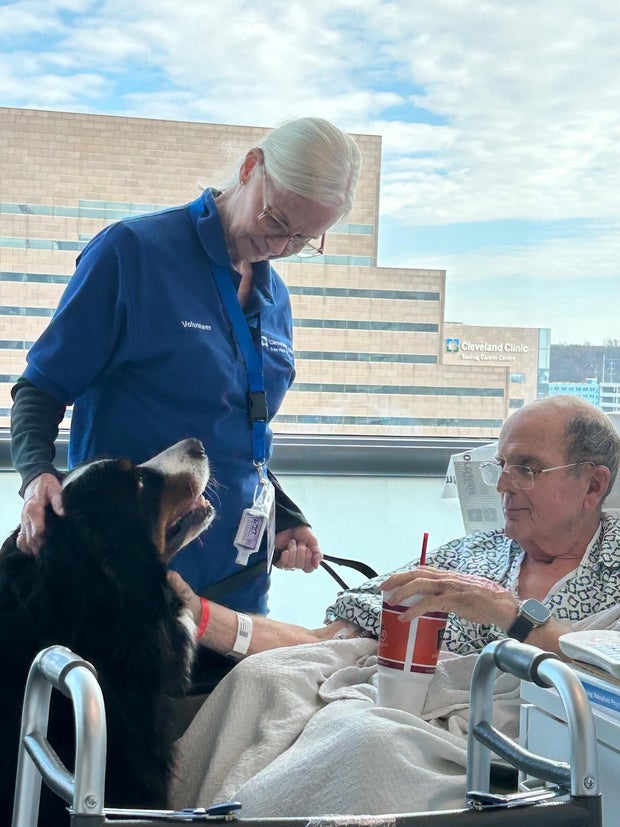
fini-visiting-chris-in-hospital.jpg
Bernese Mountain dog Fini visits Christopher Kennedy in the hospital.

Christopher Kennedy / Cleveland Clinic

“You’re reminded every breath matters” 

Kennedy spent a month in the hospital. There were two false alarms, where it seemed that a pair of lungs might be available but ultimately were not. The third time was the charm, and on Nov. 15, Kennedy underwent a double-lung transplant. 

“It was a relief. I was apprehensive, obviously, and anxious. I can remember going into the operating room,” Kennedy said. “I can remember the flurry of activity, all the people that were in there getting me ready for the surgery. Next thing you know, you’re in your room.” 

Just hours after the surgery, Kennedy’s lung capacity was already better than it had been in months. He had several setbacks, including a post-surgery infection and a stroke, but his “indomitable spirit” has helped him recover, said pulmonologist Rachel Powers, who has been part of Kennedy’s post-transplant care team.  
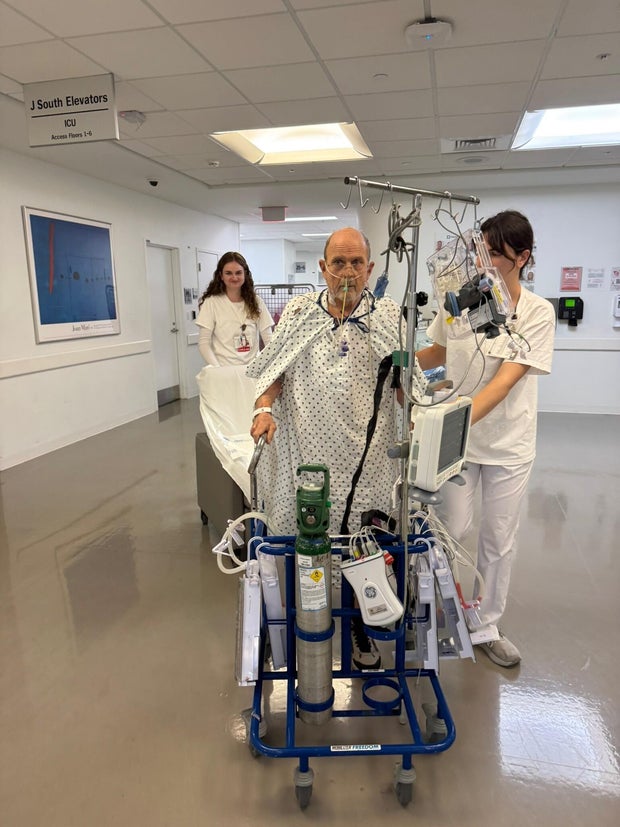
walking-after-transplant.jpg
Christopher Kennedy early in his post-transplant recovery.

Christopher Kennedy / Cleveland Clinic

“I’m very proud of him. He really has kept a very good perspective of his course of recovery,” Powers said. “He’s kept such a good outlook, and I think that’s been really important for some of the things that he’s had to overcome after transplant.” 

For Kennedy, now 75, life is now beginning to feel normal again. Tests show that his lung capacity is at 98%. He is back to spending time with his wife, children and grandkids. He is able to exercise at home and was recently able to take his dog for a walk without losing his breath. He’s almost done training the canine, a Bernese Mountain dog named Fini, to be a hospital therapy dog. 

Kennedy had believed Fini would be the last therapy dog he trained, and named him after the retirement flights conducted by Air Force members. But in a few weeks, he’ll be getting a new puppy. He plans to name her Encore to celebrate his own second chance. Training hospital therapy dogs has become even more meaningful after his own medical journey, he said. 

“There’s a lot of things that are different in my life. It gives you great perspective and proportion of life, of what’s important and what isn’t,” Kennedy said. “You take every breath for granted, because, you know, why would you not? But as soon as they become compromised, you’re reminded every breath matters. It keeps you centered.” 
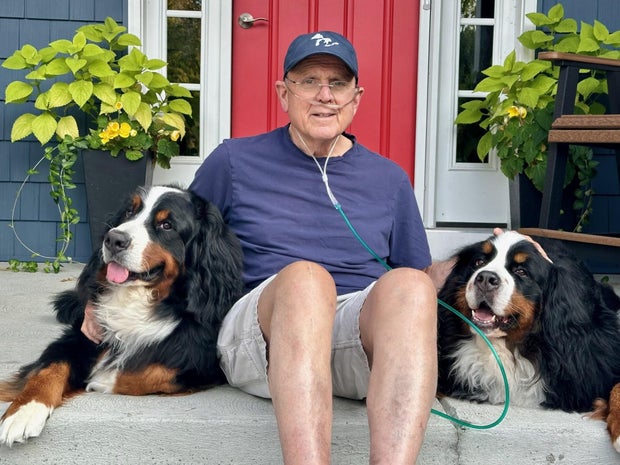
two-months-before-transplant.jpg
Christopher Kennedy in September 2024.

Christopher Kennedy / Cleveland Clinic

Democrats intensify scrutiny of David Ellison amid Paramount–WBD legal battle

(CNN) — As Paramount pushes to settle the state antitrust lawsuit that has stymied its deal to buy Warner Bros. Discovery, Democratic lawmakers continue to rally opposition to the deal.On Wednesday, Rep. Jamie Raskin, the top Democrat on the House Judiciary Committee, sent a new letter to Paramount CEO David Ellison accusing him of “colluding” with President Trump and urging him to answer questions.A Paramount spokesperson did not immediately respond to a request for comment.The letter highlights Democrats’ concerns about Paramount taking control of Warner-owned CNN. It comes the same week that Paramount chief legal officer Makan Delrahim said of CNN that Ellison “wants to bring it back to news,” a comment that raised eyebrows given that the network has been a global news brand for 46 years.The letter, which was obtained first by CNN, also suggests that Paramount’s dealings with the Trump administration — a relationship Raskin has called “corrupt” — will be a priority for the Judiciary Committee if Democrats regain the House majority in the midterm elections.Raskin opened the missive by acknowledging that Paramount has not responded to his four previous inquiries in the past 12 months.But “now that you have vowed to break your long silence,” he wrote, citing Ellison’s op-ed in The New York Times last week, “I invite you to a transcribed interview to tell Congress and America your story and answer the Committee’s questions about your Donald Trump-enabled shopping spree to consolidate news organizations, movie studios, cable channels, and streaming services.”With Republicans in control of the House, Democrats like Raskin can’t compel Ellison to testify, so the interview demand is a way to amplify his concerns about the deal.The new letter cites reports of “political interference” at Paramount-owned CBS News, which the news division has disputed.“CBS’s own reporters have shared how, under your leadership, the newsroom has catered to President Trump’s political whims and dictates under the watchful eye of a MAGA minder,” Raskin wrote, apparently referring to the accounts of fired “60 Minutes” correspondents.Ellison wrote in the Times op-ed, “Great news organizations like CNN and CBS News are here to tell it straight down the middle. That requires newsrooms that reflect the whole world, not one side of it. And it requires independence. Our journalists will continue to answer to the facts and to all the people they serve — not to any party or cause.”Ellison’s op-ed made no mention of Trump, who has been a pivotal figure throughout the nearly year-long battle for control of Warner Bros. Discovery.Paramount sought a close relationship with Trump and his administration while seeking federal approval of the WBD merger.Ellison’s father Larry, the billionaire Oracle co-founder, has been a close ally of Trump’s for years. Trump has praised both father and son, calling them his “supporters” and expressing confidence in their plans for CBS. Trump has also been outspoken about his desire for CNN to come under new ownership, calling it “imperative.”Raskin’s letter cites an anonymously sourced report from the Wall Street Journal that “David Ellison offered assurances to Trump administration officials that if he bought Warner, he’d make sweeping changes to CNN.”Raskin wrote to Ellison, “You have eagerly shown the president that you are going to deliver on both counts as if you are controlling organs of state media.”The letter also indicated that a Democrat-led Judiciary Committee would probe the Justice Department’s mid-June approval of the Paramount merger, which many critics linked to Trump’s personal interest in the deal.Raskin said the committee would scrutinize whether federal agencies “are successfully promoting free competition and innovation—or whether they are using their governmental powers to distort the market and undermine freedom of speech and freedom of the press, in violation of the First Amendment.”Other Democratic lawmakers have also foreshadowed public hearings and probes about the matter and have supported the state attorneys general lawsuit seeking to stop Paramount’s expansion plan.Sen. Elizabeth Warren wrote in a social media post on Tuesday, “The Paramount–WBD merger isn’t about creating better entertainment. It’s about cutting costs & squeezing workers. Writers, actors, and crew will have fewer employers to work for, which means less bargaining power & lower wages. State AGs are stepping in to fight back.”Paramount has consistently said the deal is pro-competitive, pointing to the regulatory approvals from the Justice Department and other authorities around the world.But the deal is frozen in place due to the state antitrust lawsuit and a parallel lawsuit from the Writers Guild of America.Facing an uphill battle in court, Paramount agreed not to complete the merger until a trial is held or until June 1, 2027. A trial is slated to be held in March, though a settlement is possible before then.Speaking at a Politico conference on Tuesday, Delrahim said “we would be delighted to engage” in settlement talks “in order to repair the industry, create more jobs, bring more jobs and production back.”California Attorney General Rob Bonta said at the same conference that “we will be open to any proposals,” but “right now, we’re focused on litigation and going to trial.”Both men also addressed a report by Puck’s Matt Belloni that Ellison told Paramount’s leadership team that he intends to move the company out of California if the antitrust case isn’t settled by October 1. Ellison has notably not made this threat in public, and Paramount has declined to comment on the report.Delrahim said Paramount doesn’t want to leave the state, but the company has to ”look at the business environment” and “ultimately, you know, go to a place where you’re wanted.”Bonta, speaking earlier in the day, said the leave-California threat “is an attempt to blackmail the regulators who are daring to enforce the law fairly and firmly.”Delrahim said it is not a blackmail attempt, and argued that “this merger is actually going to be good — not only for California — it’ll be good for America.”The-CNN-Wire™ & © 2026 Cable News Network, Inc., a Warner Bros. Discovery Company. All rights reserved.
Read Next Story