
Rare condition made mom feel like she was ‘walking on a hot bed of Legos’

When Amber Meade twisted her ankle and broke a bone in her foot, she expected recovery to be easy. She needed surgery to shave down the damaged bone and make sure the nerves and tendons in her foot were where they should be.

The procedure seemed to go smoothly, but in the weeks that followed, she began to feel debilitating pain. A second surgery found that a screw placed in her foot had been pressing on the head of one of her nerves. That screw was moved, and a nerve decompression was performed but the pain didn’t stop. 

“It would just turn black and blue, swell up really big, and I just was unable to put any weight on it,” 41-year-old Meade said. 

The pain upended everything. She left her job as a surgical assistant since she could no longer stand for long periods. She was unable to take part in family activities with her two young sons. Even light breezes could trigger the pain. Resting under a blanket was unbearable, making sleep difficult. Meade compared the sensation to “walking on a hot bed of Legos constantly, while getting stabbed with a pencil.” 

Meade spent months seeing different specialists. Finally, after nearly a year, a doctor suggested Meade might have something called complex regional pain syndrome. It was the first time Meade had heard of it. It would take even longer before she could find a treatment that helped her pain. 
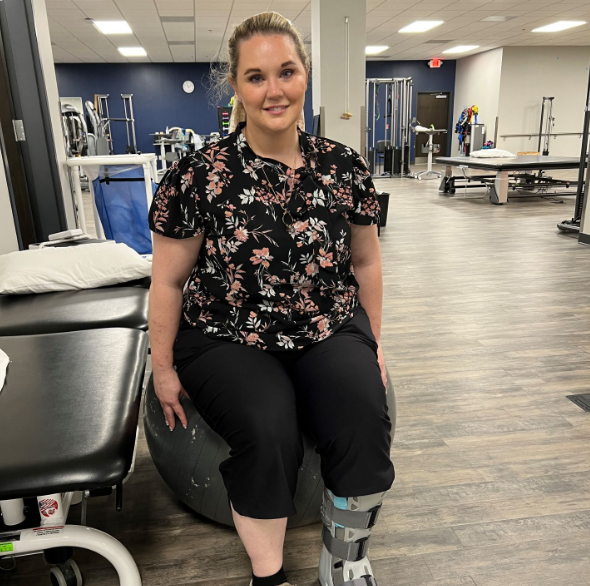
amber-meade-2023.png
Amber Meade in 2023.

Amber Meade

What is complex regional pain syndrome? 

Complex regional pain syndrome, or CRPS, is a chronic disorder with no cure, said Dr. Rohan Jotwani, an interventional pain specialist and anesthesiologist at NewYork-Presbyterian and Weill Cornell Medicine. Jotwani was not involved in Meade’s care. CRPS can occur after surgery, like Meade’s, or from other injuries to the nerve. 

“For some patients, they’ll have an injury to a nerve and it will get better with time. For some patients, that injury will actually develop into its own chronic pain disorder,” Jotwani said. 

Diagnosing the condition is difficult, Jotwani said. No test or scan can definitively identify it, and because it is a rare condition, many doctors may not be familiar with it, he added.

Physicians have to rely on clinical criteria. Telltale hallmarks for the condition are extreme levels of pain at the source, even when nothing should be causing it – like when a bedsheet causes pain, as Meade experienced. CRPS patients may also experience swelling, changes in temperature and skin color or texture changes. They may even begin to lose function in the affected area. 

Diagnosing complex regional pain syndrome is only the start, Jotwani said. Actually treating the condition requires a “multi-pronged approach” that can vary from person to person. Treatment typically starts with physical therapy. Patients may also take medication to decrease nerve signals in the area, so they feel less pain, or try interventional techniques like a nerve block. Meade tried multiple options, but nothing was improving her pain. 

“Doing regular therapies was not working. I even heard, at 33, that I was getting older and that ‘sometimes we just hurt more.’ I thought that was comical,” Meade said.  

Treating complex regional pain syndrome 

In 2022, long after Meade’s pain started, a doctor suggested she see physical therapist Dr. Anita Davis, who specializes in treating the condition and leads the comprehensive pain rehabilitation program at Brooks Rehabilitation in Florida. The pair worked to develop a physical therapy routine that would work for Meade. 

“Before me, she had all of the traditional exercises … and those things were just not possible with that much pain in her foot,” Davis said. “As healthcare providers, we ask patients to rate the pain from zero to 10. These folks are typically going to be at the top of the scale, even on a good day. When I ask her to do something that’s painful on top of her existing pain, it’s just crazy to think about doing that.” 

They also worked on relaxation and emotional exercises to cope with the mental load of the constant pain. 
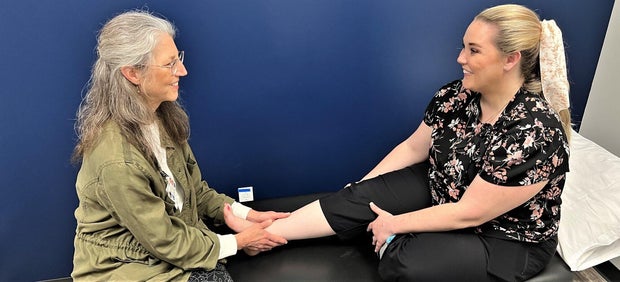
anita-and-amber-1-2000x911.jpg
Dr. Anita Davis, left, and Amber Meade, right.

Brooks Rehabilitation

“Pain management for Amber … isn’t just the physical aspects,” Davis explained. “Anything that enhances relaxing the nervous system is valuable.” 

The protocol led to some improvements for Meade, but while CRPS patients can have “symptoms subside for a length of time,” it is “a lifelong condition,” Davis said. 

“There’s not a cure for it,” Davis said. 

Working towards a less painful future  

Meade said she still feels pain and discomfort, and is at risk of flare-ups when the weather changes or if she steps the wrong way. In addition to working with Davis, she is taking medication and receiving ketamine infusions every few months. She said the combination of ketamine treatment and physical therapy allows her to “do a lot more than I have been able to.” The effects of the infusion usually last around four weeks. Meade uses that period to work on strengthening her body.

“I try to make some headway in my physical health before that starts going down, because I know it’s going to,” Meade said. “The pain is a lot less when my physical health is better.” 

Meade said even without the effects of the infusions, she is dealing with less pain than before her diagnosis and treatment. She can focus on her day-to-day activities. She sleeps better and can walk on the beach, one of her favorite activities. She can’t do too much running around with her kids, but she can play catch and help with homework most days. Meade said she hopes to improve her functionality and eventually go back to work and be more active, but for now, she is grateful for what she has gained.  

“I want to try to get to that point where I have less and less flares, and get up to doing what everybody enjoys doing: Working, coming home, having something to work towards, going on vacations,” Meade said. “Every time I have a good day, we work a little bit harder.” 

Democrats intensify scrutiny of David Ellison amid Paramount–WBD legal battle

(CNN) — As Paramount pushes to settle the state antitrust lawsuit that has stymied its deal to buy Warner Bros. Discovery, Democratic lawmakers continue to rally opposition to the deal.On Wednesday, Rep. Jamie Raskin, the top Democrat on the House Judiciary Committee, sent a new letter to Paramount CEO David Ellison accusing him of “colluding” with President Trump and urging him to answer questions.A Paramount spokesperson did not immediately respond to a request for comment.The letter highlights Democrats’ concerns about Paramount taking control of Warner-owned CNN. It comes the same week that Paramount chief legal officer Makan Delrahim said of CNN that Ellison “wants to bring it back to news,” a comment that raised eyebrows given that the network has been a global news brand for 46 years.The letter, which was obtained first by CNN, also suggests that Paramount’s dealings with the Trump administration — a relationship Raskin has called “corrupt” — will be a priority for the Judiciary Committee if Democrats regain the House majority in the midterm elections.Raskin opened the missive by acknowledging that Paramount has not responded to his four previous inquiries in the past 12 months.But “now that you have vowed to break your long silence,” he wrote, citing Ellison’s op-ed in The New York Times last week, “I invite you to a transcribed interview to tell Congress and America your story and answer the Committee’s questions about your Donald Trump-enabled shopping spree to consolidate news organizations, movie studios, cable channels, and streaming services.”With Republicans in control of the House, Democrats like Raskin can’t compel Ellison to testify, so the interview demand is a way to amplify his concerns about the deal.The new letter cites reports of “political interference” at Paramount-owned CBS News, which the news division has disputed.“CBS’s own reporters have shared how, under your leadership, the newsroom has catered to President Trump’s political whims and dictates under the watchful eye of a MAGA minder,” Raskin wrote, apparently referring to the accounts of fired “60 Minutes” correspondents.Ellison wrote in the Times op-ed, “Great news organizations like CNN and CBS News are here to tell it straight down the middle. That requires newsrooms that reflect the whole world, not one side of it. And it requires independence. Our journalists will continue to answer to the facts and to all the people they serve — not to any party or cause.”Ellison’s op-ed made no mention of Trump, who has been a pivotal figure throughout the nearly year-long battle for control of Warner Bros. Discovery.Paramount sought a close relationship with Trump and his administration while seeking federal approval of the WBD merger.Ellison’s father Larry, the billionaire Oracle co-founder, has been a close ally of Trump’s for years. Trump has praised both father and son, calling them his “supporters” and expressing confidence in their plans for CBS. Trump has also been outspoken about his desire for CNN to come under new ownership, calling it “imperative.”Raskin’s letter cites an anonymously sourced report from the Wall Street Journal that “David Ellison offered assurances to Trump administration officials that if he bought Warner, he’d make sweeping changes to CNN.”Raskin wrote to Ellison, “You have eagerly shown the president that you are going to deliver on both counts as if you are controlling organs of state media.”The letter also indicated that a Democrat-led Judiciary Committee would probe the Justice Department’s mid-June approval of the Paramount merger, which many critics linked to Trump’s personal interest in the deal.Raskin said the committee would scrutinize whether federal agencies “are successfully promoting free competition and innovation—or whether they are using their governmental powers to distort the market and undermine freedom of speech and freedom of the press, in violation of the First Amendment.”Other Democratic lawmakers have also foreshadowed public hearings and probes about the matter and have supported the state attorneys general lawsuit seeking to stop Paramount’s expansion plan.Sen. Elizabeth Warren wrote in a social media post on Tuesday, “The Paramount–WBD merger isn’t about creating better entertainment. It’s about cutting costs & squeezing workers. Writers, actors, and crew will have fewer employers to work for, which means less bargaining power & lower wages. State AGs are stepping in to fight back.”Paramount has consistently said the deal is pro-competitive, pointing to the regulatory approvals from the Justice Department and other authorities around the world.But the deal is frozen in place due to the state antitrust lawsuit and a parallel lawsuit from the Writers Guild of America.Facing an uphill battle in court, Paramount agreed not to complete the merger until a trial is held or until June 1, 2027. A trial is slated to be held in March, though a settlement is possible before then.Speaking at a Politico conference on Tuesday, Delrahim said “we would be delighted to engage” in settlement talks “in order to repair the industry, create more jobs, bring more jobs and production back.”California Attorney General Rob Bonta said at the same conference that “we will be open to any proposals,” but “right now, we’re focused on litigation and going to trial.”Both men also addressed a report by Puck’s Matt Belloni that Ellison told Paramount’s leadership team that he intends to move the company out of California if the antitrust case isn’t settled by October 1. Ellison has notably not made this threat in public, and Paramount has declined to comment on the report.Delrahim said Paramount doesn’t want to leave the state, but the company has to ”look at the business environment” and “ultimately, you know, go to a place where you’re wanted.”Bonta, speaking earlier in the day, said the leave-California threat “is an attempt to blackmail the regulators who are daring to enforce the law fairly and firmly.”Delrahim said it is not a blackmail attempt, and argued that “this merger is actually going to be good — not only for California — it’ll be good for America.”The-CNN-Wire™ & © 2026 Cable News Network, Inc., a Warner Bros. Discovery Company. All rights reserved.
Read Next Story