
Eligible seniors can get GLP-1s for $50 a month for weight loss alone

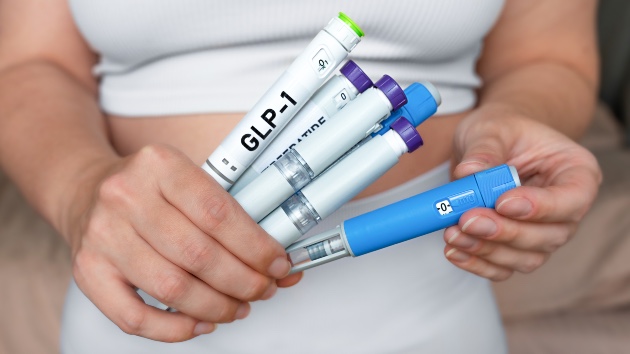
Close-up of a woman holding several GLP-1 injection pens used for weight loss and diabetes treatment. Modern injectable medication concept for obesity management, healthcare and pharmaceutical therapy. (Kateryna Borodina/Getty Images)

(NEW YORK) — For the first time, Medicare will cover GLP-1s for obesity-related weight loss, without any other medical conditions.

Starting Wednesday, eligible Medicare beneficiaries can receive GLP-1s for obesity for $50 per month by prescription. Medicare is the primary federal health insurance program in the U.S. for individuals 65 and older.

Federal rules ban Medicare Part D — which helps cover prescription drug costs — from covering drugs solely to treat obesity, but a new federal pilot bridge program approved by Health and Human Services Secretary Robert F. Kennedy Jr. will be in effect until Dec. 31, 2027.

This move could dramatically expand access to Eli Lilly’s Foundayo and Zepbound and Novo Nordisk’s Wegovy for seniors 65 and older as well as other eligible Medicare enrollees.

Foundayo and Wegovy Pill are daily tablets. Wegovy and Zepbound are weekly injections that require refrigeration.

A month supply of Wegovy will come in four pre-filled pens while Zepbound will be delivered in a KwikPen, which holds four weekly doses in a single device.

Single-dose Zepbound pens and Zepbound vials will not be covered by the bridge program.

“These treatments are a major medical advancement, but too many seniors are currently unable to access them due to high cost,” Dr. Mehmet Oz, administrator of the Centers for Medicare and Medicaid, said in a statement last month. “The Medicare GLP-1 Bridge changes that by making these medications more affordable and accessible, while advancing our broader goal of helping Americans live healthier lives.”

An estimated 3.8 million beneficiaries could be eligible for the program, according to a KFF analysis of 2023 Part D enrollment data that was published Monday.

The government negotiated with the manufacturers to reduce the price the government will pay to $250 for a month’s supply and in return the companies will have access to the larger patient population. Each patient will pay a $50 copay towards the cost of the medication, but that co-pay will not go toward an individual’s annual deductible.

Patients will first need prior authorization — prescribing clinicians will submit documentation proving the patient meets strict body mass index (BMI) and health condition requirements. That means patients will need to wait for the prescription to be approved before it can be filled.

Patients must have Body Mass Index (BMI) of 35 or higher. If their BMI is 30-35, they must have certain types of heart failure, hard to control blood or chronic kidney disease.

If their BMI is 27-30, they must have prediabetes, history of heart attack or stroke or blocked arteries in the arms or legs.

These requirements are more restrictive than the FDA approval language or what private insurance companies require, which is a BMI of 30 or over.

Patients must also not have type 2 diabetes, moderate-to-severe sleep apnea, or fatty liver disease because their Medicare plan may already cover GLP-1s.

“GLP-1s can be life-changing for patients managing obesity and related conditions,” Chris Klomp, director of Medicare and chief counselor at the U.S. Department of Health and Human Services, said in a statement last month.

“This demonstration is designed to make accessing those medications simpler, more predictable, and more consistent across the Medicare program, which means better quality of life for seniors and better value across the health care system,” the statement continued.

​Individuals will be able to fill their pre-approved prescriptions at local retail pharmacies and directly through Novo Nordisk or Ely Lilly’s direct to consumer mail order pharmacies.  

Copyright © 2026, ABC Audio. All rights reserved.

Rare condition made mom feel like she was ‘walking on a hot bed of Legos’

When Amber Meade twisted her ankle and broke a bone in her foot, she expected recovery to be easy. She needed surgery to shave down the damaged bone and make sure the nerves and tendons in her foot were where they should be.The procedure seemed to go smoothly, but in the weeks that followed, she began to feel debilitating pain. A second surgery found that a screw placed in her foot had been pressing on the head of one of her nerves. That screw was moved, and a nerve decompression was performed but the pain didn't stop. "It would just turn black and blue, swell up really big, and I just was unable to put any weight on it," 41-year-old Meade said. The pain upended everything. She left her job as a surgical assistant since she could no longer stand for long periods. She was unable to take part in family activities with her two young sons. Even light breezes could trigger the pain. Resting under a blanket was unbearable, making sleep difficult. Meade compared the sensation to "walking on a hot bed of Legos constantly, while getting stabbed with a pencil." Meade spent months seeing different specialists. Finally, after nearly a year, a doctor suggested Meade might have something called complex regional pain syndrome. It was the first time Meade had heard of it. It would take even longer before she could find a treatment that helped her pain. Amber Meade in 2023. Amber Meade What is complex regional pain syndrome? Complex regional pain syndrome, or CRPS, is a chronic disorder with no cure, said Dr. Rohan Jotwani, an interventional pain specialist and anesthesiologist at NewYork-Presbyterian and Weill Cornell Medicine. Jotwani was not involved in Meade's care. CRPS can occur after surgery, like Meade's, or from other injuries to the nerve. "For some patients, they'll have an injury to a nerve and it will get better with time. For some patients, that injury will actually develop into its own chronic pain disorder," Jotwani said. Diagnosing the condition is difficult, Jotwani said. No test or scan can definitively identify it, and because it is a rare condition, many doctors may not be familiar with it, he added.Physicians have to rely on clinical criteria. Telltale hallmarks for the condition are extreme levels of pain at the source, even when nothing should be causing it - like when a bedsheet causes pain, as Meade experienced. CRPS patients may also experience swelling, changes in temperature and skin color or texture changes. They may even begin to lose function in the affected area. Diagnosing complex regional pain syndrome is only the start, Jotwani said. Actually treating the condition requires a "multi-pronged approach" that can vary from person to person. Treatment typically starts with physical therapy. Patients may also take medication to decrease nerve signals in the area, so they feel less pain, or try interventional techniques like a nerve block. Meade tried multiple options, but nothing was improving her pain. "Doing regular therapies was not working. I even heard, at 33, that I was getting older and that 'sometimes we just hurt more.' I thought that was comical," Meade said.  Treating complex regional pain syndrome In 2022, long after Meade's pain started, a doctor suggested she see physical therapist Dr. Anita Davis, who specializes in treating the condition and leads the comprehensive pain rehabilitation program at Brooks Rehabilitation in Florida. The pair worked to develop a physical therapy routine that would work for Meade. "Before me, she had all of the traditional exercises ... and those things were just not possible with that much pain in her foot," Davis said. "As healthcare providers, we ask patients to rate the pain from zero to 10. These folks are typically going to be at the top of the scale, even on a good day. When I ask her to do something that's painful on top of her existing pain, it's just crazy to think about doing that." They also worked on relaxation and emotional exercises to cope with the mental load of the constant pain. Dr. Anita Davis, left, and Amber Meade, right.
Read Next Story