
11 charged for alleged sham marriages to help Chinese nationals get green cards

Washington — The Justice Department unveiled criminal charges against 11 people on Wednesday, alleging they participated in an “extensive marriage fraud scheme” that involved more than 1,000 “sham marriages” between Chinese nationals and U.S. citizens.

The 21-page indictment, secured in New York’s Southern District, alleged that the marriage scheme ran from 2016 to 2026, and was facilitated by defendants Amy Cheng, Xiao Mei Chan and Gang Zheng.

The alleged sham marriages were arranged to help assist Chinese nationals obtain green cards in the United States, the indictment said.

The defendants “used word of mouth, social media, and various forms of advertising to market fraudulent immigration services to foreign nationals — primarily citizens of the People’s Republic of China — including their ability to arrange sham marriages to facilitate fraudulent applications for lawful permanent resident status in the United States,” according to the indictment. 

“Foreign nationals paid facilitators as much as approximately $100,000 for assistance in obtaining a sham marriage and applying for a Green Card,” it added. Facilitators of the arrangements, meanwhile, allegedly made a commission of about $5,000.

The indictment included photos of alleged sham marriage ceremonies that prosecutors said the defendants submitted to U.S. immigration officials. 
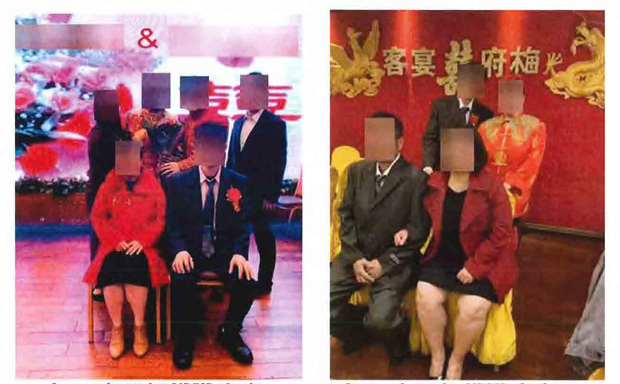
Photos included in the indictment of alleged sham marriage ceremonies submitted in support of immigration applications.

Justice Department

“In some cases, these sham wedding ceremonies were held at nearby restaurants, where the foreign nationals and United States citizens changed into traditional Chinese wedding attire, and the facilitator, recruiter, foreign national, and United States citizen invited friends and family to create the appearance of a legitimate wedding,” the indictment said.

While many of the recruiters operated in New York, the indictment alleged they orchestrated the marriages throughout the United States and abroad, in places such as Connecticut, Massachusetts, Pennsylvania, Kentucky, Tennessee, Georgia, Florida, Vanuatu, and the People’s Republic of China.

A dog trainer had no symptoms. An X-ray found a terminal disease

When Christopher Kennedy went to have an X-ray before a routine surgery, he thought he would be in and out. Then a technician spotted scarring in his lungs. Kennedy, 68 at the time, had never noticed any warning signs. He was a retired Air Force technician who exercised regularly and spent his time landscaping his backyard and training Bernese Mountain dogs to be hospital therapy animals. After several tests, a pulmonologist gave him an alarming diagnosis: Idiopathic pulmonary fibrosis, or IPF. It's a type of lung disease with no known cause where scar tissue grows in the lungs and prevents oxygen from reaching the bloodstream, according to Dr. Panagis Galiatsatos, a medical spokesperson for the American Lung Association and pulmonologist at Johns Hopkins, who was not involved in Kennedy's care. The condition is progressive with a "high mortality rate," Galiatsatos said. At first, Kennedy thought he could "beat" the disease. But as his lung function degraded, he realized that was "baloney." Medications meant to slow the progressive fibrosis weren't working, and he was starting to need oxygen in his daily life. Even walking to the kitchen was leaving him winded. In 2024, Cleveland Clinic pulmonologist Dr. Aman Pande confirmed Kennedy's worst fear: He had less than a year to live.Christopher Kennedy and his wife on their anniversary in 2021.  Christopher Kennedy / Cleveland Clinic "We all wonder, as human beings, how we're going to go," Kennedy said. "And you never know. It's a great mystery. Well, for the first time in my life, I was told 'This is how you're going to go.'" "You come out one of two ways"    Pande did have one option for Kennedy: They could see if he was eligible for a double-lung transplant. Kennedy, at 74, was older than most patients who undergo the operation, but he was otherwise a promising candidate, Pande said. Lung transplants are usually the final option offered to IPF patients, Pande said, and are usually curative, though a small percentage of patients can see the condition recur. Kennedy was initially resistant to the idea, because his younger brother had died after the same procedure. But after more convincing from Pande, he agreed to undergo testing to see if he would be eligible. Cleveland Clinic doctors "scoured everything," Kennedy said. Finally, he was approved as a candidate. He was registered on the national transplant list, and waited for a pair of suitable lungs to become available. As the months passed, Kennedy's lung function continued to degrade. He went from using two liters of oxygen a day to 10. He had a mild case of COVID-19. He lost more than 40 pounds. In October 2024, he was admitted to the hospital. "Dr. (Jason) Turowski, (a transplant pulmonologist at Cleveland Clinic) said 'OK, we're going to admit you and you come out one of two ways: With a set of lungs, or we're going to carry you out,'" Kennedy recalled. Bernese Mountain dog Fini visits Christopher Kennedy in the hospital.
Read Next Story