
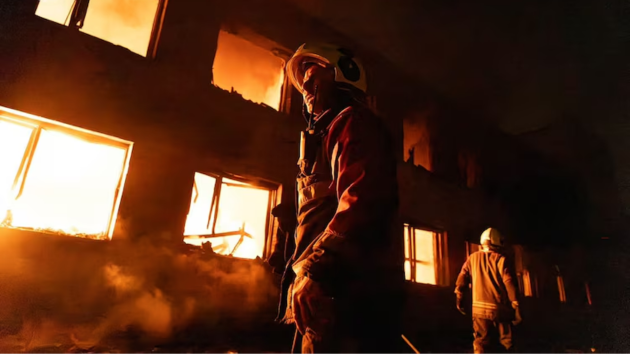
(LONDON) — At least 200 Ukrainian drones were launched toward Moscow overnight into Thursday morning, the city’s Mayor Sergey Sobyanin said, as Kyiv continued its nightly long-range strike campaign deep into Russia.
From Wednesday evening until 9 a.m. local time on Thursday, “More than 200 drones were flying towards the Moscow region. Most of them were neutralized by air defense systems at a distance,” Sobyanin wrote in a post to Telegram. Ten drones “were destroyed as they approached Moscow,” the mayor said.
Russia’s Defense Ministry said its forces downed at least 375 Ukrainian drones overnight. The ministry said in a post to Telegram that drones were intercepted over 18 Russian regions — including Moscow — as well as Crimea, the Black Sea and the Sea of Azov.
Ukraine has been significantly expanding its drone campaign — referred to in Kyiv as “long-range sanctions” — in recent months, targeting major Russian cities, Russian oil infrastructure, military and logistics targets.
Ukraine has been significantly expanding its drone campaign — referred to in Kyiv as “long-range sanctions” — in recent months, targeting major Russian cities, Russian oil infrastructure, military and logistics targets.
The Russian Defense Ministry publishes only the number of Ukrainian drones and other projectiles it claims to have intercepted. Sobyanin releases real time statements when Ukrainian drones are reported shot down while heading toward the capital.
ABC News cannot independently verify the figures from either the ministry or the mayor. But the increasing scale and rate of such reports could be seen as indicative of Ukraine’s growing ability and willingness to target sites within Russia.
So far this year, Sobyanin has reported the downing of 1,420 Ukrainian drones on approach to Moscow, according to his Telegram posts, collated and analyzed by ABC News. Across all of 2025, Sobyanin only reported the downing of 734 Ukrainian drones near the city.
More than four years after Moscow launched its full-scale invasion of Ukraine, Ukrainian President Volodymyr Zelenskyy has made clear Kyiv’s intentions to return the war back to Russian soil. Key targets have included Moscow and the so-called “second capital” St. Petersburg.
“Our responses to Russia’s prolonging of the war and strikes on our cities and communities are completely fair,” Zelenskyy wrote on Telegram in May. “The Moscow region has Russia’s densest concentration of air defenses. But we are getting through,” he added.
Ukraine’s Wednesday night attacks also reportedly targeted the Engels-2 airbase in Saratov — a key hub for Russian long-range aviation, including strategic bombers. Andriy Kovalenko, the head of the Counter-Disinformation Center operating as part of Ukraine’s National Security and Defense Council, said in a post to Telegram, “Engels is on fire.”
Russia’s federal air transport agency, Rosaviatsiya, meanwhile, announced that temporary flight restrictions were introduced at Saratov airport during the overnight attacks. Restrictions were also put in place at airports in Nizhny Novgorod, Penza, Samara, Ivanovo, Yaroslavl, Cherepovets and Gelendzhik.
Flights operating from all four of Moscow’s international airports were also put under temporary flight restrictions overnight, Rosaviatsiya said.
Russia continued its own long-range strike campaign against Ukraine. Ukraine’s air force said in a post to Telegram that Russia launched 18 missiles and 146 drones into the country overnight into Thursday morning, of which 12 missiles and 129 drones were intercepted, suppressed or failed to reach their targets.
Six missiles and 16 drones impacted across 15 locations, the air force said.
Zelenskyy said in a post to Telegram that at least two people were killed by a Russian missile strike in Kyiv, with five other people injured. Other targeted regions included Kharkiv, Sumy, Zaporizhzhia, Vinnytsia, Zhytomyr, Mykolaiv and Donetsk, Zelenskyy said.
“Moscow is relying on terror through ballistic missiles and continues its attacks,” Zelenskyy wrote.
Copyright © 2026, ABC Audio. All rights reserved.