
Trump approves U.S.-Saudi civil nuclear energy agreement, officials say

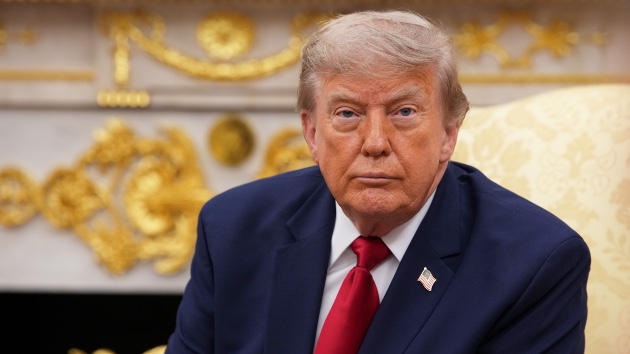
U.S. President Donald Trump looks on during a bilateral meeting with the Prime Minister of Iraq Ali al-Zaidi, in the Oval Office of the White House on July 14, 2026 in Washington, DC. . (Photo by Andrew Harnik/Getty Images)

(WASHINGTON) — President Trump has approved an agreement with Saudi Arabia to partner on developing the Kingdom’s civil nuclear energy program, according to two U.S. officials.

The deal leaves open the possibility that Saudi Arabia will enrich uranium domestically in the future, the officials said, a prospect that could raise concerns about nuclear weapons proliferation.

In the deal, the United States and Saudi Arabia have agreed to safeguards to inhibit any weaponization effort, the sources said. But that framework would be governed by the two countries themselves, instead of the International Atomic Energy Agency (IAEA), which conventionally oversees nuclear pacts.

Secretary of State Marco Rubio was asked about the agreement on Wednesday. He declined to comment on the contours of the plan but said that the Trump administration would work with Congress to formalize the deal.

“Suffice it to say, the U.S. is not going to reach any agreement with any country in the world that leads to the risk of proliferation,” Rubio said.

The agreement, under which U.S. industry would help develop Iranian nuclear infrastructure, spans 30 years and is valued at tens of billions of dollars, the officials said.

The U.S. and Saudi Arabia discussed details of the proposal during a visit to Washington, D.C. by Saudi Crown Prince Mohammed bin Salman last fall. The administration is expected to submit the deal to Congress, which is required by federal law.

The Wall Street Journal first reported that the president had approved the deal. 

Copyright © 2026, ABC Audio. All rights reserved.
French has become a sticking point in the Canada-US trade dispute. Here’s why

(CNN) — As a trade war between the United States and Canada looms following the collapse of talks last week, a key issue has emerged that’s further inflamed tensions between the longtime allies: French language laws.Canada is a bilingual country and has laws protecting both of its official languages: English and French, the first language spoken for roughly one fifth of the population, including nearly 85% of primarily Francophone province of Quebec.Among the laws, product labels must be displayed in both English and French, and US streaming platforms must support and promote Canadian content (including Indigenous and French Canadian content) to audiences north of the border.Canada’s language requirements have long been viewed by the US as a trade barrier but are generally a red line for Ottawa — which Prime Minister Mark Carney enforced by walking away from a deal which he said included “threats to French language and culture.”On Monday, Carney said Canada “could not accept” the proposed deal that would have weakened French language protections, telling reporters that his government “will not give (the US) what they have asked.”Many in Canada have rallied behind Carney’s decision — and particularly his comments about protecting French culture, a core part of Canada’s national identity.After US Trade Representative Jamieson Greer called Ottawa’s concerns about French a “funny, fake story” on Monday, the Canadian leader denied the issue was a laughing matter, saying there is an “enormous gap between our perspective and the US perspective.”“For Americans, French language, Francophone culture, Canadian culture, these are irritants,” Carney said in French at a news conference in Lévis, Quebec.“Here in Quebec, here in Canada, these are rights,” he said, as a group of reporters applauded.President Donald Trump has not directly addressed the French issue but revived old attacks on Canada, calling the country “entitled” and “among the worst Nations in the World to deal with” in a Truth Social post Monday.Since negotiations stalled Friday, the US has imposed 50% tariffs on roughly $20 billion worth of Canadian goods, which Carney said he will match “dollar-for-dollar.” The tit-for-tat measures are set to take effect on September 8.Language rights vital part of Canadian identityLanguage rights have been entrenched in Canada’s constitution for decades and are particularly important to Quebec, which has fought to protect its distinct linguistic and cultural identity in an English-dominated North America.This pursuit has at times put the province at odds with the rest of Canada. Quebec has twice held a referendum on whether to secede from the rest of the country, most recently in a 1995 vote where the “no” side won by a razor-thin margin of just 1.16%.Language laws include everything from the right for Canadians to access official services in both languages to the requirement that hair care companies display the French “shampooing” alongside English text on their bottles.For US companies looking to do business in Canada, this means added barriers as they must redesign packaging and pay extra production costs.Stewart Prest, a lecturer in the Department of Political Science at the University of British Columbia, said asking Canada to bend these rules is “not a reasonable request of the Canadian government in a trade negotiation,” and one Canada has “no choice but to say no to.”“People in Canada speak French. It’s not a country where everybody speaks English, and some people like to dabble in French,” he said. “It is not so different than asking France to relax its requirement that packaging must include French.”It’s common for service workers in Montreal to greet customers with “Bonjour-Hi.”Under any circumstance, it would be incredibly detrimental to Carney, who has built a global profile for standing up to Trump, to bow on an issue so central to Canadian identity, said Stéphanie Chouinard, associate professor of political studies at Royal Military College and Queen’s University in Kingston, Ontario.But the matter is particularly acute with Quebec just weeks away from a provincial election where the separatist Parti Québécois is surging in the polls, she said.The party’s leader recently said he would delay a possible independence referendum until Trump’s term ends — but any concession on language laws could “stoke secessionist sentiment” in the province where independence talk has been on the back burner, Chouinard said.At odds with WashingtonQuebec has implemented strict nationalist policies in recent years to reinforce French as the province’s sole language, including through the controversial language law Bill 96, which includes stricter requirements for French on products, appliances, packaging and signage.The legislation was included on the 2025 list of global trade barriers compiled annually by the Office of the US Trade Representative.The US has also expressed concerns about Canada’s Online Streaming Act, which requires online video and music services like Netflix and Spotify to invest in and promote Canadian content.Washington also opposed another streaming regulation, known as Bill 109, passed in Quebec last December, which compels streaming platforms to prioritize French-language content. In March, the US listed the measure as a potential trade barrier in its trade estimate report.Greer, in an interview with CNBC Monday, said the US does not have an issue with the French language but rather what he called a “discriminatory tax on American companies.”“I like the Quebecois, and I like that they speak French. What we don’t like is a situation where Canada’s federal government forces American tech companies to take their earnings and give a percentage to their competitors,” he said.For many in Canada, the dispute raises concerns about American interference with Canada’s national identity.Quebec’s Premier Christine Fréchette said Carney made the right decision to walk away from the negotiating table.“Our culture, our language, is central to our identity, and it is important to exclude that from the negotiation table,” said Fréchette in a news conference, according to CNN newsgathering partner CBC News.“Even though we are threatened with different tariffs, it won’t change. We will stay the way we are.”The-CNN-Wire™ & © 2026 Cable News Network, Inc., a Warner Bros. Discovery Company. All rights reserved.
Read Next Story