
Thousands died in England and Wales from recent heat waves: Report

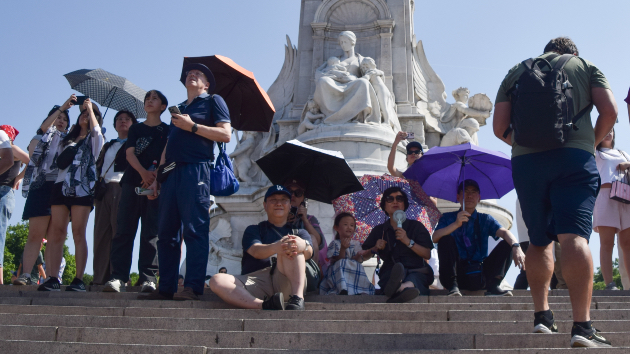
People shield from the sun under umbrellas next to the Victoria Memorial outside Buckingham Palace as the UK is hit by another heatwave. (Vuk Valcic/SOPA Images/LightRocket via Getty Images)

(LONDON) — More than 2,700 people are estimated to have died in England and Wales in recent months as a result of heat-related causes, a new report has found.

The excess deaths occurred as a result of heat waves in May and June, according to researchers at the London School of Hygiene & Tropical Medicine (LSHTM), Imperial College London and the Met Office.

Globally, heat is the leading cause of weather-related deaths, according the World Health Organization (WHO).

The heat wave that occurred between May 21 and 29 was likely responsible for around 550 deaths, while the heat wave that occurred from June 18 to 28 was likely responsible for about 2,200 deaths, the analysis found.

Both heat waves broke long-standing temperature records, according to the report.

In the U.K., the temperature threshold for an official heat wave is lower than in much of the U.S.

A heat wave is defined as a period of at least three consecutive days with daily maximum temperatures meeting or exceeding the heat wave temperature threshold, according to the Met Office. The threshold varies by county and ranges from 77 to 82 degrees Fahrenheit.

Across much of the U.S., the temperature threshold is at least three consecutive days with daily maximum temperatures at 90 degrees or greater.

The most heat-related deaths occurred southeast of England, with 549 in total. London saw 453 deaths and the West Midlands reported 368 deaths, researchers said. They suggested that people in areas less frequently exposed to extreme heat may be more vulnerable.

“It is vital that action on adapting Britain’s homes, workplaces, and critical infrastructure to extreme heat outpaces these health risks, especially if we are to protect those most vulnerable to its impacts, such as older people, babies, and children,” Malcolm Mistry, assistant professor in climate and geo-spatial modeling at the LSHTM, said in a statement.

About 42% of heat-related deaths that occurred in the U.K. during those months were exacerbated by human-caused climate change, researchers said.

“Climate change is further boosting the temperature of essentially every heat wave we observe today,” Flavio Lehner, a climate scientist at Cornell University, said in a statement to ABC News. “In other words, had the same weather pattern occurred 50 or 100 years ago, it would have also resulted in a heatwave, but one that was a bit cooler.”

It’s not only daytime high temperatures that are a concern. Heat waves are becoming even more dangerous as overnight low temperatures are still too high for people to recover from the heat stress they experience during the day, according to the WHO.

Western Europe, the region most impacted by the historic heat wave in late June, experienced its hottest June on record last month, according to Copernicus, Europe’s climate change service.

Many June and some all-time records for daily maximum temperature were broken in several countries, according to Copernicus.

France’s nationwide average temperature hit 30 degrees Celsius, or about 86 degrees Fahrenheit, on June 24 — the highest-ever temperature recorded, according to weather officials at Meteo-France, the national weather service. High temperatures in Paris recorded in the triple digits in the days after.

High temperatures also impacted cities like Madrid and Rome, according to Copernicus.

There were more than 5,000 excess deaths in Germany and another 4,700 deaths in France, Belgium, Spain and the Netherlands between June 20 and 28, Reuters reported.

Rising atmospheric and ocean temperatures “reflect a climate system continuing to accumulate heat” that result in increasingly intense heat waves and a persistently warm ocean, Samantha Burgess, strategic lead for climate at the European Center for Medium-Range Weather Forecasts, said in a statement.

“June 2026 underscored how profoundly the climate is changing,” Burgess said. “Western Europe recorded its warmest June on record, and continued record warmth in the global ocean.”

Matthew Glasser and Joe Simonetti contributed to this report.

Copyright © 2026, ABC Audio. All rights reserved.

The world’s oldest president left for a ‘brief stay’ in Europe. He hasn’t returned in two months

(CNN) — When Paul Biya won his first presidential election in Cameroon in 1984, Nformi Bime was 23 and still a student.Bime is now 65 and retired from teaching. Biya is 93 – and still president. Last year, he won a disputed eighth term that could keep him in office until he is nearly 100.“The best is yet to come,” Biya said before the election, which his opponents called fraudulent and was marred by deadly clashes between protesters and police.For the past two months, however, the man who has ruled Cameroon since 1982, when as prime minister he assumed power following the resignation of the sitting president, has been thousands of miles away. He left on June 7 for what his office called a “brief private stay in Europe” — now his longest uninterrupted absence from the Central African nation in years.Last week, government spokesman René Emmanuel Sadi told French radio RFI that Biya was in Geneva, Switzerland and was not hospitalized, but did not give more detail on his whereabouts.A president who is rarely seenBiya is Cameroon’s second president since independence in 1960 and one of the world’s longest-serving leaders. He first won office in 1984 under a one-party system, then won six more elections after multiparty politics was introduced.He has spent extended periods abroad during his presidency. But his latest absence has revived questions about his health and who is running the country while he is away.Rumors about Biya’s health and whereabouts have long been part of public life in Cameroon, where he is rarely seen in public. His office has repeatedly had to push back against speculation that he was seriously ill or had died. In 2024, the government banned media discussions about his health, calling them a national security matter.Biya’s long rule also reflects a wider contrast across Africa. The continent has the world’s youngest population, but several countries are still led by aging leaders whose political careers began decades ago, including former liberation figures now governing in a different era.For millions of Cameroonians, Biya is the only president they have ever known.Bime’s children are among them. His oldest is 32, and his youngest is 18.Abit Riassai Acha, a 26-year-old doctoral student and community youth leader at the University of Yaoundé II, belongs to the same generation.“Growing up, President Biya was the only president I knew, so his presidency has been part of my entire experience of Cameroon,” said Acha, who voted for the first time in last year’s presidential election, backing the youthful opposition candidate Samuel Hiram Iyodi, 38.After more than four decades under the same president, questions about his leadership have only grown.“Because this has happened repeatedly over the years, many Cameroonians have become used to it,” Acha said of Biya’s long absences. “But becoming accustomed to something does not necessarily mean that people should stop asking questions about how the country is being governed.”Iyodi, who finished eighth in last year’s presidential election, which several candidates, including one of Biya’s main challengers, were barred from contesting, has called on parliament to ask Cameroon’s Constitutional Council to consider whether Biya’s absence amounts to a vacancy in the presidency. But such a move is unlikely to succeed, given the dominance of Biya’s ruling Cameroon People’s Democratic Movement.Despite being away, Biya has continued to make key decisions from abroad, including a major military reshuffle announced earlier this month. Yet questions about his prolonged stay overseas have left officials publicly assuring Cameroonians that their president is still alive.Government spokesman Sadi dismissed concerns about a power vacuum, telling RFI that “President Paul Biya is alive” and “will soon return.”From hope to frustrationBime is old enough to remember when Biya was the change. He first heard Biya’s name in the 1970s, when he served as secretary-general of the presidency under Cameroon’s first president after independence, Ahmadou Ahidjo. After Ahidjo resigned in 1982, Biya took over.When Biya first appeared on the ballot two years later, Bime saw him as a “representation of hope,” he said. “We believed he was young and dynamic – handsome too. He meant so much to Cameroonians.”Few imagined that the man they saw as a new beginning would remain in power for decades. For his critics, the disappointment is not just about how long Biya has stayed in office, but what they see as his failure to improve the lives of ordinary Cameroonians.Political analyst Collins Molua Ikome, a Cameroonian based in Germany, said he saw some of the country’s problems firsthand when he visited Cameroon in April.“Roads in Cameroon are extremely bad. I even witnessed a fatal accident,” he told CNN.Ikome also pointed to frequent power cuts, corruption and a lack of jobs for young people.Wilson Tamfuh, a public and international law professor at the University of Dschang in West Cameroon, said the country has institutions that can keep the government running when the president delegates responsibilities. Key duties, he said, can be handled by the prime minister, the secretary-general at the presidency and ministers.But the bigger question, Tamfuh said, is whether the government is solving the country’s longstanding problems.“People want the Anglophone crisis resolved, standards of living ameliorated, more good roads, fewer people on the streets with degrees, and more,” he told CNN, referring to the years-long separatist conflict in Cameroon’s English-speaking regions.Whenever Biya eventually leaves office, his successor will inherit a country also facing attacks by Boko Haram militants in the north and deep economic frustration among young people.Healthcare is another concern. Ikome said access to quality healthcare remains out of reach for many Cameroonians.“Life expectancy in the country is below 70 years. However, Biya has far outlived that due to access to medical healthcare abroad, which the ordinary Cameroonian cannot access due to poverty,” Ikome said.The divide is not unique to Cameroon. Across Africa, political elites have often sought healthcare or maintained homes abroad, even as public services at home struggle.For Bime, the question is more personal: Will he live to see another president?After decades of waiting for change, he worries he may not – and that Biya could outlive him and many others who are not part of the country’s elite.“Anytime they have a cold, they run overseas and are taken care of, but the other Cameroonians are dying because of lack of care,” he said.The-CNN-Wire™ & © 2026 Cable News Network, Inc., a Warner Bros. Discovery Company. All rights reserved.
Read Next Story