Fall foliage maps show when peak color is expected across the U.S.

▶ Watch Video: How will the fall foliage look in New England this year?

The 2025 leaf peeping season is getting underway with some parts of the U.S. already starting to see fall foliage. 

But peak colors are still to come. Using a data model that factors in historical and forecast temperatures and precipitation, the types of trees in a region, trends and user data, travel brand SmokyMountains.com has predicted when trees will reach peak foliage across the country. 

Here’s what to expect:

As the season progresses, colors turn earliest in the north and gradually sweep south. The Mid-Atlantic, Great Lakes regions and much of the West will reach peak color by mid-October, followed by some states in the South and lower Midwest in late October and early November. Parts of the Deep South, Southern Plains and Florida may not see peak foliage until mid-November.

Warm, sunny days and cool, crisp but not freezing nights are the best conditions for vibrant leaf displays, according to the U.S. Forest Service.

Regional forecasts

  • Northeast and Appalachians: Cooler-than-average temperatures and below-normal precipitation are expected to cause leaves to reach peak color earlier and be more vibrant, forecasters say.
  • Pacific Northwest and Intermountain West: The weather is expected to be warmer and wetter than normal, which typically pushes color change later and may tone down the vibrancy in lowland areas, though mountains may see early color.
  • Southeast and Deep South: Warmer but drier conditions may lead to delayed and more subdued foliage, according to forecasters. These areas might see peak color around late October through mid-November.

Fall temperature trends

These regional patterns are part of a broader warming trend. 

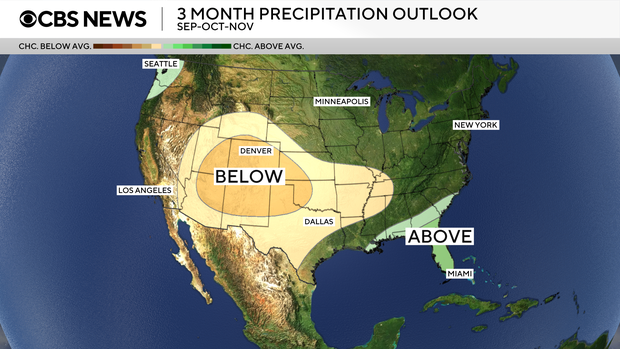
The fall outlook from the National Weather Service’s Climate Prediction Center says temperatures are forecast to be above average across the U.S., especially in the Southwest and Northeast. It also predicts less-than-average precipitation across much of the Southwest and Southern Plains with only the Pacific Northwest and the Southeast forecast to have above-average precipitation.
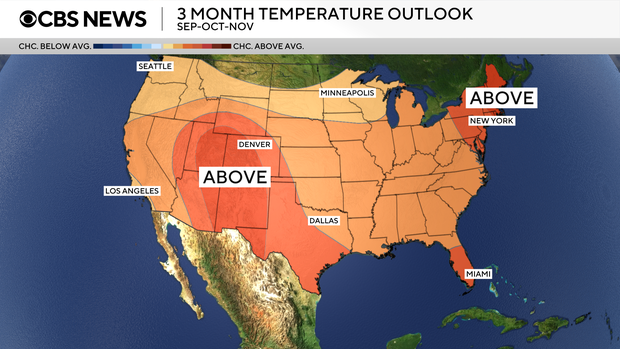
3-month-cpc-temp-outlook.png
Map shows the Climate Prediction Center’s 2025 fall temperature outlook.

Nikki Nolan

3-month-cpc-precip-outlook.png
Map shows the Climate Prediction Center’s 2025 fall precipitation outlook.

Nikki Nolan

The fall season has warmed in every county across the contiguous U.S. since 1970. It’s warming fastest in the Southwest, according to a Climate Central analysis based on data from the National Oceanic and Atmospheric Administration.

Fall temperatures have risen in 237 U.S. cities, averaging an increase of 2.8°F from 1970 through 2024. Unusually warm fall days now occur more frequently in 238 cities, or 98% of the 243 cities analyzed.

A dog trainer had no symptoms. An X-ray found a terminal disease

When Christopher Kennedy went to have an X-ray before a routine surgery, he thought he would be in and out. Then a technician spotted scarring in his lungs. Kennedy, 68 at the time, had never noticed any warning signs. He was a retired Air Force technician who exercised regularly and spent his time landscaping his backyard and training Bernese Mountain dogs to be hospital therapy animals. After several tests, a pulmonologist gave him an alarming diagnosis: Idiopathic pulmonary fibrosis, or IPF. It's a type of lung disease with no known cause where scar tissue grows in the lungs and prevents oxygen from reaching the bloodstream, according to Dr. Panagis Galiatsatos, a medical spokesperson for the American Lung Association and pulmonologist at Johns Hopkins, who was not involved in Kennedy's care. The condition is progressive with a "high mortality rate," Galiatsatos said. At first, Kennedy thought he could "beat" the disease. But as his lung function degraded, he realized that was "baloney." Medications meant to slow the progressive fibrosis weren't working, and he was starting to need oxygen in his daily life. Even walking to the kitchen was leaving him winded. In 2024, Cleveland Clinic pulmonologist Dr. Aman Pande confirmed Kennedy's worst fear: He had less than a year to live.Christopher Kennedy and his wife on their anniversary in 2021.  Christopher Kennedy / Cleveland Clinic "We all wonder, as human beings, how we're going to go," Kennedy said. "And you never know. It's a great mystery. Well, for the first time in my life, I was told 'This is how you're going to go.'" "You come out one of two ways"    Pande did have one option for Kennedy: They could see if he was eligible for a double-lung transplant. Kennedy, at 74, was older than most patients who undergo the operation, but he was otherwise a promising candidate, Pande said. Lung transplants are usually the final option offered to IPF patients, Pande said, and are usually curative, though a small percentage of patients can see the condition recur. Kennedy was initially resistant to the idea, because his younger brother had died after the same procedure. But after more convincing from Pande, he agreed to undergo testing to see if he would be eligible. Cleveland Clinic doctors "scoured everything," Kennedy said. Finally, he was approved as a candidate. He was registered on the national transplant list, and waited for a pair of suitable lungs to become available. As the months passed, Kennedy's lung function continued to degrade. He went from using two liters of oxygen a day to 10. He had a mild case of COVID-19. He lost more than 40 pounds. In October 2024, he was admitted to the hospital. "Dr. (Jason) Turowski, (a transplant pulmonologist at Cleveland Clinic) said 'OK, we're going to admit you and you come out one of two ways: With a set of lungs, or we're going to carry you out,'" Kennedy recalled. Bernese Mountain dog Fini visits Christopher Kennedy in the hospital.
Read Next Story