Primary elections are being held Tuesday in five states, including Michigan, where Democrats are watching the expensive and contentious Senate primary contest between populist Abdul El-Sayed and moderate Rep. Haley Stevens.
They’re running for retiring Democratic Sen. Gary Peters’ seat, which is among a handful that Democrats must hold in order to have any chance of winning control of the Senate. Gov. Gretchen Whitmer is backing Stevens, while Sen. Bernie Sanders and Rep. Alexandria Ocasio-Cortez are campaigning for El-Sayed. Former GOP Rep. Mike Rogers, who lost to Sen. Elissa Slotkin by less than a point in 2024, is running unopposed in the Republican primary.
After the Virginia Supreme Court struck down Democrats’ voter-approved plan to redraw the congressional districts to net up to four more districts, Virginians will be using the maps drafted by a nonpartisan commission in 2021. Democrats are still targeting several districts in their fight for control of the House.
In Missouri, ongoing redistricting legal battles may yet affect congressional races, where longtime Democratic Rep. Emanuel Cleaver’s district has been redrawn to favor the GOP and five Republicans are vying for the chance to take him on in November. In the only reliably Democratic district in the state, the 1st, Democratic Rep. Wesley Bell was projected to defeat former Rep. Cori Bush, whom he also unseated two years ago.
In Kansas, Democratic Gov. Laura Kelly’s tenure will be ended by term limits, opening up the governor’s race in the reliably GOP state.
There are also primaries in Washington, where the top two vote getters, regardless of party, will advance to the general election. Four Democrats and three Republicans are vying to take on two-term Rep. Marie Gluesenkamp Perez, who is a frontrunner to make the ballot in the 3rd District this fall. And in the Seattle area, longtime Rep. Adam Smith is being challenged by former Seattle City Council member Kshama Sawant, a socialist, along with several others.
Here are the major races to watch today:
Michigan Senate race
Progressives and moderate party leaders have been clashing for months over who’s best positioned in the race, and who is more broadly representative of Michigan’s voters. Stevens, 43, who was recruited by Senate Minority Leader Chuck Schumer, has represented Michigan in the House since 2019 and has the support of national Democrats. El-Sayed, a 41-year-old doctor and former state health official, has picked up the backing of prominent progressives like Rep. Alexandria Ocasio-Cortez and independent Sen. Bernie Sanders.
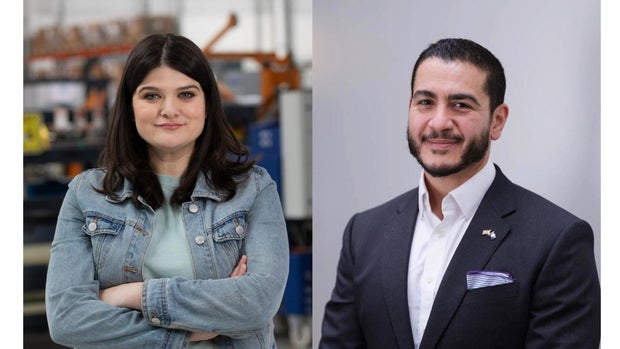
Campaigns of Haley Stevens and Abdul El-Sayed
El-Sayed spoke with CBS News senior White House and political correspondent Ed O’Keefe on the eve of the primary and suggested the Democratic Party has been losing sight of what Americans really need.
“Sometimes, when the Democratic Party talks about a big tent, we push everybody into the corner and then go talk and pander to the corner,” he told O’Keefe. “I’m just trying to bring everybody to the tent pole in the middle to talk about what we really need. We need good housing. We need good schools. We need healthcare.”
Stevens, who also talked with O’Keefe, accused El-Sayed of using the Senate race as a stepping stone to the presidency.
“This is six years of hard, unglamorous work that I’m signing up for. I’m Michigan’s workhorse. That’s what I want to be,” Stevens said. “My opponent, he’s already got his website for president.”
El-Sayed has run on progressive policies like Medicare for All and he’s been an outspoken critic of Israel’s government and the war in Gaza. And for Michigan, which is home to the largest concentration of Arab Americans in the U.S., the issue has been central to the campaign.
While Stevens is a proponent of a two-state solution, she’s received an influx of funding from pro-Israel groups, which El-Sayed seized on during their debate earlier this month. But Stevens has emphasized her priorities in the Great Lakes State, including affordability issues, healthcare and housing.
A third high-profile candidate in the race, state Sen. Mallory McMorrow, dropped out earlier this month.
Michigan’s governor’s race
Whitmer is also facing term limits, setting up an open contest. CBS News projected Tuesday that Secretary of State Jocelyn Benson had easily defeated Genesee County Sheriff Chris Swanson in the Democratic primary.
On the Republican side, former Michigan Attorney General Mike Cox dropped out of the race in July, citing Mr. Trump’s endorsement of Rep. John James in the race. Senate Minority Leader Aric Nesbitt suspended his campaign a month earlier for the same reason. Both candidates then backed James. James still has one opponent, businessman Perry Johnson. Polls show James with a significant lead.
Michigan House races
With Stevens running for Senate, the race for her suburban Detroit district is wide open. Although Stevens flipped the Republican seat in 2018, she won the seat by nearly 20 points in 2024 and the district is considered a solidly Democratic seat. Four Democrats are competing on Tuesday, with Whitmer backing state Sen. Jeremy Moss. Troy Mayor Ethan Baker is running unopposed for the Republican nomination.
There is also an open primary in Michigan’s 10th District, since James is running for governor. The nonpartisan Sabato’s Crystal Ball at the UVA Center for Politics ranks the seat as a toss-up and it has nearly 50-50 partisan split, according to the Michigan Legislative Consultants.
Republican Robert Lulgjuraj dropped out of the race in July, leaving three Republicans still in the running — Army Capt. Michael Bouchard, Justin Kirk and Steffan Demetropoulos. Three Democrats are running, attorney Eric Chung, former Pontiac Mayor Tim Greimel and prosecutor Christina Hines.
Virginia House races
Although Democrats did not succeed in enacting the congressional map that favored them in 10 out of 11 districts, the party is still trying to flip several seats. The state appears to have become more Democratic, and last year the state was severely affected by federal government layoffs. Democrats swept the 2025 statewide elections, and the redistricting referendum passed earlier this year before being struck down by the courts.
Former Rep. Elaine Luria was projected to win the Democratic primary for the 2nd Congressional District race and will take on incumbent Republican Rep. Jen Kiggans in the Virginia Beach-area district. Kiggans defeated Luria in 2024, but the Democrats’ campaign arm threw its weight behind Luria again this time.
Democrats are also targeting the 1st District, currently represented by Republican Rep. Rob Wittmann. CBS News projected Tuesday that Democrat Shannon Taylor defeated a field of six primary challengers and will face Wittmann in November’s general election to represent the Williamsburg and western Richmond suburban district.
The Democrats’ campaign arm supported Taylor, a prosecutor who in 2011 was the first Democrat in 40 years to win the Henrico Commonwealth’s Attorney’s Office. Sabato’s Crystal Ball at the UVA Center for Politics ranks the race as Lean Republican.
Another closely-watched race is in Virginia’s 5th District, currently represented by Republican Rep. John McGuire. In 2024, McGuire defeated two-term GOP Rep. Bob Goode in the Republican primary by less than 500 votes, and then went on to win the central Virginia district by 15 points in the general election. Although Sabato’s Crystal Ball at the UVA Center for Politics ranks the race as Likely Republican, three Democrats are vying for the chance to take on McGuire in November.
Republicans, meanwhile, are focused on Virginia’s competitive 7th District, where Democratic Rep. Eugene Vindman is one of the most vulnerable Democrats this cycle. Vindman, an Army colonel who was a whistleblower during Mr. Trump’s first impeachment trial, won in 2024 by 2 points after Abigail Spanberger decided to run for governor. Douglas Ollivant, a former official at the White House’s National Security Council, was projected to win Tuesday’s Republican primary and will face Vindman in November.
Missouri House races
In 2024, Rep. Wesley Bell successfully challenged the incumbent Rep. Cori Bush, a Black Lives Matter organizer who was aligned with the progressive members known as “The Squad,” in a Democratic stronghold district in St. Louis. Bush is now challenging Bell again for the seat.
Nearly 80% of the district’s constituents voted for former Vice President Kamala Harris in 2024, so the winner of Tuesday’s primary is expected to win again in November. Bush is campaigning that she will fight both Mr. Trump as well as Democratic leadership, while Bell is running as a more pragmatic candidate.
Last year, Missouri lawmakers undertook redistricting to edge out the state’s other Democratic representative, Cleaver, who has represented Kansas City in Congress since 2004. The new district now stretches from Kansas City through the suburbs into the more rural parts of the state, and Cleaver is running unopposed for the Democratic nomination. Six Republicans are vying Tuesday to take on Cleaver in November, but a Kansas City Star investigation in July found that only one lives in the new district’s boundaries.
Although the new congressional boundaries have been signed into law, the map’s legal status is still in question after an ambiguous ruling from the Missouri Supreme Court. At the heart of the case is a referendum with more than 305,000 signatures that called for a statewide vote on the map. Republican Secretary of State Denny Hoskins has until Tuesday to verify the signatures and certify the referendum. If he certifies it, the new map would be paused. The legal fight is bound to continue, whatever Hoskins decides.
Washington’s 3rd Congressional District
Democratic Rep. Marie Gluesenkamp Perez is running against eight other candidates to advance to the general election in Washington’s 3rd Congressional District.
Washington has nonpartisan primaries, with the top two candidates with the most votes appearing on the November ballot.
The race is one of the closest-watched House contests this cycle and will help decide who controls the lower chamber as of early next year. It was one of 13 districts that voted for President Trump in 2024 while also electing a Democrat to the House.
Among her challengers is Trump-backed Republican state Sen. John Braun, who has disagreed with the president on tariffs and whether he lost the 2020 election.
Kansas governor’s race
Kelly, first elected in 2018, prevailed in 2022 despite Kansas’ deep-red leanings and Mr. Trump went on to win Kansas in 2024 by 16 points. Three Democrats are vying Tuesday to replace Kelly, while seven Republicans are on the ballot.
Mr. Trump has endorsed Republican Kansas Senate President Ty Masterson, while Kelly has backed state Sen. Ethan Corson of Fairway for the Democratic nomination.