Stunning photos show total solar eclipse over Europe

▶ Watch Video: Europe sees first total solar eclipse in 27 years | Special Report

The only total solar eclipse of 2026 brought darkness across a swath of the Northern Hemisphere on Wednesday. Crowds gathered all across Europe to see it, with northern Spain a prime viewing location in the path of totality.

First, if you’ve never had the opportunity to see a solar eclipse, what you are watching is the moon passing in front of the sun. It occurs somewhere on Earth about every 18 months, but in any one particular spot on the globe they could happen hundreds of years apart.
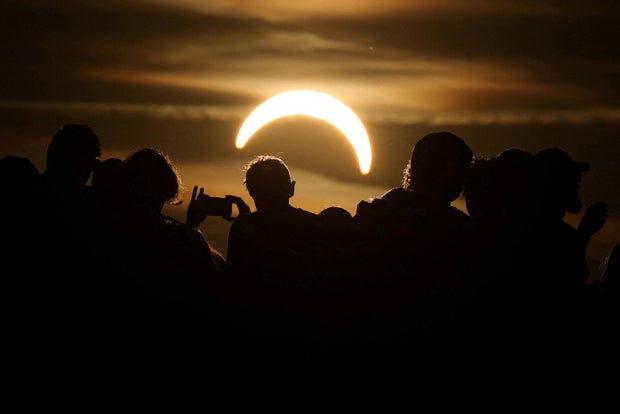
Solar eclipse in Germany
People in Berlin watch the moon partially cover the sun during the solar eclipse.

Fabrizio Bensch / REUTERS

Where was the solar eclipse visible?

Many places along the path of totality are not inhabited, like northern Greenland. But western Iceland and northern Spain were also right in the path for a peak eclipse experience. 

In Spain, they had not experienced a total solar eclipse since 1905.
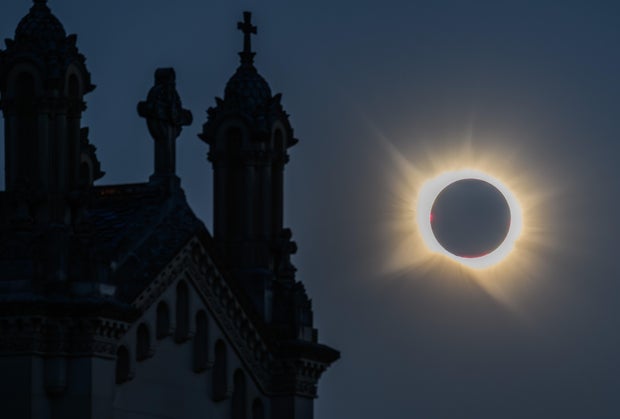
A view of the total solar eclipse in Spain
A view of the total solar eclipse in Guadalajara, Castilla-La Mancha, Spain. 

Rafael Martin/Europa Press via Getty Images
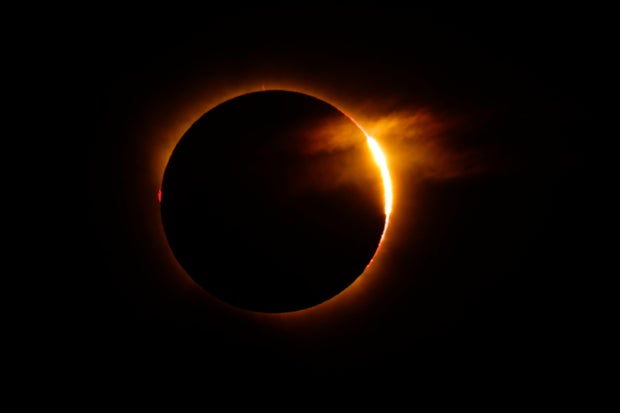
Total Solar Eclipse Seen Over Spain
The sun peeks out behind the moon during the total solar eclipse, as seen from Caspe, Spain.

Jose Breton/Pics Action/NurPhoto via Getty Images

Even though totality only reached a relatively narrow slice of the hemisphere, a partial solar eclipse was visible in a much wider area. About 230 million people live in areas getting 90% totality, according to population data from the Center for International Earth Science Information Network at Columbia University.

That includes most major cities in Europe, including Madrid, London and Paris.
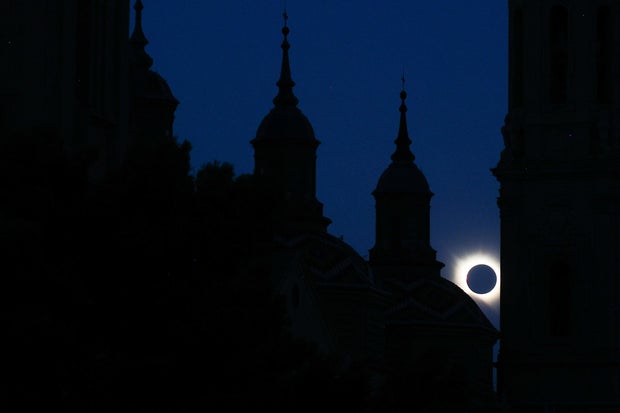
Total Solar Eclipse In Zaragoza
A view of the total eclipse of the sun behind the Catedral-Basilica de Nuestra Senora del Pilar, in Zaragoza, Spain.

Jakub Porzycki/NurPhoto via Getty Images
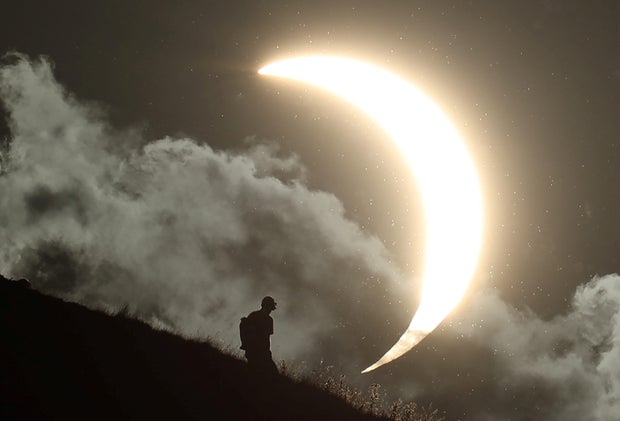
Partial solar eclipse at Glastonbury Tor in UK
A person views the partial solar eclipse on Glastonbury Tor, in Glastonbury, Britain.

Toby Melville / REUTERS

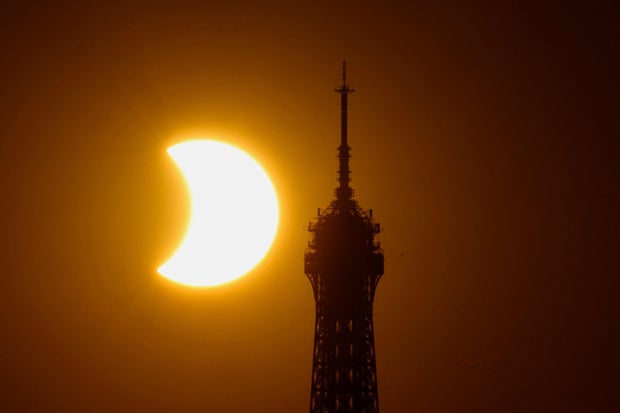
Solar eclipse in France
The Eiffel Tower in Paris is silhouetted as the moon partially covers the sun during the solar eclipse.

Sarah Meyssonnier / REUTERS

Even some of North America got a chance to see a partial solar eclipse, though it won’t be nearly as impressive as when the U.S. got to see a total eclipse in 2024. The best place to see it in the U.S.: Fairbanks, Alaska, reaching 37% totality.

Boston saw about 16% totality, while New York City reached 9% totality, Toronto about 8% and Philadelphia about 7%. 

What time did the eclipse happen?

Since the eclipse crossed just the northern part of the globe, the path of totality was fairly short from start to finish, about an hour and 45 minutes.

The first glimpse of the total eclipse became visible in extreme northern Russia at 1 p.m. Eastern time. It reached northeast Greenland about half an hour later and western Iceland 15 minutes after that.

The eclipse crossed the northern Atlantic for 45 minutes — giving the U.K. its best view, with London reaching its max of 91% at 2:13 p.m. ET — then totality reached northern Spain at about 2:30 p.m. ET.

It was all over by 2:45 p.m. ET.

This animation from NASA shows the path of totality for the eclipse: 

For those in North America seeing a partial eclipse, it reached its maximum in Toronto at 1:40 p.m. and New York City at 1:54 p.m. local time. In Fairbanks, people could see its fullest point at 8:27 a.m. local time.

Watching the eclipse in person

If you were lucky enough to be in one of the locations where the solar eclipse reached totality, plunging the day into sudden darkness, it lasted for about two minutes. 

Enthusiastic viewers came out to watch across Europe, with most seeing a partial but still dramatic view.
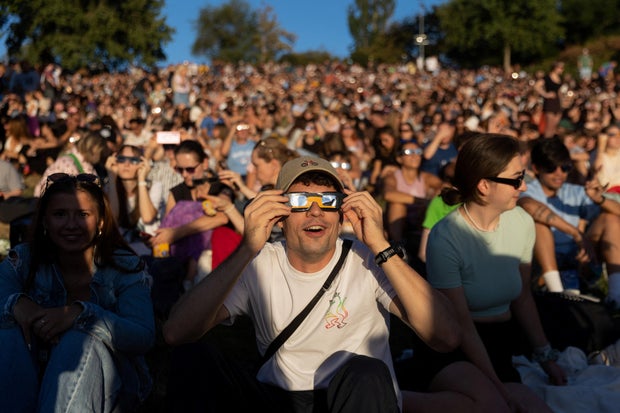
Partial solar eclipse seen from Prague
People wear protective glasses to observe the partial solar eclipse in Prague, Czech Republic.

Eva Korinkova / REUTERS

Wearing solar eclipse glasses is essential to protect your retinas from damage when viewing an eclipse. It’s only safe to take the glasses off for the brief period of totality. 

During a partial eclipse, you have to keep those glasses on the whole time to avoid eye damage.
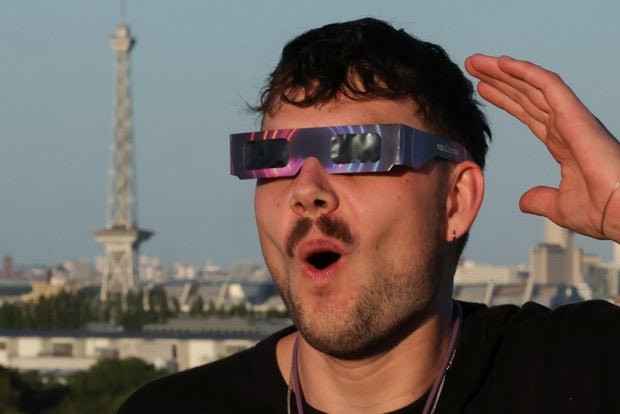
Solar eclipse in Germany
A man wears protective glasses to observe the solar eclipse in Berlin on Aug. 12, 2026.

Fabrizio Bensch / REUTERS

When is the next total solar eclipse in the U.S.?

If the total solar eclipse in Europe gets you excited for the next one in the U.S., you have some time to wait.

The next total solar eclipse over the U.S. will be in 2044, but that one will only be visible in three states: Montana, North Dakota and South Dakota. 

The next year, there will be another opportunity visible in many states as it moves from coast to coast. The eclipse will start in Northern California and move in an arc toward the east, ending in Florida, similar to one in 2017. There will be numerous U.S. cities where eclipse watchers can view the total eclipse, including Reno, Nevada; Colorado Springs; Tulsa, Oklahoma; Little Rock, Arkansas; Jackson, Mississippi; and Orlando, Florida.

There will be another in 2052 that crosses the Southeast, including Florida, Georgia and South Carolina.

To see a total eclipse in the northeastern U.S., you’ll have to wait all the way until May 1, 2079.

Australian tennis player Nick Kyrgios suspended after positive cocaine test

Australian tennis player Nick Kyrgios has been provisionally suspended from professional tennis after testing positive for cocaine. The former Wimbledon finalist, who got his first major win in more than two years at last year's Miami Open, has been provisionally suspended since Aug. 4, according to the International Tennis Integrity Agency, after a sample provided during a June tournament in Mallorca, Spain, tested positive last month for benzoylecgonine, a metabolite of cocaine.In a lengthy Instagram post, Kyrgios said he had "made a huge mistake and I take full responsibility for it."Once ranked world number 13, Kyrgios has slipped to 919 after a series of injuries. The 31-year-old has only played four singles matches this season. He got a wild card to play in the doubles competition at Wimbledon in July, but lost in the first round with his partner Alexander Bublik.Nick Kyrgios of Australia meets fans following his match against Zhang Zhizhen of China during the 2026 Kooyong Classic at Kooyong Lawn Tennis Club on Jan. 13, 2026, in Melbourne, Australia. Kelly Defina/Getty Images Kyrgios will not be able to play in or coach at any events organized or sanctioned by any of tennis's global bodies or national associations until the suspension is lifted. He has the right to appeal his provisional suspension, the ITIA said, "but has not done so to date."On Instagram, Kyrgios apologized "to my fans, my family, my sponsors and everyone close to me. Above all, I'm sorry to the kids who follow me. I know the example this sets and I'm deeply disappointed in myself.""I'm not going to make excuses, but I do want to give some context about where I've been," he added. "The last couple of years of injuries have taken a huge toll on me, both physically and mentally. My body hasn't been able to do what my mind expects it to do, and coming to terms with being near the end of my career has been harder than I ever imagined.""Letting go of something that has been my whole life is one of the hardest things I've ever had to face. At times I've felt helpless and alone," he said. "None of that excuses what I did."Kyrgios said he would be stepping away from social media and public life for a month, "while I focus on getting myself right." "I would never … dope in this sport"Kyrgios is well-known for on-court antics, including shouting obscenities, arguing with umpires and obliterating rackets, making him a controversial figure in tennis.In 2015, he made a derogatory comment to his opponent about another player sleeping with his girlfriend. In 2023, he admitted to assaulting his ex-partner by pushing her over on a sidewalk two years earlier, an incident for which he avoided criminal conviction.A year later he apologized for sharing a post by misogynist influencer and accused rapist and sex trafficker Andrew Tate. Kyrgios has previously criticized high-profile doping cases involving top players Jannik Sinner and Iga Swiatek."I just think that it's been handled horrifically in our sport," Kyrgios said in 2024. "Two world number ones both getting done for doping is disgusting for our sport.""It's a horrible look," he added in remarks reported by ESPN. "Someone like me ... I would never even in my entire life ever try and dope in this sport."Several years ago Kyrgios complained to an official during his U.S. Open match in New York that he was bothered by what he thought was the smell of marijuana wafting onto the court.
Read Next Story