
Australian tennis player Nick Kyrgios suspended after positive cocaine test

Australian tennis player Nick Kyrgios has been provisionally suspended from professional tennis after testing positive for cocaine. 

The former Wimbledon finalist, who got his first major win in more than two years at last year’s Miami Open, has been provisionally suspended since Aug. 4, according to the International Tennis Integrity Agency, after a sample provided during a June tournament in Mallorca, Spain, tested positive last month for benzoylecgonine, a metabolite of cocaine.

In a lengthy Instagram post, Kyrgios said he had “made a huge mistake and I take full responsibility for it.”

Once ranked world number 13, Kyrgios has slipped to 919 after a series of injuries. The 31-year-old has only played four singles matches this season. He got a wild card to play in the doubles competition at Wimbledon in July, but lost in the first round with his partner Alexander Bublik.
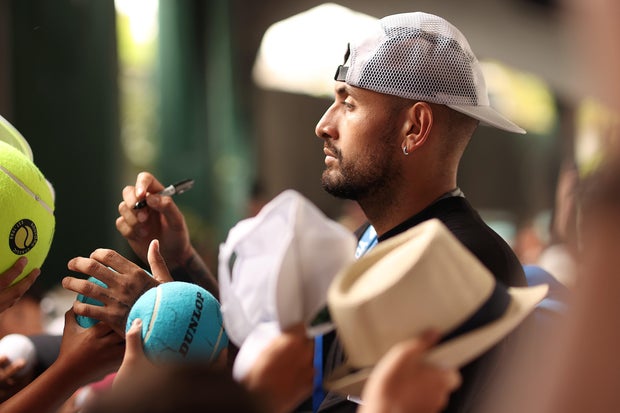
2026 Kooyong Classic - Day 1
Nick Kyrgios of Australia meets fans following his match against Zhang Zhizhen of China during the 2026 Kooyong Classic at Kooyong Lawn Tennis Club on Jan. 13, 2026, in Melbourne, Australia.

Kelly Defina/Getty Images

Kyrgios will not be able to play in or coach at any events organized or sanctioned by any of tennis’s global bodies or national associations until the suspension is lifted. He has the right to appeal his provisional suspension, the ITIA said, “but has not done so to date.”

On Instagram, Kyrgios apologized “to my fans, my family, my sponsors and everyone close to me. Above all, I’m sorry to the kids who follow me. I know the example this sets and I’m deeply disappointed in myself.”

“I’m not going to make excuses, but I do want to give some context about where I’ve been,” he added. “The last couple of years of injuries have taken a huge toll on me, both physically and mentally. My body hasn’t been able to do what my mind expects it to do, and coming to terms with being near the end of my career has been harder than I ever imagined.”

“Letting go of something that has been my whole life is one of the hardest things I’ve ever had to face. At times I’ve felt helpless and alone,” he said. “None of that excuses what I did.”

Kyrgios said he would be stepping away from social media and public life for a month, “while I focus on getting myself right.” 

“I would never … dope in this sport”

Kyrgios is well-known for on-court antics, including shouting obscenities, arguing with umpires and obliterating rackets, making him a controversial figure in tennis.

In 2015, he made a derogatory comment to his opponent about another player sleeping with his girlfriend

In 2023, he admitted to assaulting his ex-partner by pushing her over on a sidewalk two years earlier, an incident for which he avoided criminal conviction.

A year later he apologized for sharing a post by misogynist influencer and accused rapist and sex trafficker Andrew Tate. 

Kyrgios has previously criticized high-profile doping cases involving top players Jannik Sinner and Iga Swiatek.

“I just think that it’s been handled horrifically in our sport,” Kyrgios said in 2024. “Two world number ones both getting done for doping is disgusting for our sport.”

“It’s a horrible look,” he added in remarks reported by ESPN. “Someone like me … I would never even in my entire life ever try and dope in this sport.”

Several years ago Kyrgios complained to an official during his U.S. Open match in New York that he was bothered by what he thought was the smell of marijuana wafting onto the court.

A stuntman’s body was changing. It took nearly a decade to find out why

When Ray Kohn started feeling pain in his knees and elbows in 2015, he attributed it to his work as a stunt driver and mechanic.But as the years went on, he began to notice his body changing in unusual ways: His head grew so much that he needed a larger helmet, and his hands became so big he had to have his wedding ring resized three times. His voice changed. His teeth shifted in his mouth, creating an underbite. He gained over 100 pounds despite his extremely active lifestyle, and he was constantly hungry no matter what he ate. Meanwhile, the pain in his knees and elbows continued. Cortisone shots, meant to reduce inflammation and pain, never lasted long. In 2019, he had the first of three knee surgeries. Later, he'd have operations on his elbow. Nothing worked. No doctor he saw had an answer — even as knee pain forced him to cling to the wall to walk. "I was falling apart, and I didn't know why," Kohn, now 47, said.Looking at videos from past stunt work showed the extent of the changes."I was like 'Look how much I changed. I'm not growing old. I'm actually transforming.' Why is this happening?" Ray Kohn. Ray Kohn In the fall of 2022, Kohn went to a dermatologist after noticing lines form on his head. The doctor asked to see his hands and commented on their size. Then, she looked at his tongue, eyebrows and other facial features, and sent him for blood tests that found he had abnormally high hormone levels. Those results sent him to see Dr. Divya Yogi-Morren, an endocrinologist with Cleveland Clinic who specializes in pituitary diseases."I went into the clinic room and I took one look at him and I already knew what he had, just from looking at him and shaking his hand," Yogi-Morren told CBS News.She fetched her coworker, Cleveland Clinic pituitary neurosurgeon Dr. Varun R. Kshettry, with whom she usually sees patients, because she knew his expertise would also be needed.Yogi-Morren and Kshettry said Kohn had the clinical features of a disease called acromegaly, a rare illness that causes the body to produce too much human growth hormone. The disease is often caused by a tumor on the pituitary gland, and brain surgery is the first line of treatment. Wrestler Andre the Giant, who died of congestive heart failure at 46, also had the condition, which causes cardiac complications. "They said 'If you don't get this out of your brain, you're going to die. This is going to kill you,'" Kohn recalled. "And the first thing that I asked was 'Can I still stunt-jump after this surgery?'" What is acromegaly, and how is it treated? Acromegaly is a hormonal condition that occurs when you have too much human growth hormone, said Dr. Alice Levine, an endocrinologist at Mount Sinai who studies acromegaly. Levine was not involved in Kohn's care. People need large amounts of the hormone as a child, but adults need less of it. Excess human growth hormone is usually caused by an otherwise benign tumor on the pituitary gland. An MRI found that Kohn had such a tumor: His scan found a nine-millimeter mass, nearly the same size as the 10-millimeter gland.In a person with acromegaly, human growth hormone also goes to the liver and binds to receptors there, Levine said. That process elevates a different hormone, called IGF-1, which regulates growth and metabolism in the body. Those two hormones combined resulted in the symptoms Kohn experienced. Parts of the body, especially bones, just keep growing. A person with acromegaly will also experience fluid retention, soft tissue swelling and other internal issues like pre-diabetes, cardiovascular complications and respiratory issues like sleep apnea. Other hallmark symptoms include the embossed lines in the head, large hands and growth between the teeth — all symptoms that Yogi-Morren and Kshettry immediately recognized in Kohn. "He had all the symptoms," Yogi-Morren said. "He had a symptom in almost every system." It took nearly 10 years for Kohn to be diagnosed and treated for acromegaly. All three doctors told CBS News that this isn't unusual. Yogi-Morren estimated that there's usually a "diagnostic delay of about six to 10 years." Kohn said he was relieved to finally have a doctor who could tell him what was wrong. Acromegaly can be hard to diagnose because of the variety of symptoms, Kshettry said, and Yogi-Morren said patients might not realize just how much their bodies are changing.A 3-D illustration comparing a man with acromegaly (left) and the same healthy man (right).
Read Next Story