▶ Watch Video: History washes ashore as Danube River dries up from drought
As the Danube River breaks new record lows across much of its nearly 1,800-mile stretch through eastern Europe, curiosities of the past — including woolly mammoth bones in Bulgaria, sunken Nazi warships in Serbia and unexploded WWII artillery in Hungary’s capital — are emerging. But there’s also an energy crisis unfolding for Hungary’s nearly 10 million people.
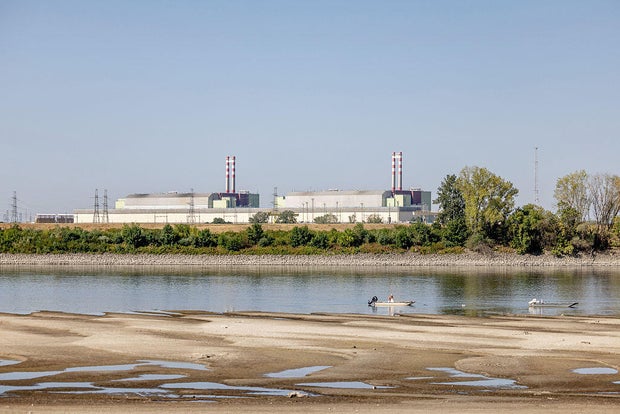
The country’s only nuclear power plant, known as Paks, is on the brink of completely shutting down. As of Wednesday morning, three of the plant’s four reactors are not in operation, while one continues to operate at approximately 50% power.
On normal days, the 44-year-old Soviet-designed facility, which sits on the Danube about 60 miles south of Budapest, generates roughly 50% of the country’s electricity.
But with a drought across southeast Europe now more than three months in, these are not normal days.
Janos Kummer / Getty Images
Unlike nuclear plants in the U.S., U.K., Germany and France — many of which sit on smaller rivers and rely on giant hourglass-shaped cooling towers to recirculate water — Paks was built to suck water in directly from the Danube, a river long assumed too mighty to run dry. Approaching the plant, there are no telltale dumb-bell silhouettes on the horizon signaling its presence.
“Several factors will determine whether Hungary’s most important power plant can avoid a complete shutdown in the coming days,” said Hungarian Prime Minister Péter Magyar, visiting the site Tuesday, attempting to balance reality while projecting optimism.
Just three months into office after his Tisza party ended Viktor Orbán’s 16-year rule in a landslide election this spring, Magyar has called on all Hungarians to unite to conserve power.
Hardly any precipitation is forecast for at least the next 10 days and the Danube’s water levels are expected to slip even lower.
“There are a few critical days left. Today and tomorrow are certainly that,” Magyar said. “I ask everyone to continue the national unity that has developed in the country. Let’s do what our country demands.”
Magyar noted there is “light at the end of the tunnel,” as forecasters predict a cold front moving in on Friday. The temperature in Budapest Wednesday and Thursday was expected to be above 100 degrees Fahrenheit.
The anxiety over Paks, Hungary’s most critical piece of infrastructure, is the first real test of Magyar’s young government.
This week, more than 300 government-linked buildings in Budapest have been ordered to turn off their lights, with the romantic spotlights on popular tourist hotspots like Buda Castle and the Chain Bridge staying dark after the late-summer sunsets.
To offset the loss of power generation, Hungary has nearly doubled its electricity imports from neighboring countries via the region’s power grid, news site Euractiv reported. Hungary’s electricity network is among Europe’s most interconnected, letting the country easily buy power from its neighbors. Costs have not hit consumers yet as the new government absorbs the difference for now.
“The electricity market is stable, and supply is problem-free,” the government said, while urging households to avoid running washing machines and tumble dryers between 5 and 10 p.m. to ease pressure on the grid.
Europe is the world’s fastest-warming continent, warming more than twice as fast as the global average, according to Copernicus, the European Union’s Earth observation and climate monitoring group.
The continent has warmed by around 4.5 degrees Fahrenheit compared to pre-industrial levels, with the fastest warming areas in eastern and parts of central Europe, as well as the European Arctic.