
Pirro brought box of evidence to show Trump what caused Reflecting Pool damage

▶ Watch Video: Trump rebukes Jeanine Pirro for dropping Reflecting Pool charges

The top federal prosecutor in the nation’s capital carted a box full of evidence to the White House on Monday, in a bid to prove to President Trump that the damage to the Reflecting Pool was caused by shoddy construction and not by vandals, sources familiar with the matter told CBS News on Tuesday.

U.S. Attorney for D.C. Jeanine Pirro, a staunch ally of the president, made the case in a sometimes heated private meeting in the Oval Office Monday, hours after Mr. Trump had publicly rebuked her for dropping criminal charges against Olympic canoeist David Hearn

She was later photographed leaving the White House carting a large white box and other bags, which sources said contained all of the evidence collected from the Interior Department that exculpated Hearn and several others from criminal vandalism.

A spokesperson for Pirro’s office declined comment.
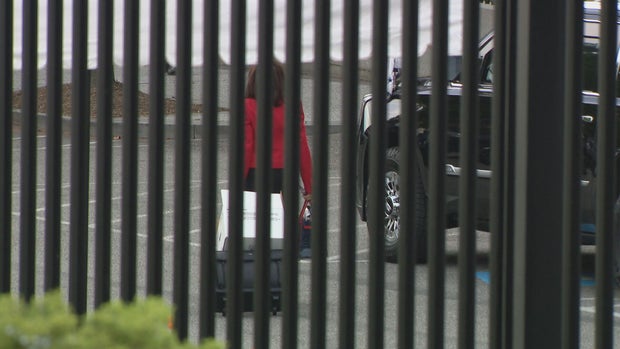
U.S. Attorney for D.C. Jeanine Pirro departs the White House
U.S. Attorney for D.C. Jeanine Pirro departs the White House, Aug. 3, 2026.

CBS News

Mr. Trump earlier in the day had accused Pirro of folding “like an umbrella,” after her office on Friday filed a motion dismissing the felony case against Hearn. 

In the motion, prosecutors blamed the Interior Department for holding back critical evidence that they claimed they did not see until after they had secured the indictment from the grand jury in D.C.’s Superior Court. They said new information they had received indicated that the damage was caused by a “botched installation” by a contractor, not vandalism, as the president and Interior Secretary Doug Burgum claimed. On Saturday, Burgum said in a post on X, “The evidence is clear, vandals have repeatedly caused damage to the Reflecting Pool.”

The U.S. attorney’s office has also since moved to dismiss criminal charges against three others accused of vandalizing the Reflecting Pool.

Pirro’s office has suffered a number of high-profile setbacks involving cases related to Mr. Trump’s enemies and topics of personal interest to him.

Earlier this year, a grand jury uniformly refused to indict six Democratic lawmakers for posting a video urging military members not to follow orders they believe are illegal. Historically, a grand jury refusing to return an indictment is highly unusual, let alone having a grand jury unanimously refuse to do so.

Then, the chief judge for the U.S. District Court for the District of Columbia quashed grand jury subpoenas issued by Pirro’s office to investigate former Federal Reserve Chairman Jerome Powell and the Fed itself in connection with a costly renovation and statements he made to Congress about that work.

In doing so, the judge said the subpoenas were merely a pretext to pressure Powell to lower interest rates. Pirro later dropped the investigation, but not before several of her deputies first made an unannounced visit to the Fed’s construction site and tried to gain access to the property before being turned away.

US Army attack helicopters crashing at historically high rate amid mechanical issues

(CNN) — The US Army’s Apache helicopters are crashing at a historically high rate amid a widespread problem with the model’s transmission, according to a CNN analysis of military accident data.The helicopter type has experienced five major crashes since October, and a deadly mishap earlier this month in Texas killed two soldiers, sparked a wildfire and led the Army to temporarily bar Apache pilots from conducting routine training flights. With that crash, fiscal year 2026 is on pace to be the second worst for Apache flight accidents since a new model of the AH-64 was rolled out in 2011.The Army announced that the pause in training flights, which exempted units deployed to the Middle East, ended Wednesday.This year’s rate of major Apache crashes — known as Class A mishaps in Army parlance, meant to represent any accident that kills or permanently disables a person or results in the loss of an aircraft or $2.5 million in damage — surpasses typical years and rivals that of the service’s most severe rate in the 2024 fiscal year, according to CNN’s review of data. The accident rate is based on the number of incidents compared to the total hours the aircraft spent flying, calculated using data that has been publicly released and flight hour estimates for the current year provided to CNN by the Army.In Fiscal year 2024 there were nine major Apache crashes amid a spike in accidents across all Army helicopter models. Army leaders ordered a special safety training initiative that year and attributed the accidents to human errors stemming from decreased experience among its pilots and an increase in training intensity and complexity after Russia’s invasion of Ukraine inspired a new focus on preparing for major conflicts.But the causes of this year’s spike are murkier. The July issue of an official Army flight safety newsletter said that just over half of this year’s Apache accidents, including more minor incidents, are primarily attributable to human error. It’s unclear how many of the most-severe crashes are due to equipment failures, but the magazine said that “a catastrophic transmission failure was noted in one Class A mishap.”CNN estimated this year’s major Apache crash rate to be approximately 6.24 per every 100,000 flying hours. Thus far in fiscal year 2026, five Class A flight mishaps involving the attack helicopter have occurred. The Apache, through August 15, had flown approximately 80,171 hours. That number combines 42,971 hours through March 31 that were listed in the internal Army safety newsletter and an estimate provided to CNN by an Army safety spokesperson that pilots had logged approximately 37,200 additional flight hours through August 15.Fiscal year 2024, by comparison, had a rate of 7.02 major crashes per 100,000 hours for the aircraft.The E-model Apache, introduced in 2011, has faced significant problems this year with its transmission that could knock out the aircraft’s tail rotor, electrical power and hydraulics, according to a pair of internal safety messages obtained by CNN. The loss of those systems can put a helicopter into a sudden spin and potentially knock out its flight controls. As of mid-July, the cause of the problems remained “under investigation,” according to a safety message released at the time.Army spokesperson Maj. Montrell Russell declined to answer questions regarding the transmission investigation or disclose any “preliminary findings” regarding the causes of this month’s deadly Texas crash at Fort Hood.“We express our deep sadness over the loss of the two Soldiers near Fort Hood,” Russell said in a statement to CNN.He said that “special controls and release protections” prevent the service from providing detailed “technical aviation information,” to include how many of this year’s crashes are related to the helicopters’ transmission.The initial April safety message, first reported by trade publication Defense One, identified 70 potentially faulty transmissions and ordered all units to stop flying affected Apaches pending repair. A follow-up message sent in mid-July said the root cause remains “under investigation” and added 10 more suspect transmissions to the no-fly list.The two safety messages combined to impact roughly a tenth of the Army’s attack helicopter fleet. In early June, an Army official told CNN that all affected Apaches remained grounded, and the Army did not answer CNN’s questions about how many, if any, have returned to flight since then.Meanwhile, the Apache’s transmission issues continue to be mentioned in Army flight documents. CNN obtained an August 14 internal Army order that formally cited the two transmission safety messages in its references for the service’s training flight pause after the Texas crash. Russell cautioned that “including these messages in safety reviews does not imply causation for any individual mishap.”The Apache’s manufacturer, Boeing, has deployed teams to Army maintenance depots to assist with inspecting and fixing the transmissions, according to the Army order.The Army and Boeing did not answer questions on how they identified the potentially faulty parts.A Boeing spokesperson confirmed to CNN that the company is “supporting the U.S. Army’s investigation to ensure the operational readiness and safety of any affected aircraft,” but referred additional questions to the Army.Davis Winkie’s work at CNN is supported by a partnership between Outrider Foundation and Journalism Funding Partners (JFP). CNN retains full editorial control of the reporting.The-CNN-Wire™ & © 2026 Cable News Network, Inc., a Warner Bros. Discovery Company. All rights reserved.
Read Next Story