
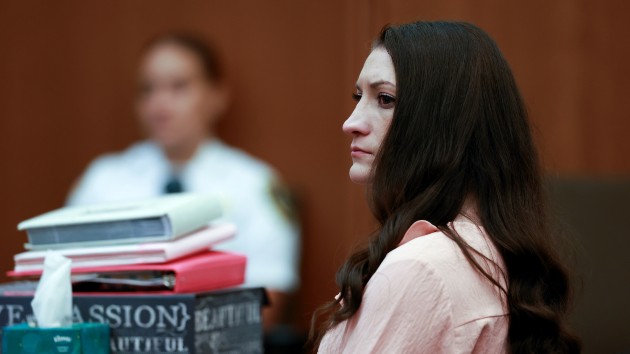
(BOSTON) — Lindsay Clancy’s defense attorney rested their case on Friday after calling one final witness to testify about the effects of postpartum psychosis.
Prosecutors are now calling three additional witnesses as part of a brief rebuttal case, and closing arguments could happen as early as Monday.
Forensic psychiatrist Phillip Resnick, who reviewed Clancy’s medical records and evaluated her several months after the killings, at the request of the defense, testified Friday that he believes Clancy was in the throes of postpartum psychosis when she killed her three children and attempted to take her own life in January 2023.
Resnick told jurors that in his opinion, Clancy was unable to tell the difference between right and wrong and lacked control at that time.
Clancy has pleaded not guilty to three counts of first-degree murder for the deaths of her 5-year-old daughter Cora, 3-year-old son Dawson, and infant son Callan, who died after being strangled by Clancy at the family’s home in the Boston suburb of Duxbury on Jan. 24, 2023.
Defense lawyers do not contest that Clancy was responsible for the deaths of her three children, instead arguing she should not be held criminally responsible for their deaths because she was suffering from postpartum psychosis at the time of the killings.
Resnick is a professor of psychiatry who has researched postpartum psychosis and testified as a key witness in the trial of Andrea Yates, a Texas mother accused of drowning her five children in a bathtub in 2001. He also served as a consultant on the cases of notorious serial killer Jeffrey Dahmer, Oklahoma City bombing culprit Timothy McVeigh, “Unabomber” Theodore Kaczynski, and the high profile murder cases of Scott Peterson and Casey Anthony, according to his biography.
Resnick testified Friday that, in his opinion, Clancy was not “psychotic every minute she was functioning” on the day of the killings but suffered a “command hallucination” after her then-husband Patrick Clancy left their family home to run errands that evening.
“My opinion is that Miss Clancy was, due to her mental disease, unable to conform her conduct to the requirements of the law on the day that she took the lives of her children,” he told jurors. “It was a matter where she was just following the command rather than being able to make any decision to do it or not.”
Resnick testified that Clancy, in his opinion, experienced “not only a command hallucination on the day that she killed her children” but also “a delusion of influence.”
“She felt that her body was taken over by an external force, where she was in a dream state and did not have control of her own body — it’s almost like she was a puppet, and someone else was pulling the strings,” he told jurors.
He added, “At the time of the crime itself on Jan. 24, 2023, Ms. Clancy was frankly psychotic. So, in that sense, she had a postpartum psychosis.”
Resnick further testified that Clancy “was obsessive about caring for her children” and likely believed her children “would be in terrible shape” if she only took her own life that day.
“In her mind, she believed that she would be doing her children a favor by having them go to heaven with her rather than remain on earth without her doing the mothering,” he testified.
Jurors are set to hear closing arguments and begin deliberating early next week, after both sides rest their cases.
Earlier this week, on Thursday, jurors heard from a hospital chaplain who testified that she met with Clancy more than 200 times in the past three years since she killed her three children.
Sheila Cavanaugh, a board-certified chaplain at Brigham and Women’s Hospital in Boston, testified that Clancy had told her she heard a “persistent” male voice ordering her to kill her children and herself in the months before she strangled them and attempted to take her own life.
Cavanaugh’s testimony came after jurors heard from defense witness Paul Zeizel earlier in the week, who also testified about Clancy’s claim she heard a voice telling her to kill her children.
Prosecutors have attempted to cast doubt on Clancy’s claim that she heard a male voice in her head telling her to kill her children and take her own life prior to the killings. According to Reddington, prosecutors have also suggested that Zeizel planted the idea Clancy heard a voice telling her to kill her children during their first meeting, two days before she made a similar comment to her husband over the phone.
Reddington has pushed back on that allegation, and an officer who stood guard outside Clancy’s hospital room testified previously that there was no evidence Zeizel planted the idea.
As the case nears its end, thousands have come to Clancy’s support online, and hundreds of supporters dressed in pink rallied outside the courthouse and the state hospital where Clancy is being held on Thursday.
A fundraiser for Clancy’s parents had raised $996,000 as of Friday morning.
If you or someone you know is struggling with thoughts of suicide, call or text 988 or chat 988lifeline.org. Free, confidential help is available 24 hours a day, 7 days a week. You are not on your own.
Copyright © 2026, ABC Audio. All rights reserved.