
Humanoid robot beats human half-marathon world record in Beijing

▶ Watch Video: Video shows humanoid robot setting record in half-marathon in Beijing

A humanoid robot aptly named Lightning made history on the streets of Beijing over the weekend, beating the human half-marathon world record by several minutes.

Dozens of robots lined up for the Beijing E-Town Robot Half Marathon on Sunday, tackling the 13-mile (21-kilometer) race separate from human runners.

Developed by Chinese smartphone company Honor, Lightning completed the half-marathon in just over 50 minutes, besting the human world record for the distance of over 57 minutes.
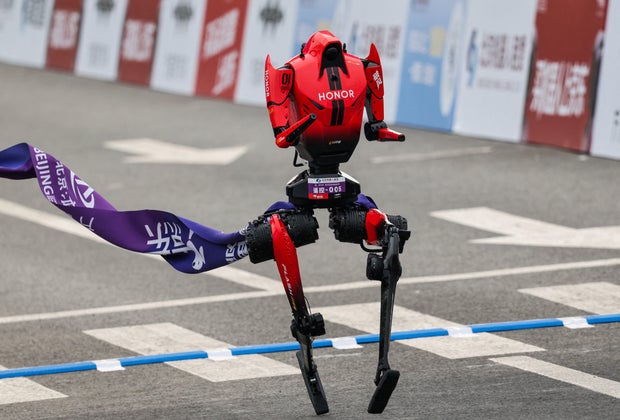
A Lightning humanoid robot by Honor crosses the finish line of the second Beijing E-Town Half Marathon and Humanoid Robot Half Marathon in Beijing, China, April 19, 2026.

Reuters/Maxim Shemetov

Lightning’s creators were delighted with the result. Du Xiaodi, a development engineer at Honor, was quick to draw comparisons with other industries.

“Looking ahead, some of these technologies might be transferred to other areas,” said Du. “It’s similar to how the automotive industry initially developed through competitions.”

The event tested robots in real-world conditions, from balance and endurance to navigation. Some ran autonomously, while others were controlled remotely, all competing on a parallel course to avoid collisions with human athletes.

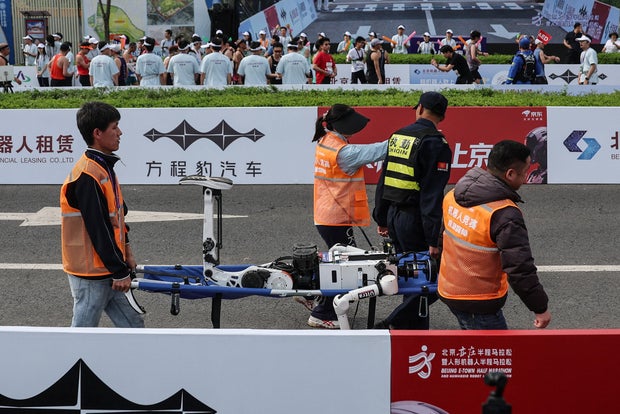
It wasn’t flawless. A few robots stumbled or veered off course, and one was carried away on a stretcher after breaking to pieces in a fall.
Humanoid Robot Half Marathon in Beijing
Staff carry a humanoid robot that crashed after the finish line of the second Beijing E-Town Half Marathon and Humanoid Robot Half Marathon in Beijing, China, April 19, 2026.

Maxim Shemetov / REUTERS

But the progress was striking compared to last year, when most struggled to even finish the race.

Some spectators weren’t worried by the failures.

“I’m very excited,” said Sun Zhigang. “First of all, it’s the first time robots have surpassed humans, and that’s something I never imagined.”

“Their performance is quite impressive,” Jiang Liangzhi said. “I didn’t expect the speeds to be this fast already, and they’re all very stable.”
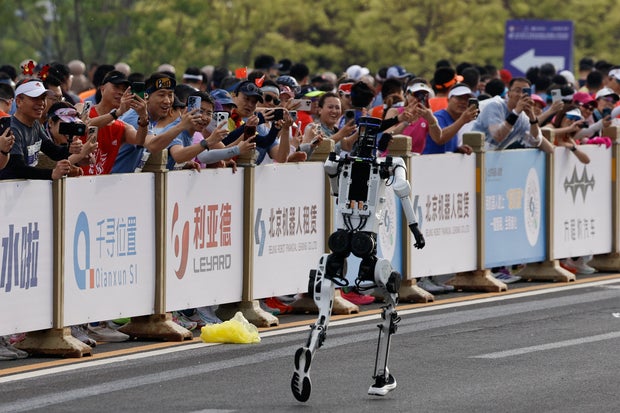
Runners participating in the second Beijing E-Town Half Marathon take pictures of the Tiangong Ultra 2026 humanoid robot participating in the Humanoid Robot Half Marathon in Beijing, China, April 19, 2026.
People take pictures of the Tiangong Ultra 2026 humanoid robot participating in the Humanoid Robot Half Marathon in Beijing, China, April 19, 2026.

Reuters/Tingshu Wang

Organizers said the marathon isn’t really about speed. It’s about pushing robotics technology beyond the lab with potential applications in manufacturing, logistics and even emergency response.

Chinese companies are pushing ahead with the development of robot technologies for both civilian and military uses, but Beijing’s robot half-marathon shows just how fast the future is moving from science fiction to sporting reality.
Second Beijing E-Town Half Marathon and Humanoid Robot Half Marathon in Beijing
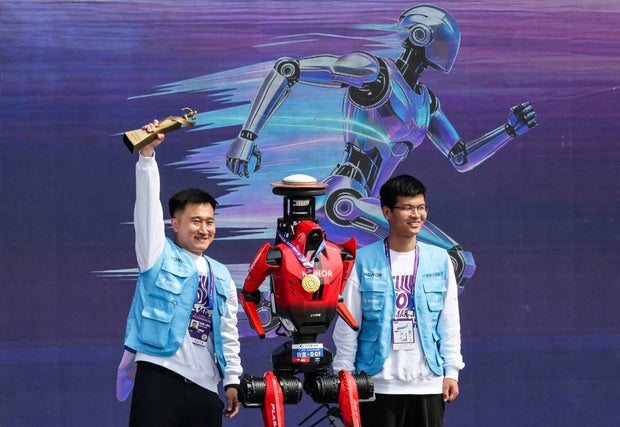
Team members celebrate next to winning robot Lightning during a medial ceremony after the second Beijing E-Town Half Marathon and Humanoid Robot Half Marathon in Beijing, China, April 19, 2026.

Maxim Shemetov / REUTERS

Technology helps restaurant owner recover after severe stroke

▶ Watch Video: A robotics activist's remarkable crusade Restaurateur Tommy Fello was driving from his Ohio establishment to his house on Christmas Eve when he started veering off the road. Fello, then 71, had been awake since 4 a.m. local time preparing a holiday buffet for his family. He chalked the disturbance up to a flat tire. Driving slowly and relying on the vehicle's autocorrect feature, he was able to complete his journey home safely.But when Fello stepped out of the truck, he couldn't get his balance. "I finally realized it wasn't the truck that was veering. It was me that was veering," Fello said. He went indoors and talked to his wife and daughter, who said he looked unwell. About five minutes later, they called 911. Paramedics took him to an area hospital, where he lost all movement in his left arm and leg. "They were literally just like appendages on me. I could not feel them and could not do anything," Fello said. A clot-busting drug reversed the stroke, but the numbness on the left side of his body, including his face, remained. He struggled to swallow, eat or drink. Physical and occupational therapy produced only minor improvements. Tommy Fello walks during a rehabilitative therapy session before his surgery. Thomas Fello
Read Next Story