
Technology helps restaurant owner recover after severe stroke

▶ Watch Video: A robotics activist’s remarkable crusade

Restaurateur Tommy Fello was driving from his Ohio establishment to his house on Christmas Eve when he started veering off the road. Fello, then 71, had been awake since 4 a.m. local time preparing a holiday buffet for his family. He chalked the disturbance up to a flat tire. Driving slowly and relying on the vehicle’s autocorrect feature, he was able to complete his journey home safely.

But when Fello stepped out of the truck, he couldn’t get his balance. 

“I finally realized it wasn’t the truck that was veering. It was me that was veering,” Fello said. He went indoors and talked to his wife and daughter, who said he looked unwell. About five minutes later, they called 911. Paramedics took him to an area hospital, where he lost all movement in his left arm and leg. 

“They were literally just like appendages on me. I could not feel them and could not do anything,” Fello said. 

A clot-busting drug reversed the stroke, but the numbness on the left side of his body, including his face, remained. He struggled to swallow, eat or drink. Physical and occupational therapy produced only minor improvements. 
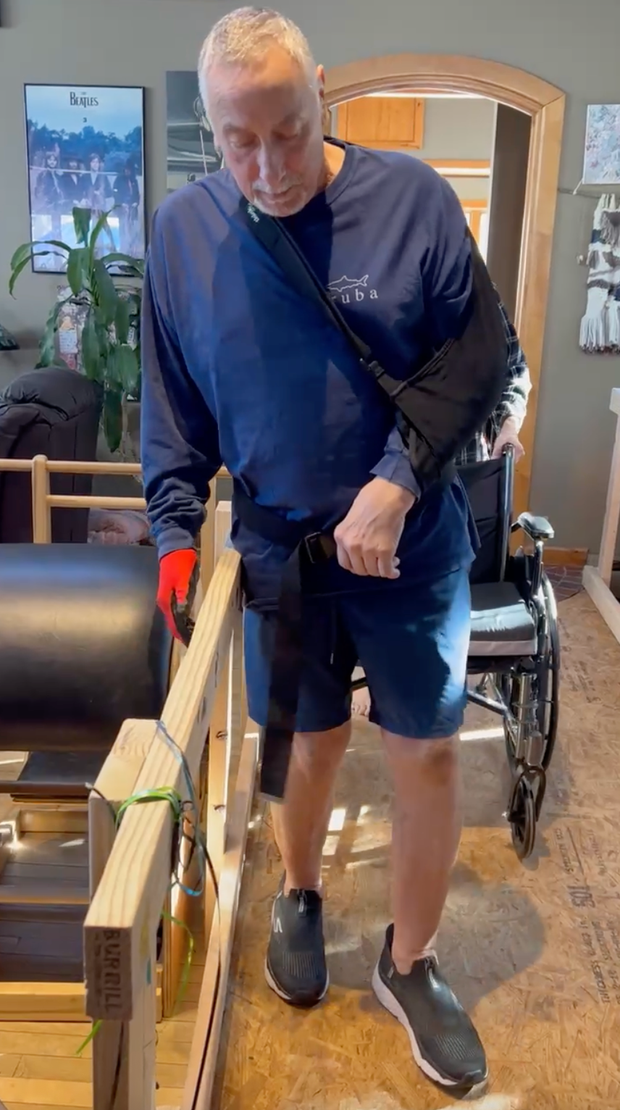
screenshot-2025-08-21-at-12-35-53-pm.png
Tommy Fello walks during a rehabilitative therapy session before his surgery.

Thomas Fello

Dr. Sharon Covey, Fello’s occupational therapist and the founder of the Center for Stroke and Hand Recovery, Inc., told CBS News that his arm was essentially stuck in a bent position with his fingers curled when he met her in January 2024. The position and tension in the limb caused Fello constant pain. Working in his restaurant was out of the question.  

“It was very scary. You take for granted so many of the things you do, and even the common, simplest things become like a chore,” Fello said. “We mark all these small victories … Being able to lift up your arm or pick up a cup is a gigantic accomplishment. Those little accomplishments are gigantic to a stroke victim. They encouraged me to keep going on. But there was always a thought in the back of my mind: ‘Is this as good as it’s going to get?'” 

A “first-of-its-kind technology”  

One day, another recovering stroke patient suggested Fello look into an implant called the Vivistim System. The FDA-approved implant, developed by the medical device company MicroTransponder Inc., uses vagus nerve stimulation during rehabilitation to improve hand and arm function for stroke victims. The vagus nerves are the body’s longest cranial nerve, with one on each side of the body, according to the Cleveland Clinic. They regulate the body’s involuntary functions. 

The Vivistim Therapy system involves a physical or occupational therapist sending wireless signals to the device. That signal delivers a brief, gentle pulse to the vagus nerve while the stroke patient performs rehabilitative tasks. The stroke patient also does at-home exercises. 

Dr. Erez Nossek, a neurosurgeon and director of the cranial bypass program at NYU Langone, told CBS News that the vagus nerve stimulation can enhance the brain’s ability to rewire itself, known as neuroplasticity. That increased neuroplasticity can result in “greater and faster improvements in motor function for stroke survivors,” Nossek said in emailed remarks. 
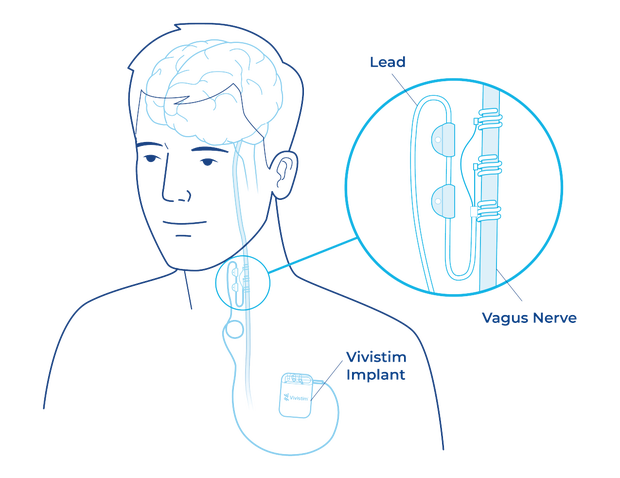
vivistim-paired-vns-system-implant-diagram-callout-labels.png
An illustration from MicroTransponder, Inc. shows the positioning of the Vivistim System device.

MicroTransponder, Inc.

“There is no other FDA-approved technology proven to boost neuroplasticity for stroke survivors, creating new connections in the brain, which is theirs to keep, even after the device is no longer in use,” Nossek said. “This is (a) first-of-its-kind technology that is redefining what is possible for this patient population.” 

A 108-person trial published in The Lancet in 2021 found that the device generated two to three times greater improvement in hand and arm function for stroke survivors when compared with just rehab. Stroke patients who have limited hand and arm function six months or more after their stroke and are considered to have “moderate to severe deficits” qualify for the device, the company said in a fact sheet.

Implant aids in recovery

Fello turned to the Cleveland Clinic, where he met cerebrovascular neurosurgeon Dr. Mark Bain. He studies stroke recovery, especially in the cases of patients like Fello, whose rehab progress has plateaued months after the stroke. Bain determined that Fello was a candidate for the Vivistim System. Fello became the first Cleveland Clinic patient to receive the implant on April 29, 2025. 

“It didn’t really scare me to try and do it. I was anxious to see how it worked,” Fello said. 

The device was placed during an hour-long procedure. The vagus nerve sits just below the carotid artery, so Bain and his surgical team made a small incision to place the leads of the implant and hid the scar in a fold of Fello’s neck. The key-fob sized implant was placed under Fello’s clavicle. Bain said the procedure itself is low-risk, with “less than 1% chance of any complications.” Two weeks after the surgery, the device was turned on and Fello returned to his rehabilitative work with Covey. 
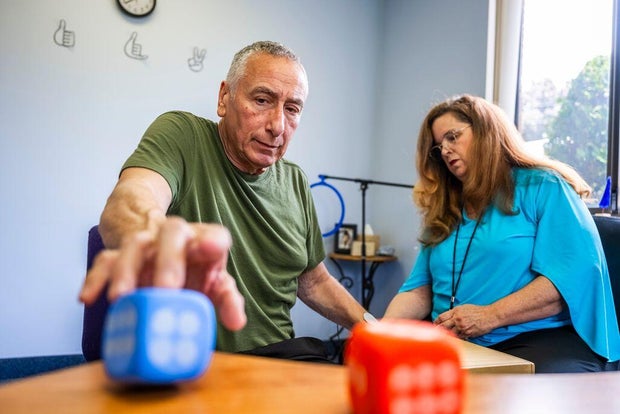
g0wywdkq.jpg
Tommy Fello and Dr. Sharon Covey during a therapy session.

Cleveland Clinic

Covey said Fello has made huge progress since the device was implanted four months ago. She said he has no pain or tension in the limb, and is beginning to practice using his left arm to carry items. The task is difficult, she said, but isn’t “something he could have done before.” Fello, now 72, said he’s been thrilled by the progress he’s made in a short time.

“I’m very, very happy to do it, very proud to do it, and I’m glad I did it,” he said. 

“The sky’s the limit”

About 800,000 people in the United States experience an ischemic stroke each year, Bain said. Vivistim and other new technologies may offer hope to the patients like Fello who struggle to recover with just rehabilitation, Bain said. 

“I think over the next probably five to 10 years, what you’re going to see is an explosion of procedures, devices and things in rehab that will help people, once they’ve had strokes, to get their lives back,” Bain said. “In the future, I think the sky’s the limit for what we can expect for stroke recovery.” 

At the time of his conversation with CBS News, Bain had given seven other stroke patients a Vivistim implant. Covey said at her practice, there are eight patients with the implant receiving the paired therapy course. MicroTransponder Inc. declined to say how many patients have received the implant, but shared a map that shows dozens of surgeons and rehabilitation therapists that provide the therapy. 

“I think this is the newest, most effective strategy for people getting their affected limbs back,” Covey said. “This is the first real technique that has been available, at least in the last 20 years, for stroke rehab. The theories that we use as practitioners to increase somebody’s use of their affected arm are 50 to 75 years old. So this is a new technology that’s really going to turn the stroke recovery world upside down.” 

Democrats intensify scrutiny of David Ellison amid Paramount–WBD legal battle

(CNN) — As Paramount pushes to settle the state antitrust lawsuit that has stymied its deal to buy Warner Bros. Discovery, Democratic lawmakers continue to rally opposition to the deal.On Wednesday, Rep. Jamie Raskin, the top Democrat on the House Judiciary Committee, sent a new letter to Paramount CEO David Ellison accusing him of “colluding” with President Trump and urging him to answer questions.A Paramount spokesperson did not immediately respond to a request for comment.The letter highlights Democrats’ concerns about Paramount taking control of Warner-owned CNN. It comes the same week that Paramount chief legal officer Makan Delrahim said of CNN that Ellison “wants to bring it back to news,” a comment that raised eyebrows given that the network has been a global news brand for 46 years.The letter, which was obtained first by CNN, also suggests that Paramount’s dealings with the Trump administration — a relationship Raskin has called “corrupt” — will be a priority for the Judiciary Committee if Democrats regain the House majority in the midterm elections.Raskin opened the missive by acknowledging that Paramount has not responded to his four previous inquiries in the past 12 months.But “now that you have vowed to break your long silence,” he wrote, citing Ellison’s op-ed in The New York Times last week, “I invite you to a transcribed interview to tell Congress and America your story and answer the Committee’s questions about your Donald Trump-enabled shopping spree to consolidate news organizations, movie studios, cable channels, and streaming services.”With Republicans in control of the House, Democrats like Raskin can’t compel Ellison to testify, so the interview demand is a way to amplify his concerns about the deal.The new letter cites reports of “political interference” at Paramount-owned CBS News, which the news division has disputed.“CBS’s own reporters have shared how, under your leadership, the newsroom has catered to President Trump’s political whims and dictates under the watchful eye of a MAGA minder,” Raskin wrote, apparently referring to the accounts of fired “60 Minutes” correspondents.Ellison wrote in the Times op-ed, “Great news organizations like CNN and CBS News are here to tell it straight down the middle. That requires newsrooms that reflect the whole world, not one side of it. And it requires independence. Our journalists will continue to answer to the facts and to all the people they serve — not to any party or cause.”Ellison’s op-ed made no mention of Trump, who has been a pivotal figure throughout the nearly year-long battle for control of Warner Bros. Discovery.Paramount sought a close relationship with Trump and his administration while seeking federal approval of the WBD merger.Ellison’s father Larry, the billionaire Oracle co-founder, has been a close ally of Trump’s for years. Trump has praised both father and son, calling them his “supporters” and expressing confidence in their plans for CBS. Trump has also been outspoken about his desire for CNN to come under new ownership, calling it “imperative.”Raskin’s letter cites an anonymously sourced report from the Wall Street Journal that “David Ellison offered assurances to Trump administration officials that if he bought Warner, he’d make sweeping changes to CNN.”Raskin wrote to Ellison, “You have eagerly shown the president that you are going to deliver on both counts as if you are controlling organs of state media.”The letter also indicated that a Democrat-led Judiciary Committee would probe the Justice Department’s mid-June approval of the Paramount merger, which many critics linked to Trump’s personal interest in the deal.Raskin said the committee would scrutinize whether federal agencies “are successfully promoting free competition and innovation—or whether they are using their governmental powers to distort the market and undermine freedom of speech and freedom of the press, in violation of the First Amendment.”Other Democratic lawmakers have also foreshadowed public hearings and probes about the matter and have supported the state attorneys general lawsuit seeking to stop Paramount’s expansion plan.Sen. Elizabeth Warren wrote in a social media post on Tuesday, “The Paramount–WBD merger isn’t about creating better entertainment. It’s about cutting costs & squeezing workers. Writers, actors, and crew will have fewer employers to work for, which means less bargaining power & lower wages. State AGs are stepping in to fight back.”Paramount has consistently said the deal is pro-competitive, pointing to the regulatory approvals from the Justice Department and other authorities around the world.But the deal is frozen in place due to the state antitrust lawsuit and a parallel lawsuit from the Writers Guild of America.Facing an uphill battle in court, Paramount agreed not to complete the merger until a trial is held or until June 1, 2027. A trial is slated to be held in March, though a settlement is possible before then.Speaking at a Politico conference on Tuesday, Delrahim said “we would be delighted to engage” in settlement talks “in order to repair the industry, create more jobs, bring more jobs and production back.”California Attorney General Rob Bonta said at the same conference that “we will be open to any proposals,” but “right now, we’re focused on litigation and going to trial.”Both men also addressed a report by Puck’s Matt Belloni that Ellison told Paramount’s leadership team that he intends to move the company out of California if the antitrust case isn’t settled by October 1. Ellison has notably not made this threat in public, and Paramount has declined to comment on the report.Delrahim said Paramount doesn’t want to leave the state, but the company has to ”look at the business environment” and “ultimately, you know, go to a place where you’re wanted.”Bonta, speaking earlier in the day, said the leave-California threat “is an attempt to blackmail the regulators who are daring to enforce the law fairly and firmly.”Delrahim said it is not a blackmail attempt, and argued that “this merger is actually going to be good — not only for California — it’ll be good for America.”The-CNN-Wire™ & © 2026 Cable News Network, Inc., a Warner Bros. Discovery Company. All rights reserved.
Read Next Story