
US-Iran strikes ‘put into question’ key parts of MOU, Qatari official says

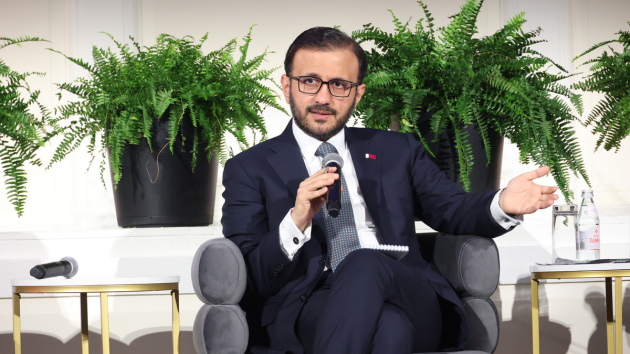
Dr. Majed al-Ansari, Advisor to the Prime Minister of Quatar and Official Spokesperson for the Ministry of Foreign Affairs, speaks onstage during Global Citizen NOW: Impact Sessions on September 24, 2025, in New York City. (Photo by Rob Kim/Getty Images for Global Citizen)

(LONDON) — Renewed fighting between the U.S. and Iran in the Middle East puts into question key elements of the memorandum of understanding (MOU) agreed by regional nations last month, a senior Qatari government official told ABC News on Thursday.

Majed al-Ansari, an adviser to Qatar’s prime minister and the spokesperson for the country’s Ministry of Foreign Affairs, said on the sidelines of the Chatham House think tank’s 2026 conference in London that Doha is hoping that intense rounds of reciprocal strikes between the U.S. and Iran do “not kill off the memorandum of understanding altogether.”

“But it does put into question a lot of other things that we have already agreed upon,” he said.

The past 48 hours, Ansari said, have been “quite tense.” He added that since the resumption of strikes, “We’ve seen again navigation through the Strait of Hormuz basically grind to a halt.”

“We are urging all sides to exercise restraint and give some more time for the talks,” Ansari said.

U.S. Central Command said it launched more than 170 strikes on Iranian targets over the past two days in response to alleged Iranian attacks on commercial shipping transiting the Strait of Hormuz earlier this week — allegations that Tehran denied. One of the ships attacked was a Qatari liquid natural gas tanker, the Al-Rekayyat, Qatar said.

In response to the U.S. strikes, the Iranian military claimed to have launched attacks on U.S. military facilities in Kuwait, Bahrain and Qatar.

The U.S. and Iran have traded several volleys of attacks since the MOU was signed on June 17.

Ansari denied the Iranian claim that it launched fresh attacks on Qatar on Thursday. “There haven’t been any attacks in Qatar. The Iranian claims, they’re claims. But our military was very much ready, immediately as the attacks began on the region,” he said. “We had some pass overs, but nothing targeting us.”

President Donald Trump on Wednesday suggested that the MOU was “over” following the reported Iranian attacks, dismissing leaders in Tehran as “scum” and threatening intensified military action.

Asked about those comments, Ansari said Doha and “all parties remain engaged in the talks.”

“Yes, we’re not at the place that we were hoping to be at this time in the chronology of where we wanted the talks to go. But talks have not broken down,” he said. “But, of course, any escalation on the ground derails the diplomatic work.”

Qatar — alongside Pakistan — played a key role in forging the 14-point MOU agreed in June, under which the U.S. and Iran agreed to the reopening Strait of Hormuz and the end of the U.S. naval blockade of Iranian ports. 

The agreement also stipulated that fighting would stop for 60 days while the U.S. and Iran negotiated the terms of a final deal, which would cover issues including Iran’s nuclear material.

Ansari said talks on that final deal are ongoing despite the escalating strikes and heated rhetoric from both Washington and Tehran.

“The easy answer is everybody’s talking to everybody,” he said when asked what was happening behind the scenes, noting that work is ongoing on all three separate tracks — one regarding the Strait of Hormuz, one regarding Iran’s nuclear program and the third regarding the sanctions on Iran and frozen Iranian assets.

“Our focus is on that diplomatic resolution right now,” Ansari added. “The focus has to be on the diplomatic track working, the talks succeeding and on the end of war to pave the way for sustainable peace in our region, and not for it just to be lulls between attacks.”

“No country, however strong that country is when it comes to its military, is able to withstand an unending military conflict in a small region like ours,” Ansari said.

Nonetheless, he said Qatar’s armed forces are prepared for renewed conflict. “We have taken all the contingencies in respect of what might happen in the region,” Ansari said. 

Qatar, he added, has “not taken part in any attacks against Iran or any other of our neighboring countries.” When asked if Doha would be willing to do so, Ansari replied, “We reserve the right to retaliate.”

Copyright © 2026, ABC Audio. All rights reserved.

Democrats intensify scrutiny of David Ellison amid Paramount–WBD legal battle

(CNN) — As Paramount pushes to settle the state antitrust lawsuit that has stymied its deal to buy Warner Bros. Discovery, Democratic lawmakers continue to rally opposition to the deal.On Wednesday, Rep. Jamie Raskin, the top Democrat on the House Judiciary Committee, sent a new letter to Paramount CEO David Ellison accusing him of “colluding” with President Trump and urging him to answer questions.A Paramount spokesperson did not immediately respond to a request for comment.The letter highlights Democrats’ concerns about Paramount taking control of Warner-owned CNN. It comes the same week that Paramount chief legal officer Makan Delrahim said of CNN that Ellison “wants to bring it back to news,” a comment that raised eyebrows given that the network has been a global news brand for 46 years.The letter, which was obtained first by CNN, also suggests that Paramount’s dealings with the Trump administration — a relationship Raskin has called “corrupt” — will be a priority for the Judiciary Committee if Democrats regain the House majority in the midterm elections.Raskin opened the missive by acknowledging that Paramount has not responded to his four previous inquiries in the past 12 months.But “now that you have vowed to break your long silence,” he wrote, citing Ellison’s op-ed in The New York Times last week, “I invite you to a transcribed interview to tell Congress and America your story and answer the Committee’s questions about your Donald Trump-enabled shopping spree to consolidate news organizations, movie studios, cable channels, and streaming services.”With Republicans in control of the House, Democrats like Raskin can’t compel Ellison to testify, so the interview demand is a way to amplify his concerns about the deal.The new letter cites reports of “political interference” at Paramount-owned CBS News, which the news division has disputed.“CBS’s own reporters have shared how, under your leadership, the newsroom has catered to President Trump’s political whims and dictates under the watchful eye of a MAGA minder,” Raskin wrote, apparently referring to the accounts of fired “60 Minutes” correspondents.Ellison wrote in the Times op-ed, “Great news organizations like CNN and CBS News are here to tell it straight down the middle. That requires newsrooms that reflect the whole world, not one side of it. And it requires independence. Our journalists will continue to answer to the facts and to all the people they serve — not to any party or cause.”Ellison’s op-ed made no mention of Trump, who has been a pivotal figure throughout the nearly year-long battle for control of Warner Bros. Discovery.Paramount sought a close relationship with Trump and his administration while seeking federal approval of the WBD merger.Ellison’s father Larry, the billionaire Oracle co-founder, has been a close ally of Trump’s for years. Trump has praised both father and son, calling them his “supporters” and expressing confidence in their plans for CBS. Trump has also been outspoken about his desire for CNN to come under new ownership, calling it “imperative.”Raskin’s letter cites an anonymously sourced report from the Wall Street Journal that “David Ellison offered assurances to Trump administration officials that if he bought Warner, he’d make sweeping changes to CNN.”Raskin wrote to Ellison, “You have eagerly shown the president that you are going to deliver on both counts as if you are controlling organs of state media.”The letter also indicated that a Democrat-led Judiciary Committee would probe the Justice Department’s mid-June approval of the Paramount merger, which many critics linked to Trump’s personal interest in the deal.Raskin said the committee would scrutinize whether federal agencies “are successfully promoting free competition and innovation—or whether they are using their governmental powers to distort the market and undermine freedom of speech and freedom of the press, in violation of the First Amendment.”Other Democratic lawmakers have also foreshadowed public hearings and probes about the matter and have supported the state attorneys general lawsuit seeking to stop Paramount’s expansion plan.Sen. Elizabeth Warren wrote in a social media post on Tuesday, “The Paramount–WBD merger isn’t about creating better entertainment. It’s about cutting costs & squeezing workers. Writers, actors, and crew will have fewer employers to work for, which means less bargaining power & lower wages. State AGs are stepping in to fight back.”Paramount has consistently said the deal is pro-competitive, pointing to the regulatory approvals from the Justice Department and other authorities around the world.But the deal is frozen in place due to the state antitrust lawsuit and a parallel lawsuit from the Writers Guild of America.Facing an uphill battle in court, Paramount agreed not to complete the merger until a trial is held or until June 1, 2027. A trial is slated to be held in March, though a settlement is possible before then.Speaking at a Politico conference on Tuesday, Delrahim said “we would be delighted to engage” in settlement talks “in order to repair the industry, create more jobs, bring more jobs and production back.”California Attorney General Rob Bonta said at the same conference that “we will be open to any proposals,” but “right now, we’re focused on litigation and going to trial.”Both men also addressed a report by Puck’s Matt Belloni that Ellison told Paramount’s leadership team that he intends to move the company out of California if the antitrust case isn’t settled by October 1. Ellison has notably not made this threat in public, and Paramount has declined to comment on the report.Delrahim said Paramount doesn’t want to leave the state, but the company has to ”look at the business environment” and “ultimately, you know, go to a place where you’re wanted.”Bonta, speaking earlier in the day, said the leave-California threat “is an attempt to blackmail the regulators who are daring to enforce the law fairly and firmly.”Delrahim said it is not a blackmail attempt, and argued that “this merger is actually going to be good — not only for California — it’ll be good for America.”The-CNN-Wire™ & © 2026 Cable News Network, Inc., a Warner Bros. Discovery Company. All rights reserved.
Read Next Story