
The new liaison to local law enforcement for the top federal prosecutor in Los Angeles is facing state criminal charges himself, and has a string of prior convictions for driving under the influence, public records show.
Shawn Christopher Lewis, who previously served as First Assistant U.S. Attorney Bill Essayli’s chief of staff when he was a California assemblyman, was hired by and now works for the U.S. Attorney’s Office for the Central District of California as a community resource specialist, a spokesperson for Essayli’s office confirmed.
Lewis, the spokesperson added, “wears many hats” and will also help in public affairs, a role that entails drafting press releases, speaking with reporters and promoting the work of the office.
Lewis was hired even though he has been convicted for driving under the influence at least three times — in 2013, 2015 and 2021, according to public records obtained by CBS News.
He is currently facing charges of misdemeanor battery and taking property in Sacramento, after he allegedly repeatedly punched a man in the head and face and threw his cellphone onto the roof of a nearby building, preventing him from calling 911, according to police reports, court filings and an interview with the alleged victim.
The May 12 police report shows Lewis was initially also booked on charges of resisting arrest and public intoxication, in addition to the battery charge he now faces in Sacramento Superior Court, records show.
Lewis was still on probation for his third DUI conviction when Sacramento police arrested him. On Wednesday, the Yolo County District Attorney’s Office filed a violation of probation and an order to appear in court for that case too, records show.
Lewis also previously violated probation after his first DUI in San Mateo County, according to court records.
Jeff Raven, an attorney for Lewis, told CBS News in a statement that his client is innocent and presumed as such unless proven guilty.
“Mr. Lewis welcomes an opportunity to clear his name,” Raven said.
He added that Lewis was hired by the Justice Department earlier this year, but did not start until more recently.
Lewis applied for a position that was publicly posted, Raven said, and “in accordance with standard hiring and screening procedures, accepted an offer in February of this year.”
Raven said Lewis continued to work for the legislature through the beginning of July before beginning his new job with the U.S. attorney’s office. “This transition had nothing to do with his pending legal matters,” Raven said.
Essayli referred all questions from CBS News to the spokesperson for his office.
Lewis “applied for a position in our office that was publicly advertised in late 2025,” according to the statement provided to CBS News from the U.S. Attorney’s Office. “In February 2026, he accepted an offer to join our office. We do not comment on personnel matters.”
Former Justice Department officials said Essayli’s decision to hire a former staffer with a criminal background to conduct outreach to law enforcement undermines the integrity of the criminal justice system.
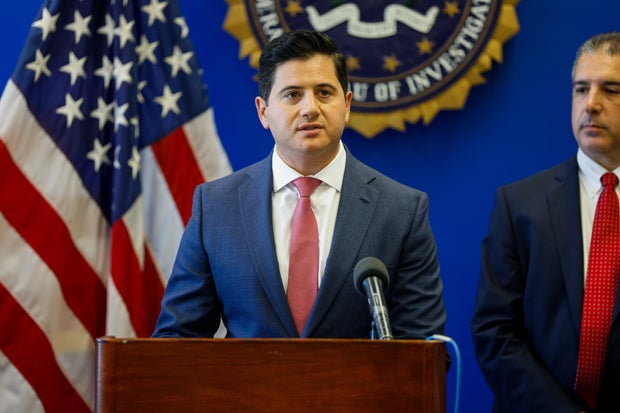
Ronaldo Bolaños / Los Angeles Times via Getty Images
“Courts and the public can’t trust DOJ to enforce the law fairly and effectively when the administration hires lawbreakers to fill high-level positions,” said Stacey Young, a former Justice Department attorney who founded the nonprofit advocacy group Justice Connection.
Current and former Justice Department officials say that in past years, someone with a criminal history like Lewis’ would not be able to pass a background check and gain employment in a U.S. attorney’s office.
But as the Justice Department continues to see employees departing in droves and struggles to recruit new personnel, the pattern of hiring people with a history of criminal convictions, court sanctions or other professional discipline has become increasingly common.
Some 16,000 employees have left the Justice Department since January 2025, according to recent data published by Justice Connection, and the department has started offering retention bonuses in some cases to try to lure in new talent.
Attorney General Todd Blanche’s deputy chief of staff Shane Hedges, for example, pleaded guilty to negligent homicide in a 2001 drunk driving incident that killed Montana’s former majority leader Paul Sliter, according to media reports at the time. He was sentenced to community service and six months in a halfway house.
Aakash Singh, an associate deputy attorney general who has been closely involved in many of the Justice Department’s most politically sensitive investigations, was also arrested for drunk driving in September 2021, according to police and court records.
At the time, he was serving as an assistant U.S. attorney in the Eastern District of North Carolina. He pleaded guilty and was ordered to serve 24 hours of community service, pay $393, and undergo a substance abuse assessment, court records show.
A Justice Department spokesperson said that Singh’s DUI incident, which occurred during Attorney General Merrick Garland’s tenure, was delegated to the U.S. Attorney’s Office for the Eastern District of North Carolina to handle.
In a letter he received in early 2022, officials determined that while he had violated the law, he was ultimately “an asset to the office,” the department told CBS News.
The department added his clearance was renewed when he started serving as associate deputy attorney general in 2025.
“I am surprised that DOJ hiring standards seem to have slipped so dramatically,” said Michael Bromwich, who previously served as the Justice Department’s inspector general — a job that entails investigating waste, fraud and abuse.
“All these officials should have had to pass what is supposed to be a rigorous background investigation. It is surprising that either the background investigation failed to learn of these issues or the person with final authority for hiring was willing to overlook or excuse these significant issues,” Bromwich said. “Neither speaks well for the level of integrity currently acceptable to the leaders of the Department of Justice.”
Hedges and Singh could not be reached for comment.
A Justice Department spokesperson told CBS News that every employee “goes through a thorough background check and employment screening” and that politically appointed officials are vetted through the Presidential Personnel Office as well.
“These are well- and long-established standards,” the spokesperson continued. “All employees go through the same clearance process, for which there is a baseline depending on the level of clearance, and the higher up, the more detailed it gets. Employees are also subject to regular re-investigations and to intense reporting standards.”
Battery charge against Lewis
The pending battery charge against Lewis stems from a confrontation with a former colleague and social acquaintance who previously worked with Lewis in the state Capitol in California.
The alleged victim told CBS News in an interview that on May 12, he went out with Lewis and a female friend of his who was dating Lewis at the time. At one point, he said, Lewis grew angry with his girlfriend and became “frustrated and physically imposing.”
In an effort to protect her, the alleged victim tried to intervene and de-escalate the situation, he told CBS News.
“He suddenly became extremely angry,” the man said of Lewis, adding that out of nowhere, Lewis punched him in the head and face and pushed him to the ground.
“He punched me multiple times,” he said, adding that he also broke bones in his right hand as he sought to defend himself.
During the skirmish, Lewis allegedly threw the victim’s phone onto a roof, prompting the victim to flag down bystanders to call 911 because he couldn’t call himself.
Lewis’ previous convictions
Court records reviewed by CBS News show that Lewis has violated the terms of probation from several of his previous DUI convictions.
After he was convicted in San Mateo County for a DUI in 2013, court records indicate he violated the terms of his probation by failing to enroll in a court-ordered program for first-time DUI offenders. A judge revoked his probation and issued a bench warrant for his arrest.
By then, Lewis had been arrested again. A CBS News review of court records shows Lewis was arrested in Sacramento County in February 2015, less than a year after his first conviction and while he was still on probation in the San Mateo case.
Prosecutors charged him with drunk driving and with driving on a suspended license. He was convicted of a second DUI that March. The Sacramento County Sheriff’s Office confirmed that he was jailed twice that spring in connection with the case.
In 2022, Lewis was convicted on his third DUI, this time in Yolo County, following a 2021 arrest, and pleaded no contest. Court records show his blood alcohol level was at least 0.15%, nearly twice the legal limit of 0.08%.
He was sentenced to 120 days in jail and five years of probation, ordered to complete an 18-month program for repeat DUI offenders and required to have an ignition interlock device that prevents his car from starting if it detects alcohol on his breath.
Records show Lewis completed the 18-month program in 2024.
He was still on probation for that case in May when Sacramento police arrested him for battery, resisting arrest and public intoxication, according to the arrest report.
On Wednesday, the Yolo County District Attorney’s Office filed a violation of probation and asked that his probation be revoked, a request that is awaiting a judge’s approval. Lewis was sent a notice to appear in Yolo County Superior Court on Aug. 19.
Lewis is not the first person hired at the Justice Department during President Trump’s second term who has been accused of assault in the past.
Last year, the Civil Rights Division hired Megan Frederick, a former Culpeper commonwealth’s attorney who performed work for the voting section and more recently, the criminal section.
While she was a commonwealth’s attorney, Frederick was accused of assaulting a probation officer and an IT systems administrator, according to local press reports from that time. In both cases, the incidents were triggered by a dispute between Frederick and then-Culpeper County Sheriff Scott Jenkins over access to information.
She denied both accusations. The IT employee later filed a civil assault and battery case against Frederick, and a judge in Virginia found her liable and ordered her to pay $1,500 in damages, according to local press accounts and court records.
Earlier this year, her employment with the Justice Department ended, and she was escorted out of the building, according to several sources briefed on the matter.
CBS News could not determine why her employment ended. Efforts by CBS News to reach Frederick for comment were unsuccessful.
One official previously said her probation period was not being extended. But the probation period at the Justice Department is usually two years, and she was employed there for less than two years. Another official later told CBS News she resigned.
Before Frederick was escorted out, the rest of the prosecutors and other staff in the office were asked to leave the building and they waited nearly 90 minutes across the street inside a local coffee shop while the personnel issue unfolded, several of the sources said.
Updated suitability and fitness regulations at Justice Dept.
Last month, the Justice Department’s top security officer issued a memo announcing that the federal government was updating its employment suitability and fitness regulations to apply to all department employees — and not just those with security clearances.
Under that new regulation, employees must self-report “major life changes” such as arrests, significant financial strain such as bankruptcy, criminal sexual behavior, “questionable judgment, dishonesty, or unwillingness to comply with rules and regulations,” illegal drug use and “excessive alcohol use,” the memo shows.
“Failure to report required information is considered a security violation,” the July 29 memo said. “Eligibility and employment can be jeopardized for failing to report adverse information about yourself or another covered individual.”