
DOJ asks appeals court to reinstate human smuggling case against Kilmar Abrego Garcia

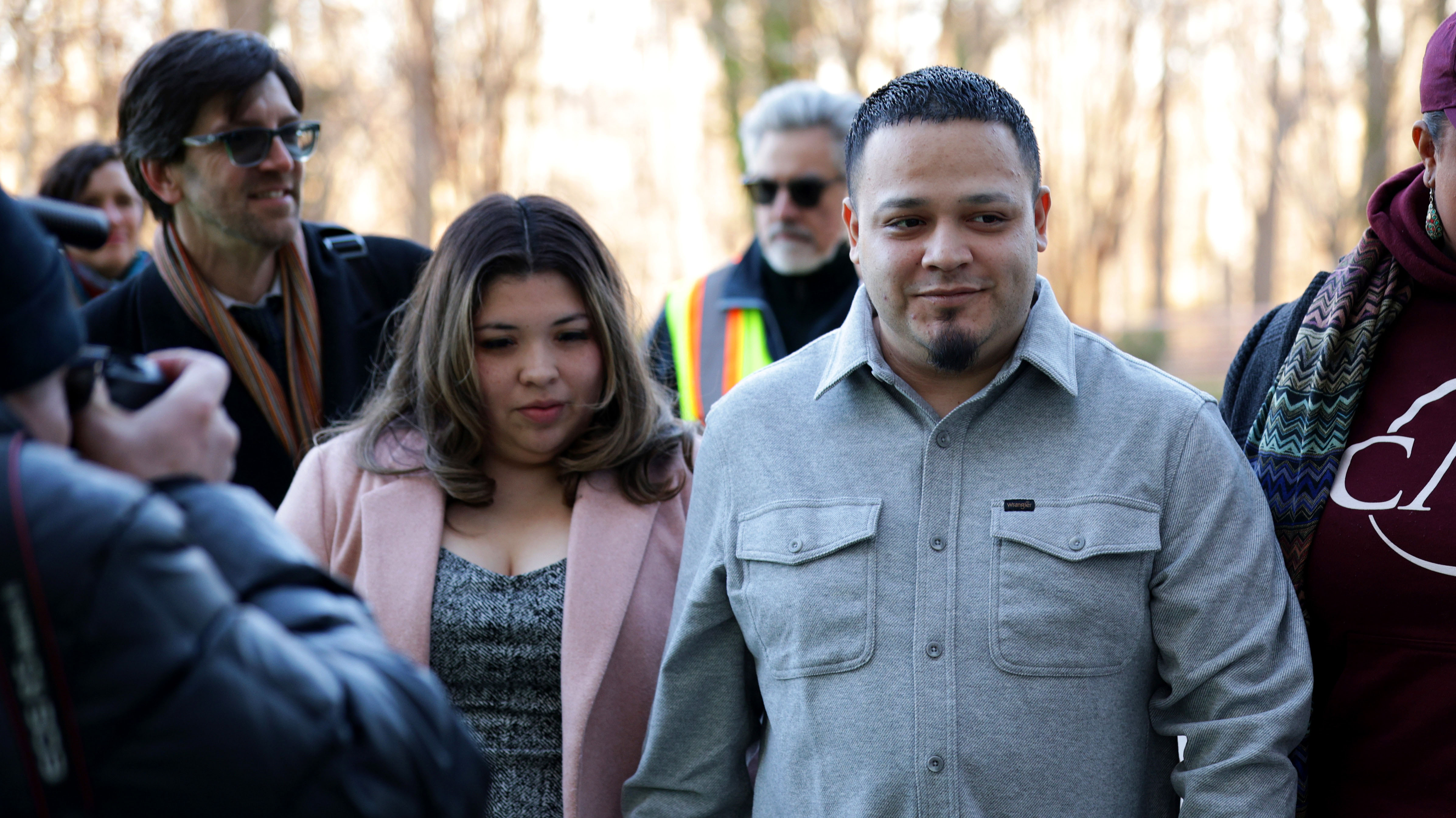
Kilmar Abrego Garcia arrives with his wife Jennifer Vasquez Sura and his attorney Simon Sandoval-Moshenberg (L) at U.S. District Court for the District of Maryland on Dec. 22, 2025, in Greenbelt, Maryland. (Alex Wong/Getty Images)

(WASHINGTON) — The Department of Justice has asked an appeals court to reinstate the criminal human smuggling case against Kilmar Abrego Garcia.

In May, a federal judge granted Abrego Garcia’s motion to dismiss the case, finding that the federal government failed to rebut Abrego Garcia’s “presumption of vindictiveness.”

“Because the presumption of vindictiveness remains unrebutted, the indictment must be dismissed,” U.S. District Judge Waverly Crenshaw wrote in May.

In a brief filed Monday, attorneys for the DOJ urged an appellate court to overturn Judge Crenshaw’s May ruling, arguing that the decision to indict Abrego Garcia was supported by “legitimate reasons.”

“The decision to seek an indictment against Abrego Garcia for human smuggling was made by career prosecutors based on the evidence, the law, and their firm belief that there is proof beyond a reasonable doubt that Abrego Garcia had committed the offenses charged,” the DOJ said in a press release. “The indictment and prosecution of Abrego Garcia in the Middle District of Tennessee was not vindictive, and the evidence before the district court established that it was not.”

Abrego Garcia, who had been living in Maryland with his wife and children, was deported in March of last year to El Salvador’s CECOT mega-prison — despite a 2019 court order barring his deportation to that country due to a fear of persecution — after the Trump administration claimed he was a member of the criminal gang MS-13, which he denies.

He was brought back to the U.S. last June to face human smuggling charges in Tennessee, after which U.S. District Judge Paula Xinis released him from ICE detention while he awaited trial.

In May, Judge Crenshaw highlighted the involvement of high-ranking DOJ officials in the case, pointing to public statements made by then-Deputy Attorney General Todd Blanche to conclude that the government could not justify its sudden shift from wanting to deport Abrego Garcia to prosecuting him.

In its filing Monday, the DOJ argued that Blanche’s public comments in an interview regarding the deportation case “do not reflect a vindictive motive.”

“At a minimum, nothing in his interview supports an inference that the United States pursued charges ‘solely’ to retaliate against Abrego for his civil suit,” the DOJ argued. “The district court’s contrary reasoning — which did not even address the full quotation — is illogical and clearly erroneous.”

The criminal charges in Tennessee stem from a 2022 traffic stop disclosed in an April 2025 press release issued by the Department of Homeland Security, which touted a “bombshell investigative report” alleging that Abrego Garcia was a suspected human trafficker. He was not charged or arrested during the traffic stop, which lasted for more than an hour. 

“Instead of investigating the November 2022 traffic stop to identify who was responsible for the human smuggling, Blanche started the investigation to implicate Abrego,” Judge Crenshaw wrote in May. “He did so to justify the Executive Branch’s decision to remove him to El Salvador.”

Copyright © 2026, ABC Audio. All rights reserved.

Justice Department to send a record 1,000 monitors to midterm polling places

▶ Watch Video: CBS News political panel on trends being seen so far in midterm elections Washington — The Justice Department is planning to deploy a record 1,000 federal monitors to polling places throughout the U.S. for the midterm elections, the head of the department's Civil Rights Division said this week.Harmeet Dhillon, the assistant attorney general for the Civil Rights Division, made the announcement in remarks to Bloomberg on Monday.The Civil Rights Division has long sent out monitors to polling places throughout the country to ensure compliance with the federal Voting Rights Act. That law prohibits discrimination in voting and ensures voters are not intimidated or otherwise prevented from casting a ballot on the basis of race, gender, ethnicity, religion, disability or another protected class.Historically, the Justice Department's own civil rights attorneys have served as monitors, and usually it sends out dozens of staff to a variety of polling places. In the 2024 general election, for instance, the department monitored compliance with federal voting rights laws in 86 jurisdictions across 27 states.The Civil Rights Division under the Trump administration, however, has been largely gutted. More than 70% of its career staff took early retirement or resigned amid concerns about changes to its mission under Dhillon's leadership. Although she has since recruited more attorneys, it remains understaffed.In order to reach 1,000 monitors for the upcoming election, a DOJ spokesperson told CBS News that the department will seek federal employees to volunteer for the effort. A department official added that the recruitment will target DOJ employees, including people in U.S. Attorney's Offices throughout the country.A full list of locations is expected to be made public once the primaries are concluded. On Tuesday, the Justice Department announced it was sending monitors to polling places for primary elections in Miami-Dade County, Florida, and Laramie County, Wyoming.While it is longstanding practice for the DOJ to send monitors to polling places, some states are more suspicious this year, given the 31 lawsuits the Civil Rights Division has filed seeking states' unredacted voter data. The division has said it wants to ensure each state's rolls are clean, and that noncitizens are not registered. The states argue the suits are an effort to cast doubt on the integrity of the election process itself. The government has not prevailed in a single lawsuit so far, with judges blocking the requests for data in 23 cases to date.The Department of Homeland Security, meanwhile, wants to use the voter information to carry out criminal and immigration enforcement.President Trump, for his part, has repeatedly refused to acknowledge that he lost the 2020 election, and claimed without evidence that it was stolen. The FBI has since launched a number of criminal investigations related to the 2020 election results, including in Fulton County, Georgia, and in Arizona.Recently, Arizona Secretary of State Adrian Fontes filed a public records request in the hopes of learning why DOJ was deploying monitors in three counties to monitor its primary election.
Read Next Story