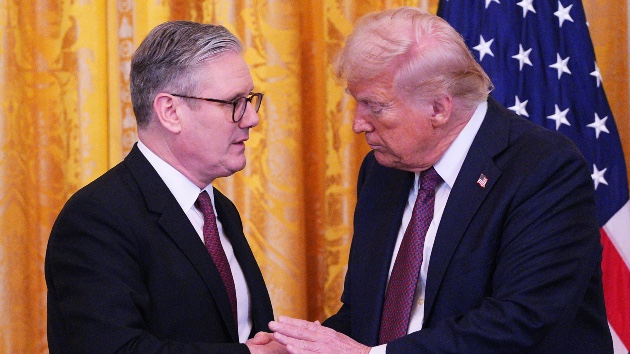
(LONDON) — As Britain prepares for yet another prime ministerial change, a former holder of the office — Theresa May, who led the country from 2016 to 2019 — urged the country’s next leader to focus on shared U.S.-U.K. interests, rather than falling prey to potential personal or political clashes with President Donald Trump.
The U.K. Parliament is expected to anoint the Labour Party’s Andy Burnham as prime minister later this month. Burnham will become the seventh leader to take the reins of the country in 10 years, a reflection of the political and economic turbulence that has beset the country since the Brexit vote in 2016.
Burnham will replace current Prime Minister Keir Starmer, who last month said he would vacate his post following a collapse in support among Labour members of parliament, exacerbated by disastrous local election results in May. Starmer delivered Labour a historic majority in parliament in the 2024 general election, but saw his authority and approval rapidly deteriorate.
Like his predecessors, Burnham will need to juggle domestic discord while navigating a raft of foreign policy demands — among them the cultivation of the so-called “special relationship” between the U.K. and the U.S., which during President Donald Trump’s two terms in the White House has been subject to strategic, ideological and economic headwinds.
Trump has already described Burnham — who until recently was serving as the mayor of Greater Manchester — as “extremely liberal.” During Starmer’s time in office, the president has been scathing toward the prime minister’s policies in areas including energy, immigration, crime and foreign policy.
May, whose time in office overlapped with Trump’s first term, told ABC News last week that institutional transatlantic relationships and shared interests can help Starmer’s successors ease possible interpersonal tensions.
“Keir Starmer, actually, on the foreign policy field, by and large, played a good hand,” May told ABC News on the sidelines of the Chatham House think tank’s conference in London. The outgoing prime minister has been broadly praised for his deft handling of the transatlantic relationship, which included hosting a state visit for Trump to the U.K. in 2025.
Of the special relationship, May said, “We talk about it perhaps slightly more than the U.S. does. But that relationship is built on a whole set of different levels of relationships. So, it’s not just about the prime minister and the president. It’s also about our security relationships, our defense relationships … It’s not just about the two people at the top.”
The same is true of the U.K.’s own political issues, May said, as the nation prepares for the coronation of its next prime minister. “It’s not about individuals. Politics today generally across the globe has become more about individuals and personalities and I think that’s problematic,” she said.
“What matters to people is not the personality at the top. What matters to the people is what they’re doing, what their policies are,” May said.
The recent joint U.S.-Israeli war with Iran has again prompted Trump to strike out at America’s European allies, who refused to join the campaign in support of Washington though expressed willingness to aid security and minesweeping missions in the Strait of Hormuz once the conflict is over.
The U.K. was among the American allies who refusal to assist the U.S. against Iran “greatly disappointed me,” Trump said in March. Starmer’s response in particular, the president said, was “very disappointing.”
Asked whether the Iran war would prove to be a long-lasting blot on U.K.-U.S. relations, May said she was hesitant to comment as the conflict “is not finished.”
Still, she — like many other current and former European leaders — noted that European nations have previously shown their “commitment to the United States,” not least in rallying to the U.S. side after the 9/11 attacks; the only time in NATO history that an ally invoked the Article 5 collective defense clause.
When asked about Trump’s repeated suggestions that the U.S. should be less involved in European security, May replied, “There have been other times when there’s been more of that sense of isolationism,” specifically noting the later American entry into the Second World War in support of the U.K. and its allies.
“But I think, again, the interests that we have together are what combines us,” May said.
Copyright © 2026, ABC Audio. All rights reserved.