
US-UK ‘special relationship’ can survive spats with Trump, ex-British PM says

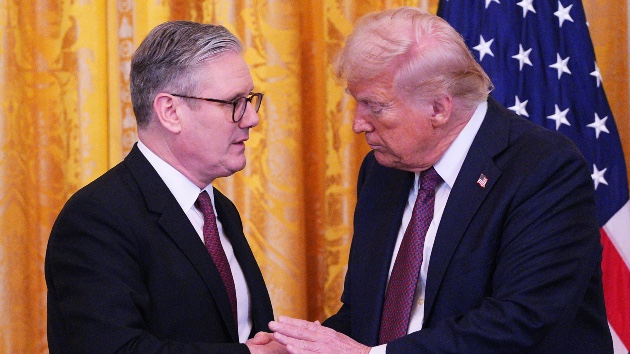
UK Prime Minister Keir Starmer and U.S. President Donald Trump shake hands at a joint press conference in the East Room at the White House on February 27, 2025 in Washington, DC (Photo by Carl Court – Pool/Getty Images)

(LONDON) — As Britain prepares for yet another prime ministerial change, a former holder of the office — Theresa May, who led the country from 2016 to 2019 — urged the country’s next leader to focus on shared U.S.-U.K. interests, rather than falling prey to potential personal or political clashes with President Donald Trump.

The U.K. Parliament is expected to anoint the Labour Party’s Andy Burnham as prime minister later this month. Burnham will become the seventh leader to take the reins of the country in 10 years, a reflection of the political and economic turbulence that has beset the country since the Brexit vote in 2016.

Burnham will replace current Prime Minister Keir Starmer, who last month said he would vacate his post following a collapse in support among Labour members of parliament, exacerbated by disastrous local election results in May. Starmer delivered Labour a historic majority in parliament in the 2024 general election, but saw his authority and approval rapidly deteriorate.

Like his predecessors, Burnham will need to juggle domestic discord while navigating a raft of foreign policy demands — among them the cultivation of the so-called “special relationship” between the U.K. and the U.S., which during President Donald Trump’s two terms in the White House has been subject to strategic, ideological and economic headwinds.

Trump has already described Burnham — who until recently was serving as the mayor of Greater Manchester — as “extremely liberal.” During Starmer’s time in office, the president has been scathing toward the prime minister’s policies in areas including energy, immigration, crime and foreign policy.
May, whose time in office overlapped with Trump’s first term, told ABC News last week that institutional transatlantic relationships and shared interests can help Starmer’s successors ease possible interpersonal tensions.

“Keir Starmer, actually, on the foreign policy field, by and large, played a good hand,” May told ABC News on the sidelines of the Chatham House think tank’s conference in London. The outgoing prime minister has been broadly praised for his deft handling of the transatlantic relationship, which included hosting a state visit for Trump to the U.K. in 2025.

Of the special relationship, May said, “We talk about it perhaps slightly more than the U.S. does. But that relationship is built on a whole set of different levels of relationships. So, it’s not just about the prime minister and the president. It’s also about our security relationships, our defense relationships … It’s not just about the two people at the top.”

The same is true of the U.K.’s own political issues, May said, as the nation prepares for the coronation of its next prime minister. “It’s not about individuals. Politics today generally across the globe has become more about individuals and personalities and I think that’s problematic,” she said.

“What matters to people is not the personality at the top. What matters to the people is what they’re doing, what their policies are,” May said.

The recent joint U.S.-Israeli war with Iran has again prompted Trump to strike out at America’s European allies, who refused to join the campaign in support of Washington though expressed willingness to aid security and minesweeping missions in the Strait of Hormuz once the conflict is over.

The U.K. was among the American allies who refusal to assist the U.S. against Iran “greatly disappointed me,” Trump said in March. Starmer’s response in particular, the president said, was “very disappointing.”

Asked whether the Iran war would prove to be a long-lasting blot on U.K.-U.S. relations, May said she was hesitant to comment as the conflict “is not finished.”

Still, she — like many other current and former European leaders — noted that European nations have previously shown their “commitment to the United States,” not least in rallying to the U.S. side after the 9/11 attacks; the only time in NATO history that an ally invoked the Article 5 collective defense clause.

When asked about Trump’s repeated suggestions that the U.S. should be less involved in European security, May replied, “There have been other times when there’s been more of that sense of isolationism,” specifically noting the later American entry into the Second World War in support of the U.K. and its allies.

“But I think, again, the interests that we have together are what combines us,” May said.

Copyright © 2026, ABC Audio. All rights reserved.

Darline Graham’s race in South Carolina is a test of Trump’s chutzpah

(CNN) — President Donald Trump’s endorsement has never looked as feeble as it has in the month of August 2026. Already six of his chosen candidates have been defeated.But Tuesday’s special primary runoff for US Senate in South Carolina is an especially big test of not just his endorsement and domination of his party, but also his chutzpah.That’s because Trump has put his reputation on the line like he rarely has before — even as his fortunes with his party have ebbed — and for seemingly relatively little upside.South Carolina’s voters will decide between Rep. Ralph Norman and the Trump-backed candidacy of appointed Sen. Darline Graham, the political neophyte sister of Sen. Lindsey Graham, who died last month.It’s difficult to say who has the edge, given the dearth of quality polling and the rapid turnaround from the first round of the primary just two weeks ago.But those results made it clear Graham was no shoo-in. She took 32.7% to Norman’s 24.6%, and there are plenty of signs the South Carolina GOP has been reluctant to accede to Trump’s advice. The president’s super PAC, MAGA Inc., has also now spent more than $800,000 — perhaps a sign of his political operation’s uncertainty.And if it doesn’t pay off, it will be a real unforced error for Trump.The situation looks somewhat accidental. After Lindsey Graham’s death, Trump recommended Darline Graham as the appointee to replace him, and Gov. Henry McMaster complied. That seemed relatively harmless; the seat, after all, was up for election in November.Darline Graham was widely expected to be a placeholder while a coterie of ambitious South Carolina Republicans tangled over a full term. But things suddenly shifted. Just three days after she was sworn in, Trump began talking her up as a candidate for a full term. And she soon said she would run.All of this despite Graham having been almost anonymous politically, until about a month and a half ago.There are a number of ways in which this was brazen.For one, by trying to anoint Graham, Trump effectively thumbed his nose at a bunch of South Carolina Republicans who have been waiting a long time for an open Senate seat. The last vacancy was also filled by an appointee who later ran for and won the seat, Sen. Tim Scott. Before then, the last vacancy was in 2004.It would be one thing for Trump to endorse in a crowded primary; it’s another to try to help someone leapfrog experienced politicians who have been building their brands for years.And that brings us to a related point: Trump is basically asking his voters just to trust him — and Graham.Because Graham has been such a political nonentity, she has almost no track record. Graham doesn’t even seem to have thought through her positions on some of the big issues, as evidenced by her recent remarks at a debate about whether Taiwan is a national security concern for the United States.So when it comes to what she believes in and would do, voters might reason it will be similar to what her brother did or what Trump wants, but how can they be sure? With someone like Norman, they can at least gauge him by what he’s done previously.What’s more, even those shortcuts might not accrue to Graham’s benefit.While there is surely some goodwill toward the sister of a senator who recently died, her brother was not a beloved figure in the South Carolina Republican Party. His past support for comprehensive immigration reform — some to his right labeled him “Grahamnesty” — haunted him over the years.He got less than 57% of the primary vote in June before his death, despite not facing a very formidable and well-known challenger. That was the lowest of any incumbent GOP senator running in a primary besides Texas’ John Cornyn and Louisiana’s Bill Cassidy, who both lost.And finally, it’s brazen from Trump because it seems somewhat pointless. It’s not clear what he gets out of the deal. It’s not like the seat is in serious jeopardy in the general election and Republicans need a strong candidate. And it’s not like whoever wins a South Carolina GOP primary wouldn’t be a pretty strong Trump ally.Trump also inserted himself in the process even as it was clear his fortunes with his party were waning somewhat.The president actually did this just a couple of weeks after his endorsed candidate for South Carolina governor, Lt. Gov. Pamela Evette, crashed and burned in the primary runoff. (Trump endorsed the other candidate, too, apparently to save himself too much embarrassment.) What better time to roll the dice again?A Graham loss would also be an especially big setback for the president because true Trump loyalists would seem to have a reason to reject Norman. After all, he initially endorsed former South Carolina Gov. Nikki Haley over Trump in the 2024 presidential primary. (Norman later backed Trump when Haley’s campaign fizzled)That kind of apostasy is usually all GOP voters need to vote against you. But imagine voters pick a non-Trump-endorser over a Trump-endorsed candidate.GOP voters also generally abide by Trump’s wishes in federal races — and especially Senate races. While a series of Trump-backed candidates for governor and other statewide office have lost primaries, only three Trump-endorsed Senate candidates have — and only one since 2018.That’s the potential rebuke Trump has set himself up for. And if it arrives, it will be the latest in a really curious succession of political moves.The-CNN-Wire™ & © 2026 Cable News Network, Inc., a Warner Bros. Discovery Company. All rights reserved.
Read Next Story