
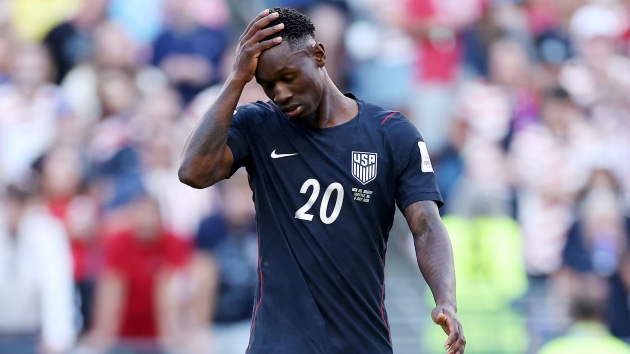
US eliminated from World Cup after 4-1 loss to Belgium, red card controversy

Folarin Balogun of the United States reacts after Belgium’s third goal by Hans Vanaken during their FIFA World Cup 2026 Round of 16 match, July 6, 2026 in Seattle, Washington. (Sarah Stier/Fifa via Getty Images)

(NEW YORK) — The United States’ run in the 2026 World Cup has come to a close after a 4-1 loss to Belgium on Monday.

The loss comes after the U.S. men’s national team’s star striker, Folarin Balogun, was deemed eligible to play in the match after his one-game suspension from a red card was put on hold by FIFA.

While the U.S. team expected a boost from Balogun’s presence on the pitch, it could not recover from a pair of goals in the first half from Belgium’s Charles De Ketelaere, despite a free kick goal from U.S. midfielder Malik Tillman that very briefly tied the game. Two more Belgian goals in the second half put victory out of reach for the Americans.

Belgium will go on to face Spain in the quarterfinals in Los Angeles on Friday.

Balogun was given a red card during the July 1 game against Bosnia-Herzegovina after the U.S. player clashed with an opposing player’s foot in the second half. The penalty automatically landed Balogun a one-game suspension. FIFA told ABC News at the time that the call was final and not able to be overturned or appealed.

FIFA said on Sunday that “the implementation of the match suspension is suspended for a probationary period of one year.”

The football governing body added that if Balogun “commits another infringement of a similar nature and gravity during the probationary period, the suspension shall be revoked and the sanction enforced without prejudice to any additional sanction imposed for the new infringement.”

Ahead of Monday night’s game, the U.S. men’s national team confirmed that Balogun will be in the starting lineup.

The Royal Belgium Football Association (RBFA) released a statement Sunday that said in part that it was “astonished” by FIFA’s decision to allow Balogun to play in Monday’s match against them.

“In order to safeguard the legitimate rights of all participating teams and to protect the fundamental principles of fair play in our sport, both at this FIFA World Cup and at future editions of the tournament, the RBFA is investigating all potential options,” the RBFA statement further said.

European soccer’s governing body, UEFA, said in a statement on Monday that a red card suspension is “a principle embedded in regulations, which cannot be made subject to exceptions, let alone in the middle of a tournament where several other players have been in the same situation and regularly served their suspension.”

“We express our disbelief at such an unprecedented, incomprehensible and unjustifiable decision,” UEFA said.

USMNT head coach Mauricio Pochettino told reporters after last week’s match, which the U.S. won 2-0, that Balogun was “sad” and “disappointed” about the call and that the clash was not intentional, according to ESPN.

The USMNT’s victory over Bosnia-Herzegovina was their first in the World Cup round of 32 since 2002 and only their second knockout round victory in program history.

The American men’s best result at the World Cup was a third-place finish at the inaugural tournament all the way in 1930.

The U.S. team had been impressive in the 2026 tournament, finishing the group stage with a 2-1 record, with wins over Paraguay and Australia before a loss to Turkey, which occurred once the team had already secured a spot in the next round.

ABC News’ Kelly McCarthy and Joe Simonetti contributed to this report.

Copyright © 2026, ABC Audio. All rights reserved.

Trump declines to rule out declaring a national security emergency to control the 2026 election

(CNN) — President Donald Trump in a new interview declined to rule out declaring a national security emergency as a means to try to assert more control over the 2026 midterm elections.It’s merely the latest warning sign that Trump could try to mess with the election not just by baselessly claiming voter fraud and challenging the results afterward — as he did in 2020, leading to a violent riot at the US Capitol — but by trying to unilaterally take control before votes are cast.In the interview, Wayne Allyn Root of Real America’s Voice pitched such a scenario to Trump. He suggested it as an alternative, given the Senate has failed to pass Trump’s coveted elections bill, known as the “SAVE America Act.”“If they never get the SAVE America Act done, you have the right to declare a national security emergency for elections,” Root said. He added that “if you declare a national security emergency as the president of the United States, they can’t challenge it. It can only be overturned by a two-thirds vote by both houses of Congress. So if you do this in the next month, we will get photo ID, proof of citizenship (for voter registration) and a limit to mail-in ballots.”It’s at this point that Trump cut Root off and coyly suggested such an option was indeed in play.“Let me just say that stranger things have happened, OK?” Trump said. “I’ll leave it at that.”Despite Root’s comments, it’s far from clear such a gambit would even work. And CNN has asked the White House for more detail on what the president meant.Trump often responds to hypotheticals by declining to rule them out — no matter how extreme the proposal might be. So it’s possible to read too much into this.But as CNN’s Jake Tapper has noted, there are plenty of signals that Trump at least aspires to try to exert more control over elections. And these methods often appear transparently geared toward helping Republicans.A major one is the administration’s threat to have the US Postal Service not deliver mail ballots for states that don’t comply with its demand that they hand over their voter lists. This is a request that even many red states have rejected, citing privacy concerns.Democrats are much more likely to use mail ballots, which Trump has baselessly connected to widespread fraud. So curtailing them could greatly help Republicans.(Federal courts have blocked this Trump executive order, and the administration recently appealed to the Supreme Court.)Trump has also gone to great lengths to try to substantiate his still-baseless claims of widespread fraud. That includes the administration seizing 2020 ballots in Fulton County, Georgia, and Trump’s recent primetime address about election security that some read as a statement of intent — a pretext for more direct federal involvement in elections, which are run by states.Ty Cobb, who served as White House counsel in Trump’s first term, said he interpreted the speech last month as a “predicate that he needs to declare an emergency.”And Trump has occasionally said things, like he did in the new interview, suggesting he would like to take control of US elections.Back in February, he urged his party to “take over the voting in at least 15 places,” adding: “The Republicans ought to nationalize the voting.”The Washington Post also reported in March that pro-Trump activists were circulating a potential executive order that claimed Chinese interference in the 2020 election gave Trump emergency authorities over the 2026 election. And Trump’s primetime address focused on China, despite the tenuous evidence.Trump’s intense focus on the “SAVE America Act,” which has never appeared to have a chance to pass but Trump has said is vital, could also be read as part of building the case for more drastic action.But whether Trump could take over elections himself, as Root posits, is far from certain.As CNN’s Marshall Cohen and Michael Williams reported in February, the Constitution makes it difficult for Trump to truly “nationalize” elections. Courts have overwhelmingly upheld the principle that states are in charge of elections.Presidents generally have more authority to act unilaterally when national security is involved — hence the significance of invoking China — but some experts are skeptical that Trump’s effort would pass legal muster.The-CNN-Wire™ & © 2026 Cable News Network, Inc., a Warner Bros. Discovery Company. All rights reserved.
Read Next Story