
Trump says Reflecting Pool has been drained for repairs

▶ Watch Video: Olympian David Hearn pleads not guilty to damaging Lincoln Memorial Reflecting Pool

Washington — President Trump said late Monday that the Lincoln Memorial Reflecting Pool was drained for repairs, after weeks of railing against alleged vandals.

“We drained the beautiful ‘Reflecting Pool’ today in order to fix the scars and damage that was done by the Vandals two weeks ago,” Mr. Trump wrote on Truth social.  

“The Parks Department had to empty the water in order to fix the water tight basin,” he said. “It will be refilled and put back into service soon.”  

The president launched an effort in April to renovate the Reflecting Pool as part of a slate of projects ahead of the nation’s 250th birthday. But the effort hit a series of snags earlier this summer, when algae turned the water a fluorescent green, before rips appeared in the new surface of the Reflecting Pool. 
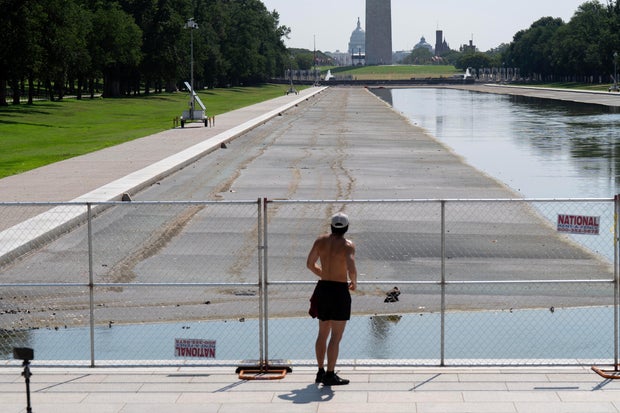
A person stops to look at the partially-drained Lincoln Memorial Reflecting Pool, Monday, July 13, 2026, in Washington.
A person stops to look at the partially-drained Lincoln Memorial Reflecting Pool, Monday, July 13, 2026, in Washington. 

Jose Luis Magana/AP

The National Park Service reported last month that the damage was caused by a sharp knife, after the president blamed the renovated project’s peeling surface on vandals. It was not clear what kind of evidence the National Park Service had.

Several people have been arrested for alleged vandalism related to the Reflecting Pool, and last week, U.S. Olympic canoeist David Hearn pleaded not guilty to charges after he was accused of ripping out a portion of the sealant from the bottom of the pool. Hearn said he stopped by the pool during a 64-mile bike ride and was arrested after reaching down into the pool. He has said he was just interested in the material and briefly touched it.

On Monday, Mr. Trump reiterated that the individuals allegedly responsible should “pay a big price for the damage done.”

The president said “slashes were 300 yards long, and the floor of the pool was cut and then pulled upward, with great force, by these thugs.” He said the administration “wanted to wait until after the July 4th Weekend” to make the repairs.

CBS News’ Ed O’Keefe asked the president in late June for evidence of his claims.

“Yeah, at the right time you’ll see it,” Mr. Trump said. “You’ll see it in court. You’ll see it in court, but all you have to do is call the Parks Department, call the Department of Interior.”

How Canada’s retaliation could hurt American businesses and consumers

(CNN) — Canada has a number of arrows in its quiver as it prepares to retaliate against the United States, and they could land hit American consumers and businesses.Already, Ottawa has vowed to match Washington’s latest tariffs dollar for dollar. But Canada also has other tools at its disposal, including restrictions on key exports to the United States.Here’s what Canada could do next — and what each move could mean for Americans.The first move: tariffsCanada’s first move in the brewing trade war is likely to be a straightforward eye-for-an-eye response.Retaliatory tariffs “will be concentrated in sectors such as steel, dairy, appliances, agricultural equipment, pulp and paper, and electronics,” Prime Minister Mark Carney said over the weekend, adding that more details would be shared “in the coming days.”With the exception of steel, all of those industries are also covered by President Donald Trump’s new tariffs. Canada is an important market for US exporters in those sectors: Last year, it ranked as either the largest or second-largest destination for American exports across most of those industries, according to US trade data.Carney also said Canada is considering tariffs aimed at industries Trump has already targeted with separate duties, including cars, steel, aluminum, lumber and copper.The risk for Americans here is that steep Canadian tariffs could weaken demand for these goods, which could force employers to cut workers’ hours or, in some cases, resort to layoffs.The bigger weaponsTrump already signaled he may go beyond the latest tariffs in his trade fight with Canada, threatening on Monday to double tariffs on Canadian cars and auto parts to 50% starting January 1.If Trump follows through — or escalates in other ways — Ottawa could use other ammunition.Canada could restrict key exports to the US, such as energy and a key fertilizer ingredient known as potash, said Diamond Isinger, a policy strategist and former special advisor on Canada-US relations to Prime Minister Justin Trudeau.Another vulnerable area is electricity. Ford said in an interview published Monday that Canada should be prepared to cut off electricity exports to the United States if the trade war worsens, putting a potentially powerful weapon on the table. Ontario supplies electricity to several US states, including New York, Michigan and Minnesota.Carney echoed Ford on Monday, telling reporters that “nothing is off the table.”Any such moves could add to the price pressures Americans have faced this year. Altogether the cost of living is up 3.4% from a year ago, according to July Consumer Price Index data. Gas prices, up almost 25% compared to last year, have weighed heavily on consumers’ finances. The cost of powering homes is also up, with electricity and piped gas both costing around 4% more annually.How badly will it hurt?Tariffs could make it harder for US companies to sell their goods in Canada.Restrictions on energy, electricity or critical minerals, something Ford also floated, could instead raise costs for American companies and consumers by making key inputs more expensive or harder to obtain.For instance, last year, Ontario briefly applied a 25% surcharge on electricity imports to the United States. The Ontario government estimated at the time that it would affect 1.5 million American homes, costing up to $400,000 CAD (around $280,000 USD) “every day the surcharge remains in place.”Restrictions on these key Canadian goods could quickly be felt by US businesses and consumers, making it harder to stay afloat, Isinger said.The-CNN-Wire™ & © 2026 Cable News Network, Inc., a Warner Bros. Discovery Company. All rights reserved.
Read Next Story