Trump says documents show voting vulnerabilities, China meddling and fraud

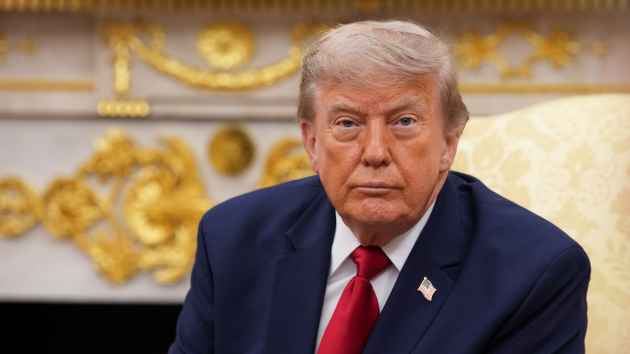
U.S. President Donald Trump looks on during a bilateral meeting with the Prime Minister of Iraq Ali al-Zaidi, in the Oval Office of the White House on July 14, 2026 in Washington, DC. (Photo by Andrew Harnik/Getty Images)

(WASHINGTON) — President Donald Trump, in a primetime address on Thursday, announced he has declassified a slew of documents he claims reveal vulnerabilities in America’s elections systems, election fraud and interference in elections by China, and ordered the Department of Justice to prosecute those believed to be involved.

“America is back and doing really well, but we still have a major challenge that must be urgently addressed because no country can be great without fair and honest elections, you have to trust your country,” Trump said. “Because if there can be no trust, there can be no greatness, and that’s very simple: no trust, no greatness.”

But throughout the more than 20-minute speech, the president did not provide specific evidence that the election outcome, or any votes, were altered in the 2020 election, despite his repeated claims that the election was “stolen” or “rigged.”

Trump has long pushed debunked conspiracy theories to claim that his 2020 election loss was fraudulent.

The president’s speech led to his main argument: he wants Congress to pass the SAVE America Act, his sweeping elections reform bill that Senate Majority Leader John Thune has repeatedly said does not have enough Republican votes to pass.  

In his remarks, the president said that he would immediately declassify the release of “critical intelligence, revealing shocking vulnerabilities in our election infrastructure.”

According to the president, the documents focus on what he said were a number of areas of concern, including claims that China “compromised” election data during the 2020 election, and attempts to downplay the extent of China’s efforts.

Trump argued that the intelligence community suppressed information about China accessing 220 million voter files and trying to turn American opinion against him in the run-up to the 2020 election.

The president also accused the “deep-state” of keeping information about election meddling from him.

Trump claimed that U.S. intelligence agencies learned that tens of millions of voters’ data in 18 states had been “bought, stolen, or hacked” by China, and that the intelligence community deliberately kept this information from him while he was president.

Trump’s remarks asserting that the Chinese undertook a far more ambitious role in attempting to dictate the outcome of the 2020 election goes beyond what U.S. intelligence community has previously assessed.

In March 2021, two months into the Biden administration, a declassified “Intelligence Community Assessment” (ICA)  that was produced at the end of Trump’s first term publicly acknowledged the belief among some intelligence officials that “China took at least some steps to undermine former President Trump’s reelection chances.” But the ICA said any such actions were “primarily through social media and official public statements and media,” not through interference with “election processes.”

Further, the ICA said that while China was “probably” trying “to gather information on U.S. voters and public opinion; political parties, candidates and their staffs; and senior government officials,” the more reliable intelligence indicated that such efforts were not actually intended to undermine Trump but instead to “predict electoral outcomes and to inform its efforts to influence US policy toward China under either election outcome.”

The heavily redacted documents released by the White House on Thursday do not appear to back up Trump’s assertions, instead containing scattershot intelligence that descries efforts to obtain — but not alter — voter records and to conduct social media activity to sow social discord.

One heavily-redacted document titled “200M Voter Records Compromised. repeatedly references personally identifiable information being compromised. This information includes names, phone numbers and addresses — which can also be found from many other sources.

In another series of near-completely redacted memos, words such as “state voter registration data” and “personal identifiable information” appear between large blocks of black redaction markings. It is impossible to surmise the meaning of these records without context, but they appear to point to some Chinese efforts to gather American voter data, much of which is publicly available.

Notably, these memos document Chinese activities ahead of both the 2020 and 2024 presidential elections.

Elsewhere in his remarks, Trump alleged that former Justice Department officials slow-walked an investigation in Michigan that involved the submission of voter registration applications that had forged signatures and other indications of fraudulent applications. Trump called on FBI Director Kash Patel to look into whether any charges can still be brought.

Local media at the time said that a state-level investigation was halted so the FBI could continue with a related investigation. It’s unclear why no federal charges were ever brought or if federal charges were warranted.

At the time, state officials said that the fact that the fraudulent applications were detected shows that the system worked.

The president also said the documents released Thursday include a Department of Homeland Security report he called “stunning,” alleging approximately 278,000 non-citizens were included on voter rolls.

In the documents released by the White House, the DHS report that alleged 250,000 noncitizen voters on the rolls came from a review of “public voter files” that appear to have come from four states: California, New Jersey, Pennsylvania and Nevada. DHS did not provide any methodology about how it reached that number, nor does it specify what “public voter files” it reviewed.

DHS acknowledged it did not have access to those states’ voter rolls, and alleges that in the 10 states that provided the federal government access to their rolls, the agency found 28,000 noncitizen voters.  

Findings from the conservative-leaning Heritage Foundation have found only around 100 verified instances of non-citizen voting going back two decades.

-ABC News’ Lucien Bruggeman and Mike Levine contributed to this report.

Copyright © 2026, ABC Audio. All rights reserved.
Iranian women defy efforts by hardliners to enforce wearing of hijab

(CNN) — A cultural fault line in Iran has re-emerged in recent months amid the turmoil of war and the revamping of the country’s hardline leadership: how and whether to enforce the wearing of the hijab by women.At the height of the conflict with the United States this year, women without the headscarf were often seen at pro-government gatherings and in state media. The government and internal security forces had bigger issues to deal with.In one video an unveiled woman carrying an Iranian flag said her husband was in the military, and that she was proud of him.But in recent weeks, the clamor for restoring a hard line on what conservative clerics and politicians call “public nudity” has grown.Many Iranian women are openly flouting the rule – and authorities seem wary of launching a crackdown, for now. The regime appears to have more pressing priorities – presenting the conflict with the United States as an existential struggle, managing the deep economic fall-out and reorganizing the security apparatus under the leadership of Mojtaba Khamenei.Still, state media have been highlighting stories about cafes and other businesses being forced to close for failing to enforce rules on clothing. A CNN tally of articles in Iranian media at the end of last month found examples in half a dozen cities, including Tehran.Four years ago, the protest movement “Woman Life Freedom” ignited after the death in police custody of Mahsa Amini, a young woman who had been detained on accusations she was improperly dressed. It was brutally suppressed.Amnesty International reported at the end of 2024 that the Iranian authorities were waging war on women and girls “through an increasingly violent crackdown on those defying draconian compulsory veiling laws.”But the protests had lasting consequences. Despite the drumbeat of warnings and sporadic enforcement, there is widespread defiance of official regulations, especially among young Iranian women.On July 19, at least seven cafes and restaurants in Tehran were closed down for not enforcing the mandatory hijab, according to human rights group HRANA. The group also compiled lists of social media accounts that have been blocked for defying public dress codes.HRANA said authorities were using vague concepts such as “violation of norms,” “violation of modesty” and “failure to observe Islamic decency” in pursuing alleged offenders. But in one instance this month, it said a boutique was closed “due to unveiling,” without giving further details.On Monday the Tehran Prosecutor’s office said it would take serious action against alleged “indecency” violations and offenses at certain cafes and restaurants in Tehran, as well as shops selling clothing deemed “unconventional” or inappropriate.In the South Khorasan Province in eastern Iran, 10 cafes have been closed over alleged violations of “social norms and mandatory hijab rules,” the Mehr news agency reported, citing the province’s chief prosecutor.The relentless state media campaign on the issue often cites prayer leaders who insist the hijab is part of Iranian cultural identity and that women should observe modesty.Mohammad Javad Haj Ali Akbari, who leads Friday prayers in Tehran, claimed there were organized efforts to promote “nudity” and that some people are paid to appear in public with “improper” dress.There have been some high-profile cases. In June a popular Iranian singer, Parastoo Ahmadi, together with eight members of her band and production team, were sentenced in Qom to 74 lashes and banned from leaving the country for two years. Ahmadi had appeared with bare shoulders and uncovered hair at an event that she livestreamed on her YouTube channel in 2024.The charges included “offending public decency through the production and publication of vulgar and immoral content on cyberspace platforms.”Hardliners are stepping up pressure on the authorities. The editor of the journal Kayhan, Hossein Shariatmadari, wrote that enforcement is both a legal obligation and a religious duty for officials.A television show – “Park Way” – produced for the Tehran Municipality has devoted several episodes to the issue of women’s dress, calling for action against those who flout approved dress codes. One said that “unconventional behaviors should not be exhibited by anyone in public places such as parks.”Women have also been mobilized to demand the hijab be worn. At a small rally in Isfahan this week, one placard read: “Netanyahu: Unveiled women are our soldiers for free.”Netanyahu is not on record as making that remark, but the slogan reflects a broader narrative promoted by Iranian hardliners, portraying women who do not wear the hijab as, at the very least, disloyal to their country.But there’s plenty of evidence that many Iranian women are not intimidated by official campaigns.Social media videos have popped up showing young women on scooters wearing helmets, but no headscarves. The government is yet to fulfil a promise that women will be issued licenses to ride motorbikes.The videos include convoys of young women on scooters riding through Tehran and other cities. One Instagram post features a group of women declaring: “We’re the motorcycle girls of Shiraz! Shiraz girls, let’s go!”Another Instagram account posted video of about 20 female motorcyclists in the central city of Isfahan, describing it as “the biggest female motorcycle event in Isfahan.”As with so many social and cultural issues in Iran, the wearing of the hijab seems to some a misplaced priority at a time of conflict and economic crisis.That appears to include President Masoud Pezeshkian. Referring to an interview with a conservative cleric, he said: “The cleric mentioned hijab… Well, there are neighborhoods, there are mosques – go and work on it there! Can you really change people’s behavior through laws?”Pezeshkian went on to say that his daughter sometimes disagreed with him.“Does it mean I should force her?!” he asked.“Changing behavior is a cultural matter; it’s about belief. You can’t create belief in people through force.”Former MP Gholamali Jafarzadeh Imanabadi argued officials should focus on inflation and livelihoods instead of the hijab.And an unofficial media outlet posted an article entitled: A Provocation to a War-Weary Public - What Is Behind the Return of Hijab Patrols and Business Closures?Iranian authorities first began urging women to wear the hijab after the 1979 revolution. Before that, the monarchy had promoted a more secular and westernized image of women.Article 638 of Iran’s Islamic Penal Code criminalizes women appearing in public without “Islamic hijab,” although it does not precisely define what that means. A much tougher law approved in 2024 would have introduced a broader system of escalating penalties and surveillance, but its implementation was halted following intervention by the Supreme National Security Council.This has antagonized hardliners. One member of Iran’s parliament, Mohammad-Taqi Naqdali, said this week: “We see what the state of nudity and public vice is like in our midst…Israel and America cannot destroy us, but this decay that has plagued our religious culture and is spreading nudity in a disastrous and widespread manner in society will.”But the regime is treading carefully – for now.“They still don’t dare say anything to people on the street. Girls in Tehran are out and about wearing crop tops, shorts, and all kinds of clothes, and headscarves are practically no longer a thing,” one Tehran woman in her 60s told CNN by phone.“I don’t think they can make these girls wear headscarves again. But then again, that’s also what we thought when the revolution happened. We never thought they would be able to force us to wear them, but in the end, they did.”The-CNN-Wire™ & © 2026 Cable News Network, Inc., a Warner Bros. Discovery Company. All rights reserved.
Read Next Story