
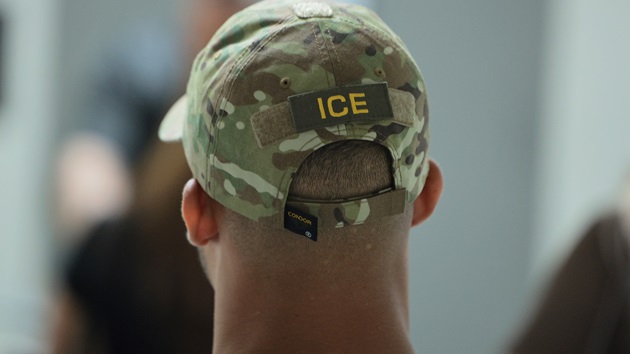
Trump overturns temporary pause on ICE traffic stops: Source

Immigration and Customs Enforcement agents patrol the halls of immigration court at the Jacob K. Javits Federal Building on June 24, 2026, in New York City. (Michael M. Santiago/Getty Images)

(WASHINGTON) — President Donald Trump has overturned the temporary pause on U.S. Immigration and Customs Enforcement traffic stops, according to a source familiar with the discussion, allowing the traffic stops to resume.

This comes after Homeland Security Secretary Markwayne Mullin gave the directive to halt the traffic stops, a law enforcement source told ABC News on Tuesday.

In an email sent to ICE deportation officers, a senior ICE official wrote that the vehicle stops were paused “immediately,” according to the email reviewed by ABC News.

“All personnel are instructed to prioritize other existing operational methods, outside of vehicle stops, to conduct immigration enforcement activities,” the official wrote.

Multiple sources said the pause was temporary and that ICE officers would receive new training on vehicle stops.

Additionally, one source said that ICE officers can conduct some vehicle stops during the pause but only in the presence of a local law enforcement officer trained to make vehicle stops that partners with ICE under the agency’s 287(g) program.

A Department of Homeland Security spokesperson told ABC News that the agency won’t “disclose or discuss law enforcement tactics,” but added that it’s “always evaluating our procedures to keep our officers safe and criminals off our streets.”

In an interview on Fox News, border czar Tom Homan confirmed the temporary pause and said DHS will review the past few incidents. 

“It is not a policy change, it is a temporary pause,” Homan said. “Look – last couple of shootings, ICE leadership along with DHS wants to look at these last couple incidents and look, is there something that could have been done better? Is there any training that could be improved? Or simply is ICE doing their job and bad things happen when people don’t comply with law enforcement officers? I think it going to be a short pause and I am confident that ICE is well trained in vehicle stops and you’re going to see us keep moving forward.”

On Monday, 26-year-old Joan Sebastian Guerrero was fatally shot by an ICE agent in Biddeford, Maine, after agents tried to stop the car he was driving, according to Sen. Angus King, I-Maine.

Guerrero, a Colombian national, was not the target of the operation and ICE agents had been given a final order for another man they were targeting to be removed from the U.S., King told ABC News.

An ICE spokesperson said that the agency was “conducting targeted surveillance on the last known address of an illegal alien with a final order of removal,” and when an “illegal alien departed the residence in a vehicle,” ICE agents “attempted to conduct a vehicle stop.”

“The vehicle attempted to flee the scene and fearing for public safety an officer discharged his weapon,” ICE said.

The Maine Attorney General’s Office said “the suspect attempted to flee in the vehicle in the direction of the officer and was fatally shot.”

Witness Daniel Boucher told ABC News that he watched agents pull the shooting victim from his car and put him on the ground.

“I heard the young man say, ‘I tried to stop.’ I clearly heard him say that,” said Boucher, adding that he overheard one of the ICE agents allegedly say the driver tried to run him over.

Copyright © 2026, ABC Audio. All rights reserved.

US Army attack helicopters crashing at historically high rate amid mechanical issues

(CNN) — The US Army’s Apache helicopters are crashing at a historically high rate amid a widespread problem with the model’s transmission, according to a CNN analysis of military accident data.The helicopter type has experienced five major crashes since October, and a deadly mishap earlier this month in Texas killed two soldiers, sparked a wildfire and led the Army to temporarily bar Apache pilots from conducting routine training flights. With that crash, fiscal year 2026 is on pace to be the second worst for Apache flight accidents since a new model of the AH-64 was rolled out in 2011.The Army announced that the pause in training flights, which exempted units deployed to the Middle East, ended Wednesday.This year’s rate of major Apache crashes — known as Class A mishaps in Army parlance, meant to represent any accident that kills or permanently disables a person or results in the loss of an aircraft or $2.5 million in damage — surpasses typical years and rivals that of the service’s most severe rate in the 2024 fiscal year, according to CNN’s review of data. The accident rate is based on the number of incidents compared to the total hours the aircraft spent flying, calculated using data that has been publicly released and flight hour estimates for the current year provided to CNN by the Army.In Fiscal year 2024 there were nine major Apache crashes amid a spike in accidents across all Army helicopter models. Army leaders ordered a special safety training initiative that year and attributed the accidents to human errors stemming from decreased experience among its pilots and an increase in training intensity and complexity after Russia’s invasion of Ukraine inspired a new focus on preparing for major conflicts.But the causes of this year’s spike are murkier. The July issue of an official Army flight safety newsletter said that just over half of this year’s Apache accidents, including more minor incidents, are primarily attributable to human error. It’s unclear how many of the most-severe crashes are due to equipment failures, but the magazine said that “a catastrophic transmission failure was noted in one Class A mishap.”CNN estimated this year’s major Apache crash rate to be approximately 6.24 per every 100,000 flying hours. Thus far in fiscal year 2026, five Class A flight mishaps involving the attack helicopter have occurred. The Apache, through August 15, had flown approximately 80,171 hours. That number combines 42,971 hours through March 31 that were listed in the internal Army safety newsletter and an estimate provided to CNN by an Army safety spokesperson that pilots had logged approximately 37,200 additional flight hours through August 15.Fiscal year 2024, by comparison, had a rate of 7.02 major crashes per 100,000 hours for the aircraft.The E-model Apache, introduced in 2011, has faced significant problems this year with its transmission that could knock out the aircraft’s tail rotor, electrical power and hydraulics, according to a pair of internal safety messages obtained by CNN. The loss of those systems can put a helicopter into a sudden spin and potentially knock out its flight controls. As of mid-July, the cause of the problems remained “under investigation,” according to a safety message released at the time.Army spokesperson Maj. Montrell Russell declined to answer questions regarding the transmission investigation or disclose any “preliminary findings” regarding the causes of this month’s deadly Texas crash at Fort Hood.“We express our deep sadness over the loss of the two Soldiers near Fort Hood,” Russell said in a statement to CNN.He said that “special controls and release protections” prevent the service from providing detailed “technical aviation information,” to include how many of this year’s crashes are related to the helicopters’ transmission.The initial April safety message, first reported by trade publication Defense One, identified 70 potentially faulty transmissions and ordered all units to stop flying affected Apaches pending repair. A follow-up message sent in mid-July said the root cause remains “under investigation” and added 10 more suspect transmissions to the no-fly list.The two safety messages combined to impact roughly a tenth of the Army’s attack helicopter fleet. In early June, an Army official told CNN that all affected Apaches remained grounded, and the Army did not answer CNN’s questions about how many, if any, have returned to flight since then.Meanwhile, the Apache’s transmission issues continue to be mentioned in Army flight documents. CNN obtained an August 14 internal Army order that formally cited the two transmission safety messages in its references for the service’s training flight pause after the Texas crash. Russell cautioned that “including these messages in safety reviews does not imply causation for any individual mishap.”The Apache’s manufacturer, Boeing, has deployed teams to Army maintenance depots to assist with inspecting and fixing the transmissions, according to the Army order.The Army and Boeing did not answer questions on how they identified the potentially faulty parts.A Boeing spokesperson confirmed to CNN that the company is “supporting the U.S. Army’s investigation to ensure the operational readiness and safety of any affected aircraft,” but referred additional questions to the Army.Davis Winkie’s work at CNN is supported by a partnership between Outrider Foundation and Journalism Funding Partners (JFP). CNN retains full editorial control of the reporting.The-CNN-Wire™ & © 2026 Cable News Network, Inc., a Warner Bros. Discovery Company. All rights reserved.
Read Next Story