
Trump overturns pause of ICE vehicle stops implemented after deadly shootings

▶ Watch Video: Federal officials suspend most vehicle stops during ICE operations after deadly shootings

President Trump overturned a suspension of U.S. Immigration and Customs Enforcement traffic stops that multiple law enforcement sources said had been implemented after fatal shootings in Texas and Maine over the last week.

ICE agents had been instructed to immediately suspend most vehicle stops during immigration enforcement operations nationwide, except in cases involving serious criminal targets.

In a Truth Social post Wednesday morning, however, Mr. Trump wrote that “we CANNOT give up one of I.C.E.’s most important and effective Crime Fighting tools, THE TRAFFIC STOP! Once we do, we are playing right into the criminal’s hands.” But he told ICE to “be judicious, fair and smart.” 

The White House confirmed to CBS News that the president’s Truth Social post was intended to overturn Tuesday’s memo from DHS temporarily suspending vehicle stops by ICE Enforcement and Removal Operations, or ERO.

Later Wednesday, ICE sources confirmed to CBS News the agency’s deportation officers can again make vehicle stops.

A law enforcement official and a DHS official said that ICE field offices issued verbal clarifications to personnel, and agents were told that traffic stops are “not off the table” and remain “a tool in the toolkit.”

DHS Secretary Markwayne Mullin wrote on X that he and the president are “on the same page.”

“We want our [ICE] officers to have all options available to keep them safe while executing our mission of deporting as many illegal alien criminals from our country as possible,” Mullin said.

While the DHS directive pausing vehicle stops applied to ICE ERO, the division responsible for civil immigration arrests and removals, it did not include Homeland Security Investigations, which primarily handles criminal investigations, according to sources with visibility on the memo. The directive was intended to be a temporary pause while Enforcement and Removal Operations officers received additional training on vehicle-stop tactics, the sources said.

“It’s not a policy change. It’s a temporary pause,” Trump administration border czar Tom Homan said later Tuesday on Fox News.

Homan said ICE leadership and DHS “want to look at these last couple of incidents. And look, is there something that could have been done better?” He added, “I’m confident that ICE is well trained in vehicle stops and you’re going to see us keep moving forward.”

Under the now-overturned directive, ERO officers were still permitted to conduct vehicle stops when working with partner law enforcement agencies to target criminal suspects with judicial warrants, sources said.

Vehicle stops have been a common tactic in ICE enforcement operations under the Trump administration, allowing officers to identify, follow and arrest targeted individuals away from homes or workplaces.

In the most recent incident, Johan Sebastián Durán Guerrero, 25, a Colombian national who was in the country illegally, was shot when he “attempted to flee the scene” Monday when ICE tried to stop him at around 7 a.m. ET in Biddeford, Maine, according to the Department of Homeland Security. “Fearing for public safety, an officer discharged his weapon,” DHS said in a statement.

While Durán Guerrero was not the target of the operation, ICE agents attempted to pull over the man’s car while “conducting targeted surveillance on the last known address of an illegal alien with a final order of removal,” DHS said.

Durán Guerrero’s father, Omar Duran, told CBS News partner Noticias Caracol that his son leaves behind a wife and 3-year-old daughter, adding that he had “left the country to build a future for his family.”

“I only ask God … that this be resolved in the best way, and that there be justice,” Duran said, translated from Spanish. 

Durán Guerrero had previously been given an order to leave the country, independent Maine Sen. Angus King said Monday. 

Speaking to CBS News on Tuesday, King called for an independent investigation.

“I want a full, fair, open, transparent investigation of this, not strictly run by the feds,” said King, an independent who caucuses with Democrats. “Unfortunately, the feds don’t have the credibility today. The people of Maine are not going to accept an investigation that’s run by ICE or at the FBI.”
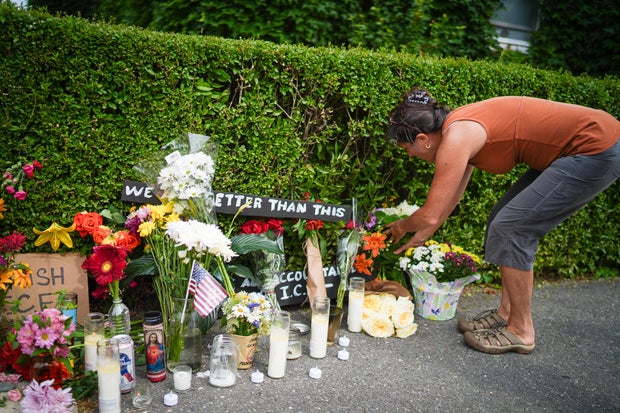
ICE Officers Fatally Shoot Undocumented Immigrant In Maine
A woman places flowers at a makeshift memorial for a man who was fatally shot by U.S. Immigration and Customs Enforcement agents, on July 14, 2026 in Biddeford, Maine.

Ryan Murphy/Getty Images

Maine Republican Sen. Susan Collins said she had urged Mullin to halt the vehicle stops.

“While the investigation of the Biddeford shooting is not yet complete, it raises sufficient critical questions that I spoke with DHS Secretary Mullin last night and urged him to cease all non-urgent vehicle stops,” Collins said in a statement.

Just six days earlier, a similar situation unfolded in Houston.

Mexican national Lorenzo Salgado Araujo was fatally shot by ICE officers who had pulled over his vehicle while looking for a different person, DHS confirmed last week.

“After receiving a credible tip from our law enforcement partners, our officers conducted surveillance on a target’s address. Weeks prior to the incident, they noted two white vans at the property,” DHS said. “On July 7, officers were almost at the target’s address when they observed a white van with an individual who resembled the target. Officers then initiated the vehicle stop.”

DHS initially said ICE officers were targeting Salgado Araujo because he was living in the country illegally. The department alleged he was shot after he ignored “multiple verbal commands” and attempted to ram an officer who fired his weapon in self-defense.

Salgado Araujo had no criminal record and was close to obtaining a work permit after living in the U.S. for more than three decades without legal status, his family has said.

In his remarks to CBS News, King criticized the Trump administration’s immigration enforcement tactics.

“It’s a tragedy for our country that we’re going through this process that’s based on a phony premise,” he said. “The whole premise of this has been [arresting] ‘the worst of the worst.’ How frequently have we heard that term? ‘We’re going after the worst of the worst. We’re going to take criminals off our streets.’ Well, in Maine last winter, they arrested over 200 people. Nineteen of them had criminal records. That means 90% of the people arrested had no criminal records.”


Críticas a Trump terminan en inusuales cargos penales contra un oficial de la Fuerza Aérea que pidió su destitución

Un militar de la Fuerza Aérea de Estados Unidos que fue arrestado dos veces, una de ellas en las escalinatas del Capitolio mientras pedía la destitución del presidente Donald Trump, fue acusado formalmente este lunes por sus comentarios, según un documento de acusación que su abogado compartió con CNN.El mayor Jason Watson enfrenta los siguientes cargos en virtud del Código Uniforme de Justicia Militar, según el documento: tres infracciones del Artículo 88 por presuntos comentarios “desdeñosos” sobre Trump, cinco infracciones del Artículo 92 por presuntamente desobedecer órdenes y dos infracciones del Artículo 133 por presunta conducta inapropiada de un oficial.Los inusuales cargos en virtud del Artículo 88 están relacionados con la entrevista que el oficial de la Fuerza Aérea concedió en junio al boletín de Substack Defenders of our Republic, su protesta uniformado el 1 de julio en el Capitolio de Estados Unidos y una entrevista con CNN del 17 de agosto.Participar uniformado en cualquier actividad abiertamente partidista, como una protesta política, o emplear “palabras desdeñosas” contra el presidente y otros altos funcionarios civiles puede considerarse una infracción del Código Uniforme de Justicia Militar. Muchas infracciones menores de estas normas se resuelven de manera informal, pero las de Watson tuvieron una repercusión pública inusualmente alta.Watson fue arrestado por primera vez en julio mientras protestaba uniformado en el Capitolio de Estados Unidos, y volvió a ser arrestado la semana pasada, apenas unos días después de criticar nuevamente a Trump durante una entrevista con CNN. Uno de sus abogados, Chris Mutimer, dijo a CNN que se ordenó que su cliente permanezca en “detención preventiva” —una medida análoga a la denegación de libertad bajo fianza en un tribunal civil— a la espera de que se emprendan acciones legales contra él.“(Trump) no solo es un fracaso como presidente, sino que está violando flagrantemente la Constitución, infringiendo la ley, involucrado en una corrupción desenfrenada y matando a estadounidenses”, dijo Watson a Erin Burnett, de CNN, durante la entrevista. “Y eso es inaceptable para mí”.En julio, el secretario de la Fuerza Aérea, Troy Meink, dijo en una publicación en redes sociales que esperaba que todos los miembros de la Fuerza Aérea “cumplan todas las leyes y políticas que rigen la conducta personal, la participación política y el uso del uniforme”.“Los estadounidenses depositan su confianza en nosotros”, dijo Meink. “No podemos ni vamos a poner en riesgo la confianza de la nación”.Los cargos contra Watson por desobedecer órdenes alegan que infringió las normas del Departamento de Defensa que prohíben a los militares pronunciarse a favor de causas partidistas; utilizó “indebidamente” su uniforme en una conferencia de prensa en el Capitolio; incumplió las normas sobre permisos al viajar a Washington; y se negó a vestir su uniforme para ir a trabajar la mañana posterior a su entrevista con CNN.Los fiscales de la Fuerza Aérea también alegaron que la protesta de Watson en el Capitolio y su entrevista con CNN constituyeron “conducta impropia de un oficial”.Mutimer, abogado de Watson, dijo a Erin Burnett, de CNN, en “OutFront” que habló con su cliente el lunes y que “básicamente está en aislamiento por su seguridad”.Mutimer dijo: “Él cree verdaderamente en todo lo relacionado con nuestra Constitución y en lo que representa, así como en el juramento que prestó, y sostiene que hizo esto para que otros no tuvieran que hacerlo y para transmitir ese mensaje a cualquiera que tenga miedo y se sienta solo”.La fundadora de la organización que convocó la protesta de julio, Jessica Denson, de Removal Coalition, dijo a CNN en ese momento que Watson era consciente de los riesgos de lo que estaba haciendo y que se había puesto en contacto con ellos por correo electrónico.“Comenzamos a conversar, nos tomamos muy en serio su deseo de manifestarse y pensamos en la mejor manera de hacer que su sacrificio valiera la pena”, dijo Denson.Los consejos de guerra que derivan en cargos por “desacato a funcionarios” son poco frecuentes: una revisión de CNN solo identificó dos condenas de este tipo desde que se promulgó el actual Código Uniforme de Justicia Militar en 1951. En 1965, un teniente del Ejército fue declarado culpable de este cargo después de participar en una protesta fuera de la base contra la guerra de Vietnam en El Paso, Texas. El teniente Henry Howe fue condenado a la expulsión del servicio —el equivalente a una baja deshonrosa para un oficial— y a un año en la prisión militar de Fort Leavenworth, Kansas. Finalmente, el secretario de Defensa Robert McNamara concedió la libertad condicional a Howe, poniendo fin a su condena.La condena más reciente en virtud del Artículo 88 se produjo en 2021, cuando el exteniente coronel del Cuerpo de Marines Stuart Scheller se declaró culpable de desacato a funcionarios y de otros cargos relacionados con una serie de videos que publicó en redes sociales en los que criticaba la gestión de la retirada de las fuerzas armadas estadounidenses de Afganistán por parte de la administración Biden. Scheller, quien estuvo recluido en una prisión militar durante un tiempo antes de su juicio, fue condenado a la pérdida de US$$ 5.000 de su sueldo y renunció al Cuerpo de Marines sin pensión como parte de un acuerdo de culpabilidad.Desde entonces, la administración Trump ha nombrado a Scheller asesor principal del subsecretario de Defensa para Personal y Preparación.Aún está por verse si el caso de Watson será remitido a juicio y si ese juicio se considerará un consejo de guerra especial o general. Los consejos de guerra especiales equivalen aproximadamente a juicios por delitos menores, mientras que los consejos de guerra generales son análogos a juicios por delitos graves y pueden imponer condenas más severas.La Fuerza Aérea no respondió de inmediato a una solicitud de comentarios enviada este lunes. En una declaración a CNN del 19 de agosto, un portavoz de la Fuerza Aérea dijo que Watson “se presume inocente” y que el Distrito de la Fuerza Aérea de Washington supervisará su juicio “si (su) caso es remitido a un consejo de guerra general”.Cpn información de Piper Hudspeth Blackburn, Carmen Conte Widman y Francesca Giuliani Hoffman, de CNNEl trabajo de Davis Winkie en CNN cuenta con el apoyo de una alianza entre Outrider Foundation y Journalism Funding Partners (JFP). CNN conserva el control editorial absoluto del informe.The-CNN-Wire™ & © 2026 Cable News Network, Inc., a Warner Bros. Discovery Company. All rights reserved.
Read Next Story