
Trump blames Minnesota governor, not Iran, for cyberattacks on the state’s water systems

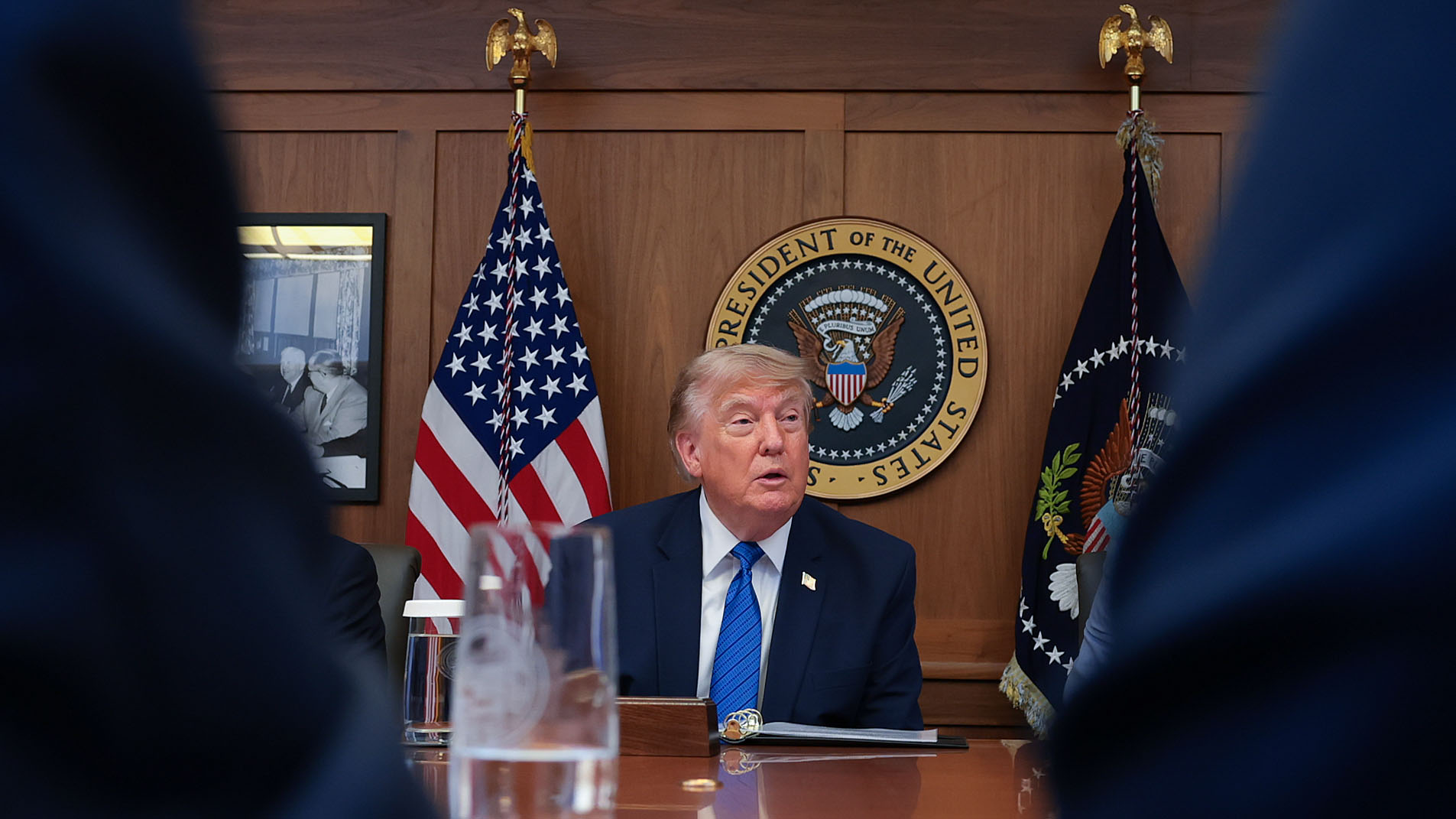
U.S. President Donald Trump at a Cabinet meeting at Camp David, the presidential retreat, on July 31, 2026 in Camp David, Maryland. (Photo by Anna Moneymaker/Getty Images)

(WASHINGTON) — President Donald Trump on Friday blamed Minnesota’s Democratic governor for cyberattacks on the state’s water systems even though U.S. officials previously told ABC News authorities are investigating whether Iran or hackers associated with the country could be behind them.

“We heard in Minnesota there was a cyberattack and they blame it on Iran. I don’t think so. I think, I blame it on Minnesota because they’re grossly incompetent,” Trump said a Cabinet meeting at Camp David.

Walz pushed back against Trump’s comments in statements on social media Friday.

“Trump knows exactly who is responsible for this attack, and knows that other states were hit too. This is what modern warfare looks like, and it further illustrates there’s no plan to win a war with Iran,” Walz wrote in a social media post.

The governor also noted federal cuts by the Department of Government Efficiency (DOGE) weakened cybersecurity.

“DOGE took an axe to CISA and left the U.S. exposed to cyber attacks. Thankfully, our experts in Minnesota were able to identify the vulnerability quickly and work with local communities to stop it,” Walz wrote.

More than 30 water systems in Minnesota were targeted in a cyberattack Sunday and Monday, according to Minnesota IT Services (MNIT).

MNIT said the attackers targeted systems to remotely monitor and control equipment, including the programmable logic controllers (PLCs), which are used for remote access.

The Cybersecurity and Infrastructure Security Agency (CISA) said in an alert Thursday that cyber threat actors are targeting PLCs and modifying passwords to “to lock out operators” from U.S. water systems.

MNIT said there are no active requests from Minnesota localities for residents to change their water use and that it is working with federal investigators in the probe. The agency said it has not determined who was responsible.

Minnesota Democratic Sen. Amy Klobuchar said in a statement Friday that she spoke with U.S. National Cyber Director Sean Cairncross about the attacks and said the director “confirmed that at this point there are no effects on services.”

“Director Cairncross and I discussed updated technology, recognizing that resources are an issue for so many communities, not just in Minnesota but across the country,” the senator wrote.

Klobuchar added that the FBI and Environmental Protection Agency have issued warnings to water utilities across the country about potential cyberattacks. 

Copyright © 2026, ABC Audio. All rights reserved.

New Colorado River plan will require steep cuts for three states as reservoirs tumble to new lows

(CNN) — California, Arizona and Nevada will be required to slash their water use from the drought-stricken Colorado River by 16 to 20% through 2028, under a federal plan set to be released in the next few days, according to a senior state water official.But some fear it won’t be enough to save the lifeblood water basin as vital reservoirs plummet toward record lows.The cuts will mark the latest stage of a long-running effort to figure out how seven basin states should share the depleted water of the Colorado River. They’re coming after years of fraught negotiations between the states have not managed to produce a deal, as the river system spirals further into crisis.On Friday, the US Bureau of Reclamation published its final environmental impact statement, a 10-year operating framework for the waterway under which the lower basin states of California, Arizona and Nevada could face collective cuts of up to 3 million acre feet per year — enough water to supply roughly 9 million average US families.🥵 Get your heat forecast in the CNN Weather app“This framework provides the flexibility to respond to changing hydrologic conditions while preserving the opportunity for the Basin States to continue working toward durable, consensus-based solutions,” said Secretary of the Interior Doug Burgum in a statement Friday.The framework provides for specific operating plans to be developed every two years. Federal officials are expected to publish the first of these in the coming days, which will specify the exact cuts required of states through 2028 — anticipated to be around 20% for the lower basin. The upper basin states of Colorado, New Mexico, Utah and Wyoming are not expected to face mandatory cuts.The Colorado River is the lifeblood of the Southwest. It irrigates more than 5 million acres of farmland, generates enough electricity to power around 700,000 homes and provides water for 40 million people. However, it has shrunk dramatically over the past 25 years after years of heavy use and as climate change delivers hotter, drier weather and dwindling snow. Today, 95% of the basin is in drought.The combined water level in Lake Powell and Lake Mead — the most important Colorado River reservoirs and two of the biggest in the United States — fell to a historic low last week.Colorado River water is divided between states under the 1922 Colorado River compact, which allots 7.5 million acre-feet of water yearly for the four upper basin states and another 7.5 million for the three in the lower basin. But as water levels dwindle, states have been trying to work out how to get by with less.The lower basin states have historically used the most water, primarily to support their vast farms and booming cities. Over the past few years, the three states have proposed cuts in their water use but want the upper basin states to share in the pain.The upper basin states — which, unlike the lower basin states, cannot be compelled by federal authorities to cut their water use — have resisted mandatory cuts, arguing that climate change has reduced water availability and the cuts should be shouldered by the more water-intensive states.The current agreement governing the operation and management of the Colorado River, which came into force in 2007, expires this year and a February federal deadline for the states to reach a new agreement came and went with no deal.Experts fear the current plan won’t be enough as the water crisis deepens. Last winter was one of the driest, warmest winters on record for the western US, leaving the region in a snow drought.Lake Mead appears on track to tumble to its lowest level on record as early as next week, and Lake Powell may do so next month. Lake Powell could potentially fall so low by spring 2027 that it reaches “minimum power pool” level, meaning its dam will no longer be able to generate hydropower, according to a July report from the Bureau of Reclamation.There are fears that the issue may end up the subject of lengthy and expensive court battles. Arizona in particular has been rattling the litigation saber. The state is likely to get saddled with the steepest cuts during times of shortage due to a deal it made in the 1960s, but its needs are huge to feed sprawling farms and industry.The new framework “does nothing to elevate expectations around a coherent seven-state plan for shared sacrifice,” the Arizona Department of Water Resources said in a statement Friday, saying the reductions proposed “would devastate Arizona’s water users and its economy.”States will still be able to carry on negotiations in the meantime, and any agreement could supplant the federal plan.The-CNN-Wire™ & © 2026 Cable News Network, Inc., a Warner Bros. Discovery Company. All rights reserved.
Read Next Story