
Startup company reveals prototype of tsunami survival pod

▶ Watch Video: Designers develop survival pod for range of weather-related disasters

A French startup company has unveiled a prototype for a survival device that it says can save people from tsunamis and severe flooding. 

The prototype was revealed at a technology conference in Paris earlier this month. The company, Lifepods, says it believes the device will help save lives minutes before disaster strikes, when evacuation is no longer a safe option. 

LifePods CEO Cedric Choffat said emotional images of the aftermath of the world’s deadliest tsunamis, such as in the Indian Ocean in 2004 and off the coast of Japan in 2011, prompted him to consider how a purpose-built survival capsule could work. Even as better forecasting and preparedness have led to fewer fatalities from tsunamis and floods over time, extreme weather events like the historic central Texas floods in 2025 have still wreaked destruction. So how could he help save lives? 

“That question became the starting point of LifePods,” Choffat told CBS News. 

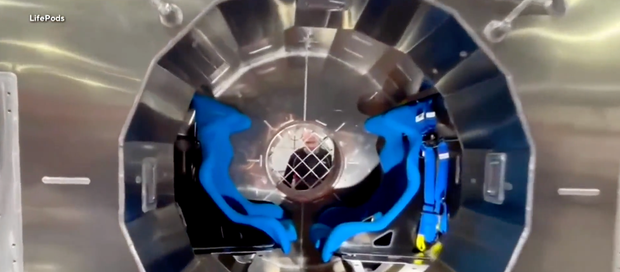
That led to the creation of the W-01. The device is essentially a floating fortress, with enough room for up to four adults and four children to fit inside, albeit snugly. The capsule is equipped with harnesses and can broadcast an emergency distress signal until rescuers arrive. There is room under seats for essential supplies like food, water and medicines. A GPS tracker can be installed to ensure rescuers can find the pod. 
screenshot-2026-07-09-at-9-21-23-am.png
The interior of a LifePod prototype.

CBS Chicago / LifePod

There isn’t room within the capsule to do much but sit and wait. The device is meant to be used short-term, as a last-chance refuge. Unlike traditional bunkers, which are fixed in place, Choffat described the floating capsule as “rapidly deployable,” including by air, and easy to install at scale in high-risk areas.

W-01 relies on what Choffat refers to as a passive hydrodynamic design, in which the capsule’s buoyancy and shape carry it through the water rather than mechanical motors or steering systems. The device is made from a marine-grade double-aluminum shell separated by a foam core. Its makers say this creates a rigid structure that distributes the force of a potential impact throughout the capsule rather than concentrating it in a single spot, protecting the inhabitants from massive floating debris like cars, trees and building materials, which is one of the biggest dangers during flood events. 

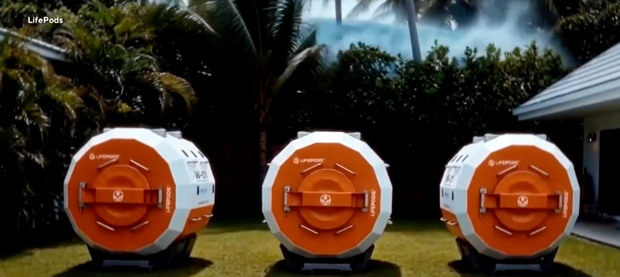
However, the W-01 has yet to undergo real-life testing, which LifePods describes as a process that would start with harbor trials to verify buoyancy under different payloads, move to towing tests at sea to assess how the capsule would cope with waves, and then progress to more demanding conditions. The company did release a dramatic AI-generated video showing how the product could work. 
screenshot-2026-07-09-at-9-20-44-am.png
An AI image of LifePods as a tsunami approaches. 

LifePod / CBS Chicago

The product is expected to become commercially available next year, LifePods says. It will likely have a price tag of $45,000 per pod. Choffat said government agencies, civil protection organizations, and private security companies have shown interest in the device, suggesting the target consumer is institutional rather than individiual. In the U.S., discussions are “still at an early stage,” he said. 

“We believe the market has tremendous potential due to the increasing number of hurricanes, floods, and coastal storm surges affecting many states each year,” said Choffat. 

LifePods isn’t breaking into a flooded market, but it does have a competitor – Seattle-based Survival Capsule LLC.  Their patented spherical pod is already on sale, and for much cheaper, costing $13,500, or less than a third of the expected price of the W-01. 

LifePods is also designing mobile land-based survival pods, including one that can withstand earthquakes and building collapses, and another for protection against armed attack and explosions.
screenshot-2026-07-09-at-9-20-18-am.png
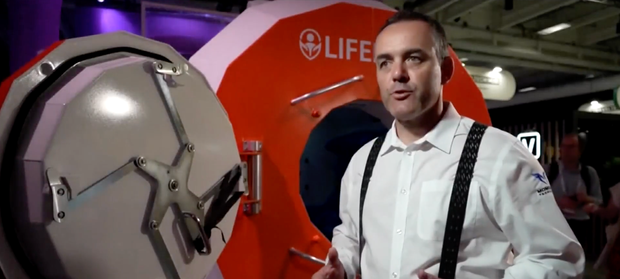
LifePod CEO Cedric Choffat stands in front of a device prototype at a conference in Paris. 

CBS Chicago

Darline Graham’s race in South Carolina is a test of Trump’s chutzpah

(CNN) — President Donald Trump’s endorsement has never looked as feeble as it has in the month of August 2026. Already six of his chosen candidates have been defeated.But Tuesday’s special primary runoff for US Senate in South Carolina is an especially big test of not just his endorsement and domination of his party, but also his chutzpah.That’s because Trump has put his reputation on the line like he rarely has before — even as his fortunes with his party have ebbed — and for seemingly relatively little upside.South Carolina’s voters will decide between Rep. Ralph Norman and the Trump-backed candidacy of appointed Sen. Darline Graham, the political neophyte sister of Sen. Lindsey Graham, who died last month.It’s difficult to say who has the edge, given the dearth of quality polling and the rapid turnaround from the first round of the primary just two weeks ago.But those results made it clear Graham was no shoo-in. She took 32.7% to Norman’s 24.6%, and there are plenty of signs the South Carolina GOP has been reluctant to accede to Trump’s advice. The president’s super PAC, MAGA Inc., has also now spent more than $800,000 — perhaps a sign of his political operation’s uncertainty.And if it doesn’t pay off, it will be a real unforced error for Trump.The situation looks somewhat accidental. After Lindsey Graham’s death, Trump recommended Darline Graham as the appointee to replace him, and Gov. Henry McMaster complied. That seemed relatively harmless; the seat, after all, was up for election in November.Darline Graham was widely expected to be a placeholder while a coterie of ambitious South Carolina Republicans tangled over a full term. But things suddenly shifted. Just three days after she was sworn in, Trump began talking her up as a candidate for a full term. And she soon said she would run.All of this despite Graham having been almost anonymous politically, until about a month and a half ago.There are a number of ways in which this was brazen.For one, by trying to anoint Graham, Trump effectively thumbed his nose at a bunch of South Carolina Republicans who have been waiting a long time for an open Senate seat. The last vacancy was also filled by an appointee who later ran for and won the seat, Sen. Tim Scott. Before then, the last vacancy was in 2004.It would be one thing for Trump to endorse in a crowded primary; it’s another to try to help someone leapfrog experienced politicians who have been building their brands for years.And that brings us to a related point: Trump is basically asking his voters just to trust him — and Graham.Because Graham has been such a political nonentity, she has almost no track record. Graham doesn’t even seem to have thought through her positions on some of the big issues, as evidenced by her recent remarks at a debate about whether Taiwan is a national security concern for the United States.So when it comes to what she believes in and would do, voters might reason it will be similar to what her brother did or what Trump wants, but how can they be sure? With someone like Norman, they can at least gauge him by what he’s done previously.What’s more, even those shortcuts might not accrue to Graham’s benefit.While there is surely some goodwill toward the sister of a senator who recently died, her brother was not a beloved figure in the South Carolina Republican Party. His past support for comprehensive immigration reform — some to his right labeled him “Grahamnesty” — haunted him over the years.He got less than 57% of the primary vote in June before his death, despite not facing a very formidable and well-known challenger. That was the lowest of any incumbent GOP senator running in a primary besides Texas’ John Cornyn and Louisiana’s Bill Cassidy, who both lost.And finally, it’s brazen from Trump because it seems somewhat pointless. It’s not clear what he gets out of the deal. It’s not like the seat is in serious jeopardy in the general election and Republicans need a strong candidate. And it’s not like whoever wins a South Carolina GOP primary wouldn’t be a pretty strong Trump ally.Trump also inserted himself in the process even as it was clear his fortunes with his party were waning somewhat.The president actually did this just a couple of weeks after his endorsed candidate for South Carolina governor, Lt. Gov. Pamela Evette, crashed and burned in the primary runoff. (Trump endorsed the other candidate, too, apparently to save himself too much embarrassment.) What better time to roll the dice again?A Graham loss would also be an especially big setback for the president because true Trump loyalists would seem to have a reason to reject Norman. After all, he initially endorsed former South Carolina Gov. Nikki Haley over Trump in the 2024 presidential primary. (Norman later backed Trump when Haley’s campaign fizzled)That kind of apostasy is usually all GOP voters need to vote against you. But imagine voters pick a non-Trump-endorser over a Trump-endorsed candidate.GOP voters also generally abide by Trump’s wishes in federal races — and especially Senate races. While a series of Trump-backed candidates for governor and other statewide office have lost primaries, only three Trump-endorsed Senate candidates have — and only one since 2018.That’s the potential rebuke Trump has set himself up for. And if it arrives, it will be the latest in a really curious succession of political moves.The-CNN-Wire™ & © 2026 Cable News Network, Inc., a Warner Bros. Discovery Company. All rights reserved.
Read Next Story