▶ Watch Video: Shania Twain on “Little Miss Twain”
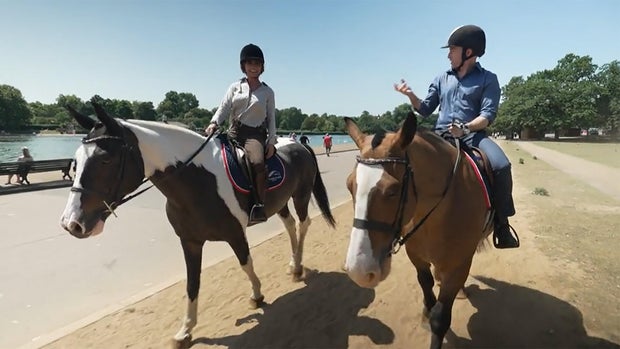
She can command a stadium crowd, but spend some time with Shania Twain and you’ll see she may be most herself with the horses. “I just love being with them,” she said. “I ride in my pajamas in the mornings! … It’s just a great escape.”
CBS News
It sounds a little like how she sees music, that other passion, which made her the top-selling female country artist of all time. Sometimes she’ll blend the two, taking her horses on tour, which she admits takes some planning.
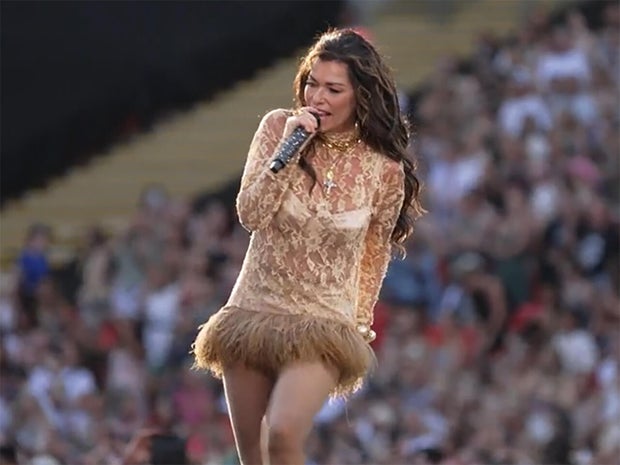
We joined her for a ride in Hyde Park on a down day between performances at London’s Wembley Stadium, where we’d just seen her electrify the audience. She’d gotten an invite from Harry Styles to join him as his special guest for 12 nights at Wembley in June.
CBS News
Watching her perform, it’s hard to imagine that Twain has suffered from stage fright. “The amount of people is not necessarily what affected me over the years with stage fright,” she said. “It was starting so young in bars that were, you know, I was eight years old, and the bars were smoky, and everyone was intoxicated. I don’t know what I’m actually singing about, because I’m singing about divorce, and I’m eight.”
Twain grew up poor in rural Ontario, Canada, but her mom recognized riches and potential in her voice, and would ferry her to bars to sing. As a minor, Twain was only allowed on stage after last call. “This was just an uncomfortable place to be as a child, and I carried that with me,” she said. “And only in my 50s, I finally just said, Whoa. I’ve got my voice. I have an audience. I have everything to just celebrate. And the fear just dropped away.”
She reminisces about all of this in her new album, “Little Miss Twain,” out later this month.
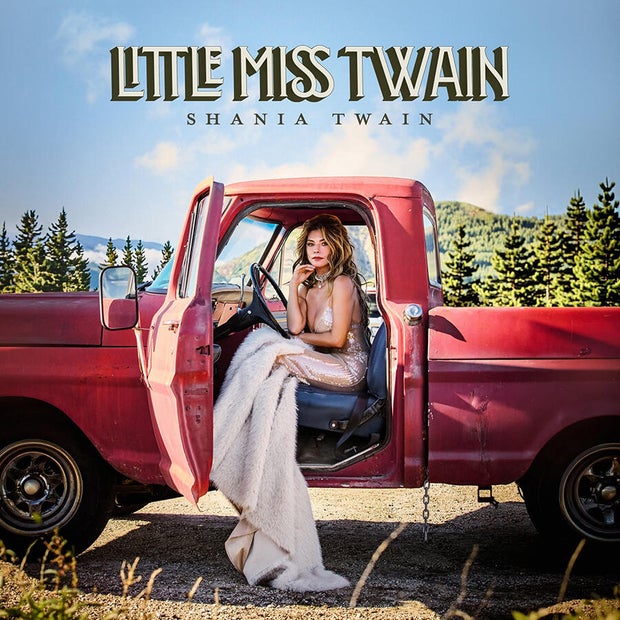
Republic Records/UMG
“‘Little Miss Twain’ is me, now, looking back at my child’s self and the journey that child went through, from starting out in those bars at eight years old, right up to when I got my recording contract in Nashville,” she said. “I didn’t get a contract until I was in my late 20s. My first Top 10 record, I was 30 already. So, there’s all of these years that were me making a living with singing in bars as a cover singer, collecting all of the songwriting that would end up becoming the Shania Twain records.”
She was “Eileen Twain,” until someone at her record label suggested she change her name. This new album reflects the process of going from being Eileen to being Shania. “It’s the bridge,” she said.
As Shania, she’d become the star her mother dreamed of.
To hear Shania Twain perform “Little Miss Twain,” click on the video player below:
According to my mother, I’m the next Tanya Tucker
She drives me to sing in the bar
Push start the Chevy, it’s old and it’s heavy
And I’m still smaller than my guitar
Smoking like a chimney, coachin’ it in me
“Honey, you’re gonna go far”
According to my mother, I’m the next Tanya Tucker
I’m gonna be a star
Yeah, I’m gonna be a star
“When I was younger, I was so over-responsible for the household,” said Twain. “My mother was depressed a lot of the time. She spent a lot of her days in bed. She lived off coffee and cigarettes that I would bring her in bed just to see if she was still alive. There was a lot of violence in the house. And we didn’t eat well a lot of the times. We weren’t clothed properly a lot of the time. …
“When I reflect back on those times, I’m reflecting on them from where I am now, which is a very good place. Like, I made it out of there. It’s like, Whoa, I’m just celebrating all of that. And what makes me feel so accomplished, is staying connected to where I came from. It’s the contrast that makes it feel so good.”
Her parents would never see her success; they died in a car crash when she was 22, and Twain became guardian of her younger siblings. Challenges came later as well: divorce from her record producer-husband, Mutt Lange, who collaborated on many of her hits. Then, the loss of her voice due to Lyme disease. She did not release any music for 15 years.
She had experimental open throat surgery to bring her voice back. “Once I made a sound, it was just there,” she said. “I feel lucky. I don’t want to make it sound easy! It wasn’t easy, it was a very long road, but I just feel very grateful and very lucky that I have it back.”
Her voice is different: “I have more, like, of a fry to my voice, you know, a little gravel. I don’t mind that. I’ve embraced it. It’s now part of my sound.”
Asked how she changes her sound mid-career, she laughed: “I know, tell me about it! How does one do that? You just adapt. I’ve taken a different approach to singing my older songs. In fact, I’ve found new placements in my voice that I enjoy, you know, that I didn’t have before.
“I love to experiment. I think it’s the same with any art form. You have to experiment a little bit to get just the right – whatever’s satisfying you the most at that time, you know?” she said.
Asked what the itch was that she scratched with her latest album, she replied, “This album was indulging in reflection of my life with a smile.”
CBS News
Twain remarried, to Frédéric Thiébaud, and lives in Switzerland. Looking back, she is remarkably forgiving of her parents. It’s all part of what’s allowing her to celebrate her past.
“I started life out a little bit on the tough side,” she said. “In my 60s now, I feel like I’ve really gotten it, or I’m just now getting all of that right.”
Asked what it is about her 60s that enabled her to “get” it right, Twain replied, “You know what it is? It’s called time. I’d love to have been able to get it right in my 50s, but I just – that wasn’t enough time. I needed to be in my 60s to start getting it right, you know? And that’s fine. I plan to live to be 200 anyway!”
Sounds like a good song! “That does, doesn’t it?” she laughed. “I better live to be 200, to get everything in that I want to get in.”
WEB EXCLUSIVE: Watch an extended interview with Shania Twain (Video)
Extended interview: Shania Twain
26:24
For more info:
- “Little Miss Twain” is available for pre-order, will be released July 24
- shaniatwain.com
- Thanks to Hyde Park Stables, London
Story produced by Mikaela Bufano. Editor: Steven Tyler.
See also:
- From 2017: Shania Twain on finding her voice again (“Sunday Morning”)