
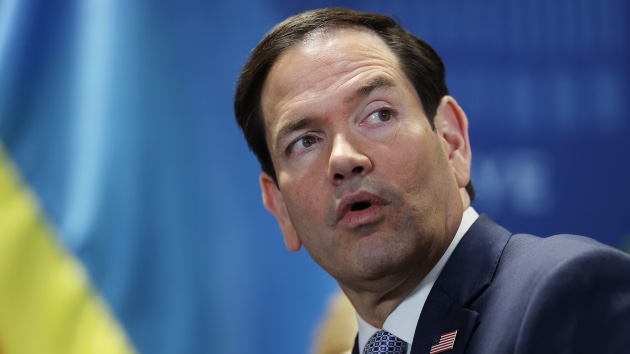
Rubio expands plans for high-level meeting focused on ‘far-left terrorism’

Marco Rubio, Secretary of State looks on as U.S. President Donald Trump meets with Volodymyr Zelenskyy, President of Ukraine for bilateral talks at Bestepe Presidential Compound during the NATO Summit, July 8, 2026 in Ankara, Turkey. (Win McNamee/Getty Images)

(WASHINGTON) — Secretary of State Marco Rubio is preparing to host delegations from more than 70 countries this week for a gathering focused on addressing what the Trump administration describes as the overlooked threat posed by “the resurgence of transnational far-left terrorism,” according to a State Department official and internal documents reviewed exclusively by ABC News.

“For too long this threat has remained a blind spot in the international community’s counterterrorism focus, underestimated and under-resourced, despite the danger it poses,” a note shared with foreign governments describing the concept of the meeting reads.

It goes on to assert that law enforcement and counterterrorism experts have revealed a “clear trend” of “globally networked, politically-motivated terrorists — particularly far-left terrorists” increasingly turning to “organized, deadly violence to advance their political objectives.”

The meeting, which will take place in Washington on Thursday, will lay the foundation for “coordinated action” to counter international organizations that are “seeking to implement an extreme political vision through intimidation and coordinated campaigns of terror,” the document states.

Representatives from roughly 60 countries were initially expected to attend, but the State Department said in a post to X on Friday it would expand the ministerial due to “overwhelming interest” by inviting additional countries “working to combat the growing international threat of far-left violence.”

A State Department official said more than 10 additional invitations had been extended.

Some critics of the Trump administration’s counterterrorism approach have claimed its focus on threats from the far left is misguided.

Analysis conducted by the Center for Strategic and International Studies (CSIS) in 2025 found that while left-wing violence in the U.S. has increased over the past decade, “it has risen from very low levels and remains much lower than historical levels of violence carried out by right-wing and jihadist attackers.”

The CSIS report concluded it was “important to resource all dimensions of the terrorism threat.”

“Left-wing terrorism is a Trump administration priority, but jihadist terrorism also remains a concern even though it has declined,” it states. “Right-wing terrorism could come roaring back, especially if in 2028 there are complaints of a ‘stolen election’ or similar incendiary claims.”

The ACLU has also taken issue with multiple actions taken by the Trump administration’s counterterrorism approach, accusing it of targeting politically opposed but peaceful activists and donors “under the guise of addressing political violence and domestic terrorism.”

Copyright © 2026, ABC Audio. All rights reserved.

Darline Graham’s race in South Carolina is a test of Trump’s chutzpah

(CNN) — President Donald Trump’s endorsement has never looked as feeble as it has in the month of August 2026. Already six of his chosen candidates have been defeated.But Tuesday’s special primary runoff for US Senate in South Carolina is an especially big test of not just his endorsement and domination of his party, but also his chutzpah.That’s because Trump has put his reputation on the line like he rarely has before — even as his fortunes with his party have ebbed — and for seemingly relatively little upside.South Carolina’s voters will decide between Rep. Ralph Norman and the Trump-backed candidacy of appointed Sen. Darline Graham, the political neophyte sister of Sen. Lindsey Graham, who died last month.It’s difficult to say who has the edge, given the dearth of quality polling and the rapid turnaround from the first round of the primary just two weeks ago.But those results made it clear Graham was no shoo-in. She took 32.7% to Norman’s 24.6%, and there are plenty of signs the South Carolina GOP has been reluctant to accede to Trump’s advice. The president’s super PAC, MAGA Inc., has also now spent more than $800,000 — perhaps a sign of his political operation’s uncertainty.And if it doesn’t pay off, it will be a real unforced error for Trump.The situation looks somewhat accidental. After Lindsey Graham’s death, Trump recommended Darline Graham as the appointee to replace him, and Gov. Henry McMaster complied. That seemed relatively harmless; the seat, after all, was up for election in November.Darline Graham was widely expected to be a placeholder while a coterie of ambitious South Carolina Republicans tangled over a full term. But things suddenly shifted. Just three days after she was sworn in, Trump began talking her up as a candidate for a full term. And she soon said she would run.All of this despite Graham having been almost anonymous politically, until about a month and a half ago.There are a number of ways in which this was brazen.For one, by trying to anoint Graham, Trump effectively thumbed his nose at a bunch of South Carolina Republicans who have been waiting a long time for an open Senate seat. The last vacancy was also filled by an appointee who later ran for and won the seat, Sen. Tim Scott. Before then, the last vacancy was in 2004.It would be one thing for Trump to endorse in a crowded primary; it’s another to try to help someone leapfrog experienced politicians who have been building their brands for years.And that brings us to a related point: Trump is basically asking his voters just to trust him — and Graham.Because Graham has been such a political nonentity, she has almost no track record. Graham doesn’t even seem to have thought through her positions on some of the big issues, as evidenced by her recent remarks at a debate about whether Taiwan is a national security concern for the United States.So when it comes to what she believes in and would do, voters might reason it will be similar to what her brother did or what Trump wants, but how can they be sure? With someone like Norman, they can at least gauge him by what he’s done previously.What’s more, even those shortcuts might not accrue to Graham’s benefit.While there is surely some goodwill toward the sister of a senator who recently died, her brother was not a beloved figure in the South Carolina Republican Party. His past support for comprehensive immigration reform — some to his right labeled him “Grahamnesty” — haunted him over the years.He got less than 57% of the primary vote in June before his death, despite not facing a very formidable and well-known challenger. That was the lowest of any incumbent GOP senator running in a primary besides Texas’ John Cornyn and Louisiana’s Bill Cassidy, who both lost.And finally, it’s brazen from Trump because it seems somewhat pointless. It’s not clear what he gets out of the deal. It’s not like the seat is in serious jeopardy in the general election and Republicans need a strong candidate. And it’s not like whoever wins a South Carolina GOP primary wouldn’t be a pretty strong Trump ally.Trump also inserted himself in the process even as it was clear his fortunes with his party were waning somewhat.The president actually did this just a couple of weeks after his endorsed candidate for South Carolina governor, Lt. Gov. Pamela Evette, crashed and burned in the primary runoff. (Trump endorsed the other candidate, too, apparently to save himself too much embarrassment.) What better time to roll the dice again?A Graham loss would also be an especially big setback for the president because true Trump loyalists would seem to have a reason to reject Norman. After all, he initially endorsed former South Carolina Gov. Nikki Haley over Trump in the 2024 presidential primary. (Norman later backed Trump when Haley’s campaign fizzled)That kind of apostasy is usually all GOP voters need to vote against you. But imagine voters pick a non-Trump-endorser over a Trump-endorsed candidate.GOP voters also generally abide by Trump’s wishes in federal races — and especially Senate races. While a series of Trump-backed candidates for governor and other statewide office have lost primaries, only three Trump-endorsed Senate candidates have — and only one since 2018.That’s the potential rebuke Trump has set himself up for. And if it arrives, it will be the latest in a really curious succession of political moves.The-CNN-Wire™ & © 2026 Cable News Network, Inc., a Warner Bros. Discovery Company. All rights reserved.
Read Next Story