
Reclaiming the lost art of listening to music

▶ Watch Video: Reclaiming the lost art of listening to music

Seattle’s Shibuya HiFi is a listening bar. While guests can chat and sip cocktails in the lounge, they leave behind their drinks, and their shoes, as they settle into the back room to enjoy full-length albums in a communal setting. An evening might feature anything from Bjork to David Bowie.

seattle-listening-bar-a.jpg
David Bowie fans enjoy the album “The Rise and Fall of Ziggy Stardust and the Spiders from Mars” at the Shibuya HiFi listening bar in Seattle. 

CBS News

One fan, who showed us her Bowie tattoo, said, “I had to be here! It’s the closest thing I could get to a David Bowie concert.”

These curated sessions (Shibuya hosts around 80 a month) regularly sell out. People are buying $20 tickets to listen to albums they could hear at home for free.

“That seems to me to be something that people are really rediscovering: that pleasure and the beauty of focus and intentional listening,” said Quentin Ertel, the co-owner of Shibuya HiFi, which takes its name from a neighborhood in Tokyo. In Japan, listening bars (often called jazz kissas) started gaining popularity back in the 1930s.

But similar venues have exploded in the U.S. in recent years, popping up everywhere from Minnesota (like noma hifi in Edina), to Missouri (XO HiFi in Kansas City), to Colorado (ESP HiFi in Denver).

esp-hifi-in-denver-1280.jpg
ESP HiFi in Denver is a “records only” listening bar.  

ESP

A “new wave” of listening bars

Artist and engineer Devon Turnbull describes these spaces devoted to listening as a “new wave” of listening bars. Turnbull designs high-end, handmade audio equipment for his company Ojas. While his speakers often end up in private living rooms, he’s also created larger public listening spaces.

Smithsonian’s Cooper Hewitt Museum, in New York City, is currently showcasing what Turnbull has called his “HiFi Pursuit Listening Room Dream No. 3,” installed in what was once Andrew Carnegie’s private library.

“Pursuit is a really important part of the title,” said Turnbull. “I am not here to say that I have made the ultimate sound system. This is about my pursuit as a builder, as someone who’s passionate about building audio equipment and listening to music through it.”
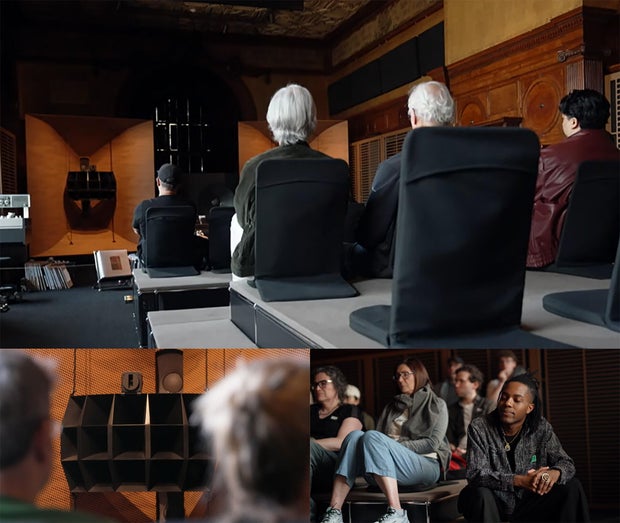
cooper-hewitt-listening-room.jpg
Devon Turnbull’s installation, “HiFi Pursuit Listening Room Dream No. 3,” at the Smithsonian’s Cooper Hewitt Museum in New York City. The exhibit features rotating playlists of jazz, classical, ambient sounds and other genres. 

CBS News

Turnbull works out of a warehouse in Brooklyn’s Navy Yard. His interest in all things audio traces back to an early age: “My mom always told me that I used to just crawl to the living room and just sit in-between the speakers.”

The shift to digital music – first mp3s, and later streaming – meant that people suddenly had access to millions of songs they could listen to everywhere. But what was gained in quantity was lost in quality.

“I realized I was really, like, losing touch with the way of listening to music that was moving emotionally for me,” said Turnbull.

So, Turnbull immersed himself in DIY audio culture, spending time in Japan, sourcing old parts, and building custom equipment as he develops his craft. “I see it as a folk art, making the kinds of things that I love making,” he said.

In his speaker-building workshops, Turnbull has attempted to get younger listeners thinking more about all aspects of sound. When designing a listening room, it can be just as much about ensuring the quality of the experience as it is about the quality of the sound. “As much as the way it looks is important, just the smell and the light and everything – the comfort of the seat – that all contributes to the experience,” he said.

This can all feel very low-tech and old-fashioned – people sitting around listening to records. But for attendees of “HiFi Pursuit Listening Room Dream No. 3,” like Brandon Stalling, that’s the point.

“To sit and be quiet, it’s a lost form, it’s a lost art,” said Stalling. “To have a space to sit and just wonder and be in your own thoughts and be able to sit quietly and just let the music kind of take you on that ride, I think that’s the type of journey that needs to happen a lot more.”

A space devoted to listening, whether it’s in a museum or a bar, is also a chance to sample a sound system that might otherwise cost tens of thousands of dollars to own. Turnbull has already started thinking about what installation “HiFi Pursuit Listening Room Dream No. 4” might look like.

“I just love making this stuff, you know?” he said. “When my hearing is gone and my hands are shaky, I’ll still be messing around with circuits and speaker enclosures. I just love the process.”
turntable-a-1280.jpg

CBS News

     
For more info:

     
Story produced by Wonbo Woo. Editor: Jennifer Falk.

US Army attack helicopters crashing at historically high rate amid mechanical issues

(CNN) — The US Army’s Apache helicopters are crashing at a historically high rate amid a widespread problem with the model’s transmission, according to a CNN analysis of military accident data.The helicopter type has experienced five major crashes since October, and a deadly mishap earlier this month in Texas killed two soldiers, sparked a wildfire and led the Army to temporarily bar Apache pilots from conducting routine training flights. With that crash, fiscal year 2026 is on pace to be the second worst for Apache flight accidents since a new model of the AH-64 was rolled out in 2011.The Army announced that the pause in training flights, which exempted units deployed to the Middle East, ended Wednesday.This year’s rate of major Apache crashes — known as Class A mishaps in Army parlance, meant to represent any accident that kills or permanently disables a person or results in the loss of an aircraft or $2.5 million in damage — surpasses typical years and rivals that of the service’s most severe rate in the 2024 fiscal year, according to CNN’s review of data. The accident rate is based on the number of incidents compared to the total hours the aircraft spent flying, calculated using data that has been publicly released and flight hour estimates for the current year provided to CNN by the Army.In Fiscal year 2024 there were nine major Apache crashes amid a spike in accidents across all Army helicopter models. Army leaders ordered a special safety training initiative that year and attributed the accidents to human errors stemming from decreased experience among its pilots and an increase in training intensity and complexity after Russia’s invasion of Ukraine inspired a new focus on preparing for major conflicts.But the causes of this year’s spike are murkier. The July issue of an official Army flight safety newsletter said that just over half of this year’s Apache accidents, including more minor incidents, are primarily attributable to human error. It’s unclear how many of the most-severe crashes are due to equipment failures, but the magazine said that “a catastrophic transmission failure was noted in one Class A mishap.”CNN estimated this year’s major Apache crash rate to be approximately 6.24 per every 100,000 flying hours. Thus far in fiscal year 2026, five Class A flight mishaps involving the attack helicopter have occurred. The Apache, through August 15, had flown approximately 80,171 hours. That number combines 42,971 hours through March 31 that were listed in the internal Army safety newsletter and an estimate provided to CNN by an Army safety spokesperson that pilots had logged approximately 37,200 additional flight hours through August 15.Fiscal year 2024, by comparison, had a rate of 7.02 major crashes per 100,000 hours for the aircraft.The E-model Apache, introduced in 2011, has faced significant problems this year with its transmission that could knock out the aircraft’s tail rotor, electrical power and hydraulics, according to a pair of internal safety messages obtained by CNN. The loss of those systems can put a helicopter into a sudden spin and potentially knock out its flight controls. As of mid-July, the cause of the problems remained “under investigation,” according to a safety message released at the time.Army spokesperson Maj. Montrell Russell declined to answer questions regarding the transmission investigation or disclose any “preliminary findings” regarding the causes of this month’s deadly Texas crash at Fort Hood.“We express our deep sadness over the loss of the two Soldiers near Fort Hood,” Russell said in a statement to CNN.He said that “special controls and release protections” prevent the service from providing detailed “technical aviation information,” to include how many of this year’s crashes are related to the helicopters’ transmission.The initial April safety message, first reported by trade publication Defense One, identified 70 potentially faulty transmissions and ordered all units to stop flying affected Apaches pending repair. A follow-up message sent in mid-July said the root cause remains “under investigation” and added 10 more suspect transmissions to the no-fly list.The two safety messages combined to impact roughly a tenth of the Army’s attack helicopter fleet. In early June, an Army official told CNN that all affected Apaches remained grounded, and the Army did not answer CNN’s questions about how many, if any, have returned to flight since then.Meanwhile, the Apache’s transmission issues continue to be mentioned in Army flight documents. CNN obtained an August 14 internal Army order that formally cited the two transmission safety messages in its references for the service’s training flight pause after the Texas crash. Russell cautioned that “including these messages in safety reviews does not imply causation for any individual mishap.”The Apache’s manufacturer, Boeing, has deployed teams to Army maintenance depots to assist with inspecting and fixing the transmissions, according to the Army order.The Army and Boeing did not answer questions on how they identified the potentially faulty parts.A Boeing spokesperson confirmed to CNN that the company is “supporting the U.S. Army’s investigation to ensure the operational readiness and safety of any affected aircraft,” but referred additional questions to the Army.Davis Winkie’s work at CNN is supported by a partnership between Outrider Foundation and Journalism Funding Partners (JFP). CNN retains full editorial control of the reporting.The-CNN-Wire™ & © 2026 Cable News Network, Inc., a Warner Bros. Discovery Company. All rights reserved.
Read Next Story