
‘Pretty dire’: Aid workers reveal health needs in Venezuela amid recovery from earthquakes

Adi, 38, has been struggling to access health services for her daughter Camila, 10, who was injured a few months ago, due to the high cost and limited services. (Mauro Jose Medina Garcia/The International Rescue Committee)

(NEW YORK) — As Venezuela continues to recover from powerful twin earthquakes that rocked the north-central part of the country in late June, humanitarian organizations are warning of a “dire” situation on the ground.

The earthquakes, which officials say killed more than 4,400 people and injured more than 16,000, have displaced thousands of Venezuelans.

Aid workers told ABC News that countless people are in need of psychosocial support, in addition to those recovering from earthquake injuries.

Many Venezuelans are also suffering from chronic conditions — such as diabetes and hypertension — and are struggling to get care in the aftermath of the natural disaster.

Additionally, there has been a rise in reports of skin conditions and gastrointestinal diseases due to a lack of clean water and poor sanitation conditions, the workers said.

“The situation on the ground is pretty dire in terms of humanitarian needs,” Aisha Majid, a media manager at the international NGO Save the Children who is currently based in Caracas, told ABC News. “I’ve been here for a week, and there are thousands of families who are displaced on the streets.”

Mobile clinics treating wide range of conditions

Aid workers told ABC News that hospitals in Venezuela are currently overwhelmed treating people injured by the earthquakes, adding that some of the backlog predates the earthquakes.

“There are thousands of patients seeking help, and there aren’t enough doctors or hospitals or primary healthcare facilities,” Claudia Manresa, a regional compliance legal manager for the humanitarian organization Project HOPE in Latin America who is based in Venezuela, told ABC News. “There also aren’t enough medications, so this crisis joins a system that was already overwhelmed.”

Mobile clinics have been helping to fill some of the gaps. Manresa said Project HOPE has two mobile medical units running every day and, as of July 9, they have treated about 2,000 patients.

Save the Children is running a mobile clinic treating both patients with earthquake-related injuries, as well as other health needs including infections and chronic conditions. Majid said the organization is hoping to set up several mobile clinics across the capital of Caracas and the city of La Guaira, which was hit hard by the earthquakes.

Majid recalled that she visited a mobile clinic earlier in the month that Save the Children ran on the northeastern outskirts of Caracas through a local partner, which treated about 150 patients in around four hours.

“The second the clinic opened, there was a queue of people waiting to receive services, which just tells you how much in need people are, and the doctors in the clinic were working nonstop all day, just seeing patient after patient,” she said.

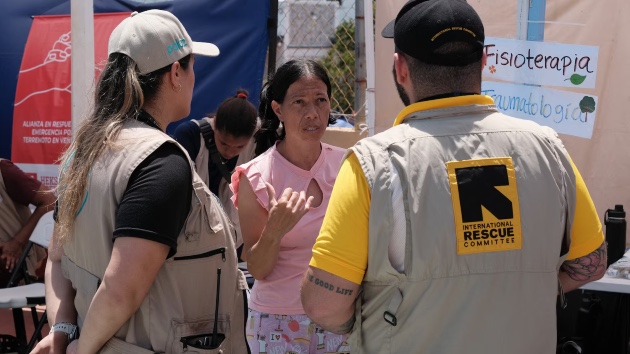
Everardo Esquivel, associate director for communications for the International Rescue Committee (IRC), told ABC News that many healthcare facilities were damaged in the earthquakes. As a result, he said people lost access to primary care and follow-up care.

Thirty-eight hospitals were damaged by the earthquakes, with the main referral hospital in La Guaira exceeding capacity within one day, according to the IRC.

The IRC’s mobile medical unit has been trying to help manage the increase in patient care, providing medicine for those with chronic conditions, including hypertension and diabetes, as well as antibiotics for certain conditions, he said.

Esquivel explained that there’s been a rise in skin conditions and diarrheal diseases due to the lack of clean water in the aftermath of the earthquake. Many shelters have virtually no access to toilets or showers, he said.

“People don’t have access to clean water and to properly clean wounds every day, so they get infections,” he said. “So, it’s two cases [at the mobile clinics]: it’s people with chronic diseases or in need of regular treatment and people who got new diseases related to the situation after the earthquakes.”

Need for psychosocial support

Humanitarian workers told ABC News there are also mental health issues that may arise after the earthquakes.

The World Health Organization said almost all people affected by emergencies experience psychological distress, which generally improves over time, but a fraction of people will go on to develop mental health conditions.

Manresa said Project HOPE is providing what aid workers refer to as psychological first aid, with a psychologist team deployed in La Guaira, offering different activities for kids and for adults.

She said the organization also has several phone lines that people can contact if they need help.

Children are particularly vulnerable. After a disaster, they may develop mental health symptoms including anxiety, depression and post-traumatic stress disorder (PTSD), according to the Centers for Disease Control and Prevention (CDC).

A 2017 review of eight studies of children following natural disasters found that 4% to 23% experienced chronic symptoms, with persistently elevated PTSD over time.

Majid, with Save the Children, said she’s met several children who are experiencing trauma after the earthquake.

Majid recalled meeting an 11-year-old boy who told her he’s scared when he sees cracks in the ground because he thinks it means the Earth will open again. She noted that another boy told her he’s scared to use the bathroom nearby because there is a crack in it.

“What we’re seeing is that there is a huge need for psychological support for children, and this is something that we provide through safe spaces that we run in affected areas,” Majid said. “And this is a place where children can come, they can play for a while.”

She noted that the organization has psychologists and specialists in mental health working with the young people there.

“It’s so important that children not only have a place where they can play but a place where they can also safely express their emotions and find a way to connect with the trauma and the grief that so many of them have been through,” she said.

Copyright © 2026, ABC Audio. All rights reserved.

Russia and Ukraine have stepped up their aerial war. Civilians are paying the price

(CNN) — The front lines of Russia’s invasion of Ukraine are largely stagnant. But in the skies, the war is ratcheting up.Each sides’ offensive capabilities now appear to be outstripping their air defenses, analysts say. That means more strikes are hitting their targets, more critical and economic infrastructure is being damaged, and more civilians are killed each week.“We definitely see an increased number of (attack) events, an increased number of casualties as well,” said Olha Polishchuk, the Eastern Europe research manager at ACLED, a global conflict monitor. “There has been an escalation also with regard to the variety of targets that are hit.”Ukraine has long been able to hit areas of Russia that are thousands of miles away from the front line, but the sophistication of its drone technologies has increased rapidly in the last year. In late June, Ukrainian President Volodymyr Zelensky announced a 40-day campaign to ramp up drone strikes deep into Russian territory – a push that his top adviser has said will continue.“That is a significant issue for Russia, because obviously the past 40 days have demonstrated that they have a serious weakness when it comes to interception, and Ukraine has been able to reach their targets quite successfully,” said Natia Seskuria, a senior research fellow at the Royal United Services Institute, a UK-based security think tank.Rather than occasional long-range strikes on Russian oil refineries, Ukraine is now carrying out frequent attacks on refineries, oil tankers, power substations and broader energy infrastructure, according to ACLED’s Polishchuk. Kyiv has also increased aerial attacks aimed at disrupting Russian military logistics in the occupied eastern areas.The analysts also noted an increase in attacks targeting the Russian economy more broadly, such as strikes on the warehouses of Russia’s largest online retailer, Wildberries. The Ukrainian government has said the facilities are legitimate military targets because the company supplies Russia’s frontline troops.Kyiv also recently broke through Russian defenses in St. Petersburg and has repeatedly hit Moscow.It appears to be an effort to bring the war home to everyday Russian people and to place more pressure on the business elite, who may have some sway with the Kremlin, to push for an end to the full-scale invasion.In addition, Seskuria said, Ukraine’s long-range strike campaign has a “pragmatic aim to slow down Russia’s summer offensive, in terms of stretching Russia’s resources towards intercepting the drone attacks.”Earlier in the conflict, Russia concentrated its air defense systems at the border with Ukraine and along the front line, Ukrainian military sources previously told CNN. But Kyiv’s strategy has been to target many different locations inside occupied areas of eastern Ukraine and Russia, forcing the Russian military to spread its air defense systems into a more threadbare tapestry.Recent attacks have also exposed how Russia’s air defense systems were not designed to combat drones, but rather to shoot down conventional military aircraft and missiles, analysts previously told CNN. Video captured in June showed Russian soldiers scrambling to respond to one attack by firing off man portable air defense systems (MANPADS) on a busy highway.Ukrainian forces have also slammed Russian-occupied Crimea, with ACLED recording a significant uptick in June of strikes targeting the peninsula’s power and transportation infrastructure.But the increase in air strikes goes both ways.“We’ve seen all of those strikes that Ukraine conducts also mirrored in Ukraine,” Polishchuk said. “So, after the attacks on Wildberries, for example, now a lot of warehouses in Ukraine belonging to the Rozetka electronic store have been targeted.”Meanwhile, on the front line, ACLED recorded a decline in armed clashes in recent months. Russia continues to push forward and capture some small settlements, but overall movement “has been very, very slow,” Polishchuk said.Civilian death toll mountingThe escalation in the air war has led to even more civilian casualties.In June, the United Nations recorded the highest number of civilians in Ukraine killed and injured in a single month since 2022. In Ukraine, at least 1,396 civilians were killed and 7,978 wounded in the first half of this year – a 37% increase compared to the same time period in 2025. The vast majority of those civilian casualties occurred in areas of Ukrainian government control, according to the UN, but some were recorded in Russian-occupied areas.The Russian foreign ministry has said that at least 797 Russian civilians have been killed so far this year. CNN and international monitoring groups are unable to independently verify that figure.Russia’s nightly assaults on Ukraine well exceed the number of attacks it is experiencing at home. Last month, Moscow launched a daily average of 172 strikes on Ukraine, compared to 28 on average launched by Kyiv.And for months, Russia has increased the number of drones, cruise missiles and ballistic missiles it fires in each attack wave, a strategy intended to overwhelm Ukrainian air defenses.Those mass aerial attacks are in addition to small drone attacks targeting civilians in cities close to the front line, who have previously described feeling like victims of a “drone safari” carried out by Russian troops. Russia denies targeting civilians.In July, Russia fired 139 ballistic missiles into Ukraine, more than in any other month this year, according to analysis by the Center for Strategic and International Studies (CSIS). Ballistic missiles are particularly difficult to defend against because they move at a speed and altitude that requires US-made Patriot interceptor missiles, which are both expensive and in short supply.Earlier this week, at least 17 people were killed in Kyiv and surrounding areas as Russia fired more than two dozen ballistic missiles and anti-ship missiles – none of which were shot down.Zelensky has repeatedly appealed to allies for more Patriot interceptors, but the war with Iran has complicated that effort, having diminished stockpiles of US-made weapons. Ukrainian hopes were buoyed when US President Donald Trump promised at last month’s NATO summit to allow Ukraine to manufacture Patriot interceptors on its own soil. But Trump later walked that back.Window for diplomacy?Beyond the Patriot interceptors, some observers have noted that both the United States and Ukraine’s allies in Europe could be doing more to bolster the country’s position, and to enable talks that finally end the four-and-a-half-year war.The US had allocated more than $130 billion (115 billion euros) in support to Ukraine before February 2025, according to the Kiel Institute, a think tank based in Germany. But Congress has not passed any new major financial or military aid packages for Ukraine during the second Trump administration.Ukraine does appear to have some momentum right now, and it’s plausible that some negotiation could happen at a time when Kyiv is in a more confident position, Polishchuk said. “But from what we’ve seen so far, it has been so ineffective to try to negotiate with Russia.”She said it’s more likely that Russian President Vladimir Putin’s war calculation would only change based on internal pressure in Russia, which could increase as its economy suffers.RUSI’s Seskuria also said she doesn’t see a strong window for diplomacy right now.“The problem is that (Putin) no longer has the leverage that he had back in the days when he started negotiating with the United States, and the United States back then had a more favorable position towards Russia,” she told CNN, adding that it would currently be hard for the Kremlin to portray an end to the war as any great victory.“I think the other option is escalation, which is probably more likely.”CNN’s Alex Leeds Matthews and Anna Chernova contributed to this report.The-CNN-Wire™ & © 2026 Cable News Network, Inc., a Warner Bros. Discovery Company. All rights reserved.
Read Next Story