Mysterious ‘golden orb’ found in deep sea in 2023 is finally identified

▶ Watch Video: A dive to the deepest parts of all five oceans

Scientists have solved the mystery of a “golden orb” found thousands of feet underwater by researchers from the National Oceanic and Atmospheric Association in 2023, the agency said on Wednesday

The orb was found in the Gulf of Alaska, by a remotely operated underwater vehicle. The device was over two miles underwater when it spotted a “strange, golden, mound-shaped object with a hole in it, stuck to a rock,” NOAA said. It was collected and sent to the Smithsonian National Museum of Natural History for study. 

Allen Collins, the director of NOAA Fisheries’ National Systematics Laboratory and a zoologist, said that he thought “routine processes” would allow scientists to identify the object. But the orb proved trickier. 
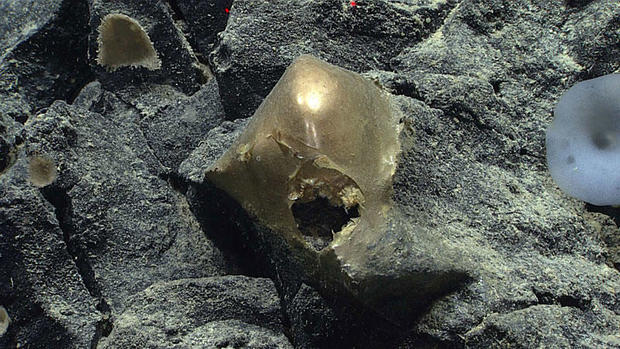
orb-800.jpg
Scientists with NOAA discovered an unidentified golden orb-like organism while operating a remote deep-sea diving vessel off the coast of Alaska on August 30.

NOAA

“This turned into a special case that required focused efforts and expertise of several different individuals. This was a complex mystery that required morphological, genetic, deep-sea and bioinformatics expertise to solve,” Collins said. 

First, scientists studied the physical structure of the orb. They found it didn’t have animal anatomy, but that it was a “fibrous material” covered with stinging cells, like an anemone or coral might be. Those cells were identified as spirocysts, a specialized cellular structure that can capture prey. Such cells only exist on one group of aquatic invertebrates, called cnidarians. 

The research team realized that the cells looked similar to the ones seen in a specimen collected in 2021. They compared the golden orb to that specimen, and found they were the same species. 

Initial DNA testing on the golden orb and the 2021 specimen was inconclusive, but whole-genome sequencing showed that both were “genetically almost identical” to a kind of cnidarian called Relicanthus daphneae. More analysis allowed the team to determine that the orb “had once been part of the base of a giant sea anemone,” NOAA said in a video explaining the process

The golden object that caught everyone’s eye is usually hidden underneath the anemone, NOAA said, but somehow, this one “seems to have been left behind.” Scientists still don’t know what happened to the top of the anemone. In the video, NOAA suggested it might have died or moved to a new home. 

The full anemone has a pink-colored, cylindrical body that can grow to up to three feet across, according to researchers. Its tentacles can be up to six feet long. It stinging spirocysts are the largest among all known cnidarians.

“So often in deep ocean exploration, we find these captivating mysteries, like the ‘golden orb,'” said NOAA Ocean Exploration acting director William Mowitt. “With advanced techniques like DNA sequencing, we are able to solve more and more of them. This is why we keep exploring—to unlock the secrets of the deep and better understand how the ocean and its resources can drive economic growth, strengthen our national security, and sustain our planet.” 

How Canada’s retaliation could hurt American businesses and consumers

(CNN) — Canada has a number of arrows in its quiver as it prepares to retaliate against the United States, and they could land hit American consumers and businesses.Already, Ottawa has vowed to match Washington’s latest tariffs dollar for dollar. But Canada also has other tools at its disposal, including restrictions on key exports to the United States.Here’s what Canada could do next — and what each move could mean for Americans.The first move: tariffsCanada’s first move in the brewing trade war is likely to be a straightforward eye-for-an-eye response.Retaliatory tariffs “will be concentrated in sectors such as steel, dairy, appliances, agricultural equipment, pulp and paper, and electronics,” Prime Minister Mark Carney said over the weekend, adding that more details would be shared “in the coming days.”With the exception of steel, all of those industries are also covered by President Donald Trump’s new tariffs. Canada is an important market for US exporters in those sectors: Last year, it ranked as either the largest or second-largest destination for American exports across most of those industries, according to US trade data.Carney also said Canada is considering tariffs aimed at industries Trump has already targeted with separate duties, including cars, steel, aluminum, lumber and copper.The risk for Americans here is that steep Canadian tariffs could weaken demand for these goods, which could force employers to cut workers’ hours or, in some cases, resort to layoffs.The bigger weaponsTrump already signaled he may go beyond the latest tariffs in his trade fight with Canada, threatening on Monday to double tariffs on Canadian cars and auto parts to 50% starting January 1.If Trump follows through — or escalates in other ways — Ottawa could use other ammunition.Canada could restrict key exports to the US, such as energy and a key fertilizer ingredient known as potash, said Diamond Isinger, a policy strategist and former special advisor on Canada-US relations to Prime Minister Justin Trudeau.Another vulnerable area is electricity. Ford said in an interview published Monday that Canada should be prepared to cut off electricity exports to the United States if the trade war worsens, putting a potentially powerful weapon on the table. Ontario supplies electricity to several US states, including New York, Michigan and Minnesota.Carney echoed Ford on Monday, telling reporters that “nothing is off the table.”Any such moves could add to the price pressures Americans have faced this year. Altogether the cost of living is up 3.4% from a year ago, according to July Consumer Price Index data. Gas prices, up almost 25% compared to last year, have weighed heavily on consumers’ finances. The cost of powering homes is also up, with electricity and piped gas both costing around 4% more annually.How badly will it hurt?Tariffs could make it harder for US companies to sell their goods in Canada.Restrictions on energy, electricity or critical minerals, something Ford also floated, could instead raise costs for American companies and consumers by making key inputs more expensive or harder to obtain.For instance, last year, Ontario briefly applied a 25% surcharge on electricity imports to the United States. The Ontario government estimated at the time that it would affect 1.5 million American homes, costing up to $400,000 CAD (around $280,000 USD) “every day the surcharge remains in place.”Restrictions on these key Canadian goods could quickly be felt by US businesses and consumers, making it harder to stay afloat, Isinger said.The-CNN-Wire™ & © 2026 Cable News Network, Inc., a Warner Bros. Discovery Company. All rights reserved.
Read Next Story