Gracie Abrams: Now center stage

▶ Watch Video: Gracie Abrams: Now center stage

In the middle of New York City is a spot that Gracie Abrams calls a secret garden: a park where she says she can hang out unnoticed (when TV cameras aren’t around, that is). It’s a respite from a life where she’s very much front-and-center.

At 26, Abrams is a reigning queen of so-called whisper pop – her witty, intimate style praised by critics and millions of fans around the world. She’s graced the top of Billboard charts, Chanel ads, and the most recent cover of Vogue. 

Backstage on tour last summer, she told us she still seemed stunned by it all: “I’m constantly pinching myself,” she said. “And I don’t know at what point you could get to where you’re not doing that.”
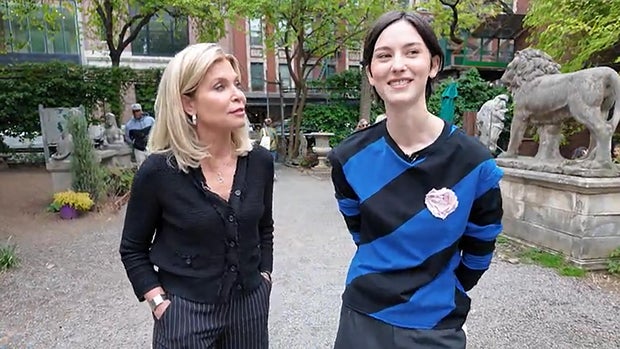
gracie-abrams-with-tracy-smith.jpg
Correspondent Tracy Smith with singer-songwriter Gracie Abrams. 

CBS News

Being center-stage didn’t come naturally to Abrams. Born and raised in Los Angeles, she always had a passion for songwriting, but not necessarily performing. She says she felt fear from the idea of sharing her songs: “Like, just really physical fear … in the pit of your stomach. I felt that when I would hear footsteps coming down the hall, and I would stop playing.”

She eventually got up the nerve to post a few songs online, such as “Minor.”

“I don’t know what my goal was,” Abrams said. “I think it was probably that naïve kind of concept of the internet that it’s not real – you know what I mean? I’m like, ‘Okay.’ It was easier to hide behind.”

The gamble paid off. By 2019 Abrams had her first record deal. And thanks in part to COVID, she did her first tour on Zoom from her bedroom. “It was such a gift, because I was vomiting at the thought of performing!” she laughed. “And then I got to do it in the comfort of my own space. And it felt like this baby step.”

That baby step turned into a running leap onto the world’s largest stages. By 2022, Abrams was opening for some of the brightest stars in music: Olivia Rodrigo, and then Taylor Swift. Stepping out onto stage on Swift’s Eras Tour, Abrams said, “felt like being in some kind of, like, alternate universe. It was just the best thing.”
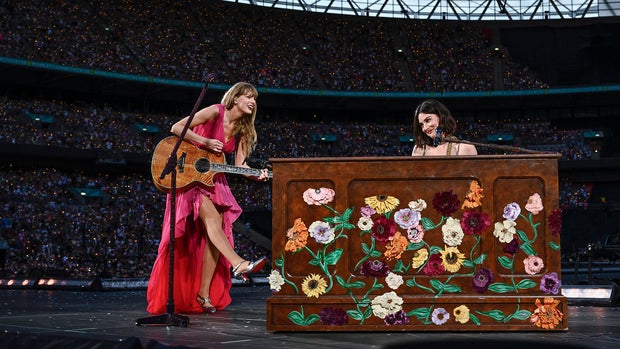
Night Three Of Taylor Swift | The Eras Tour - London, UK
Taylor Swift and Gracie Abrams perform on stage during “Taylor Swift | The Eras Tour,” at Wembley Stadium, June 23, 2024 in London.

Gareth Cattermole/TAS24 via Getty Images

Asked what advice she took from Swift, Abrams said, “The first thing that comes to mind when you ask that is, like, the encouragement to just never stop writing. For me, any time I had a feeling where I was like, ‘I would rather just cry about this for a while,’ [instead], just pick it up and write it down. And it serves you every time to do that.” 

And now, Abrams is selling out arenas on her own – with audiences singing her words back to her. “It just doesn’t feel like it’s remotely about me,” she said. “I love it, but it feels like even though they might be my words, they’ve adopted them and made them their own.”

Still, Abrams has had to deal with accusations of nepotism. Her mom, Katie McGrath, is an entertainment executive, and dad J.J. Abrams created hit TV shows and directed a couple of “Star Wars” films. Being blessed with successful parents means she has also heard the term “nepo baby.”

“My parents have both worked in the entertainment industry since before I was born,” she said. “And I think there is no question there are a million visible and invisible ways in which I have benefited as a result of my proximity. I am the luckiest person in the world to have grown up learning from the two of them in all of the ways. It’s been everything, of course.”
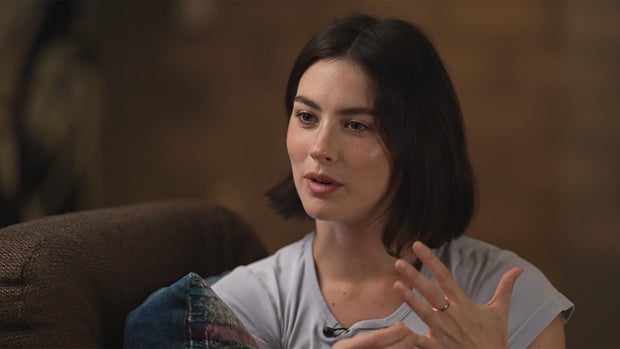
gracie-abrams-int-c-1920.jpg
Singer-songwriter Gracie Abrams. 

CBS News

In fact, instead of avoiding talking about her parents, Abrams has leaned in. Her latest album, out Friday, is called “Daughter From Hell.” Its title track is a love song for her mom, one Abrams calls “very overdue.”

“I sent it to my mom, I was like, ‘So sorry it took me 26 years to write one that wasn’t laced with, you know, some kind of angsty anger,'” she laughed. “I’m like, ‘I want to be you now, Mom!'”

Her mother’s reaction? Abrams said it “got” her – and talking about it “got” Abrams, too: “I want more than ever to say thank you to the people that made me who I am, and who have given every ounce of love that they have. So … I’m like, it’s so weird to get emotional with my … ! But it is true.”

The first single released from the album was the emotional anthem “Hit the Wall.”

And when she goes on tour later this year, some of the lyrics fans will be screaming were written in the quiet little garden in Manhattan’s Lower East Side. “I feel very, yeah, grateful to this particular stretch of land,” Abrams said.

She is also well aware of the fleeting and fickle nature of fame. In fact, she wrote a song about it, “Look At My Life.”

How long have I got
In the hot light till the shine rusts? …

But oh well, look at my life
Bet you can’t tell but it’s kind of a bad time
A new spiral every night
Bawling my eyes out, no, but I’m so fine
Yeah, I might just shut up and drive
Hope I don’t crash and blow out the headlights
My nightmare actualized
Got what I wanted, it doesn’t sit right

Asked about the line “How long have I got in the hot light?” Abrams said, “There’s always the next girl, there’s always the next shiny object, there’s always the next great show. My hope is longevity, not like white-hot moment, you know? So, I want to do this thing for as long as, you know, the people will have me. And when they don’t want to have me anymore, I will still be hopefully here, making stuff!”


WEB EXCLUSIVE: Watch an extended interview with Gracie Abrams and producer Aaron Dessner (Video)

Extended interview: Gracie Abrams, Aaron Dessner

20:38


For more info:

Thanks to:

     
Story produced by Julie Kracov and Sara Kugel. Editor: Steven Tyler. 
What Trump’s Supreme Court win means for mail ballots

(CNN) — The Supreme Court on Monday permitted President Donald Trump to move forward with a controversial executive order targeting mail ballots, but the decision will almost certainly not be the final word in whether the administration can actually implement its far-reaching plan.At the center of the dispute is an executive order Trump signed in March that gives the US Postal Service an unprecedented role in deciding whether to send mail ballots — a move that has followed years of the president making baseless claims about illegal voting by mail.But the Supreme Court’s order, which came over the dissent of three liberal justices, doesn’t resolve the legality of Trump’s proposal. The president’s plan for the USPS remains blocked on a nationwide basis. And further court action is almost certain to put Trump’s executive order before the justices again, potentially within a few days.For now, no voters who expect to cast their ballots by mail in the midterm elections need to change their plans. Still, the high court’s decision handed the president a procedural win on an issue that has been central to his messaging for years. And it is likely to inject uncertainty for both voters and state election officials who are scrambling to prepare for this year’s high profile midterm elections.What the Supreme Court ruled on mail ballotsThe court’s decision Monday didn’t deal with the legality of Trump’s executive order but rather with the timing of a lawsuit filed by 23 Democratic states that challenged it. The court’s conservatives concluded that the lawsuit had been filed too soon because the Trump administration hadn’t yet taken any steps to actually implement its plans.“The executive order makes no demand of the states,” the high court wrote in an unsigned decision that did not disclose the vote count. To pause the order, the court wrote, lower courts had to “speculate” about the potential harm that would be inflicted on the states that sued.The decision on Monday, the court said, doesn’t mean the president will ultimately be able to implement the provision of the executive order that dealt with USPS.“On that score,” the court wrote, “time will tell.”Trump did score a cleaner win on another section of his executive order. The Department of Homeland Security will be allowed to move forward with a plan to create lists of voters for each state that it has deemed are US citizens and therefore eligible to vote. But Trump’s plan doesn’t require individual states to do anything with those lists.What happens nextTrump’s emergency appeal at the Supreme Court had been pending for nearly a month, an unusually long time. In that span, the on-the-ground dispute over mail ballots has moved far beyond the case the high court decided on Monday.One of the Justice Department’s main arguments for why the states filed their challenge prematurely was that the US Postal Service had not yet formally adopted a required regulation spelling out how it would implement the president’s plan. While the case was pending at the court, the USPS issued that regulation — offering more clarity about how it intended to carry out the executive order.Meanwhile, the same federal district court in Massachusetts that had shut down Trump’s USPS plan in the challenge filed by the Democratic states issued another ruling in a separate case from voting rights groups like the American Civil Liberties Union. In that ruling, Judge Indira Talwani, nominated to the bench by President Barack Obama, issued a ruling that blocked the USPS directives nationwide.That separate ruling is still in effect. And that is why, despite the Supreme Court decision on Monday, the president’s USPS order remains blocked.Talwani is already moving quickly and has ordered a new round of briefing by Tuesday morning. She could hand down another decision as early as Tuesday temporarily blocking Trump’s order once again — and in a way that would tee the dispute up for a fast-track return to the Supreme Court.What the Supreme Court decision means for votersBecause of the ongoing legal maneuvering, it’s not yet clear that the Supreme Court’s decision on Monday will mean anything for this year’s midterm elections. Under the Constitution, states and Congress determine voting procedures, not the White House or federal agencies — a point that will almost certainly be raised at a later stage of the case.That said, for both Trump and the groups challenging him, time is of the essence.If federal courts attempt to shut down Trump’s executive order closer to November, they are likely to run headlong into a wonky judicial doctrine known as the “Purcell principle.” Rooted in a 2006 Supreme Court decision, the principle warns federal courts at all levels against making last-minute changes to voting rules. If the litigation drags out, the Justice Department is almost certain to argue that it’s too late for courts to intervene to stop the administration before this year’s midterm.Justice Ketanji Brown Jackson, writing in dissent on Monday, warned that the administration might be able to “game the system.”“The court has held for a while now that even valid election-related legal claims can come too late,” Jackson, the court’s junior liberal, wrote on Monday. “Today’s revelation is that such claims can also come too early — never mind that an election is looming and related harms are presently occurring.”The November 3 election is less than 80 days away.What Trump’s order would doThe president’s March executive order set two major changes in motion.First, it directed DHS to build state-by-state citizenship lists using federal databases, including Social Security data and immigration records. The goal: Identify who may be eligible to vote in federal elections and give states data to compare with their voter rolls. For now, the Supreme Court’s decision allows that effort to move forward.Second, it ordered the Postal Service to change how it manages mail-ballot delivery.Under a final rule published by USPS last week, state and local election officials would have to upload the names and addresses of every mail-ballot recipient to a Postal Service portal before the ballots are sent to voters. They would also have to adopt standardized envelopes and unique, machine-readable barcodes.Ballots not added to the portal would be rejected and returned to election officials. States that refuse to comply would lose USPS ballot-delivery services for federal general elections.That data would become a kind of ballot “manifest” used to flag anomalies — and would be shared with federal law enforcement and election officials for audits and investigations. DHS and the Justice Department could then use it to investigate suspected unlawful voting, an effort this administration has backed with the weight of the federal government for the past 18 months.But there’s a crucial caveat: USPS says it won’t implement the rule before the midterms — or at all — without federal court approval. The White House has made clear it wants the system in place for the November elections.More than 20 states, Democratic Party leaders and nonpartisan voting-rights groups have sued to stop the administration, arguing that the Constitution does not give Trump the unilateral power to change how states carry out their mail voting programs.Election officials, including some Republicans, warn the policy could vastly expand the roles of USPS and DHS in running elections, create major logistical problems and fuel voter confusion. They fear the resulting turmoil could give Trump and his allies fresh grounds to challenge the results.“USPS is no longer merely a carrier of ballots; it is instead transformed into a gatekeeper of voter eligibility,” lawyers challenging the order wrote in one case.USPS downplayed those concerns after receiving more than 200,000 public comments, including warnings about disenfranchisement, errors and confusion.“Despite any logistical or financial difficulties states may face complying with the rule, including some claims that immediate implementation would prove impossible, the visibility and law-enforcement benefits of the rule, including for this election cycle, are such that there is no compelling reason for any delay,” the agency wrote in its final rule.The-CNN-Wire™ & © 2026 Cable News Network, Inc., a Warner Bros. Discovery Company. All rights reserved.
Read Next Story