
Eligible seniors can get GLP-1s for $50 a month for weight loss alone

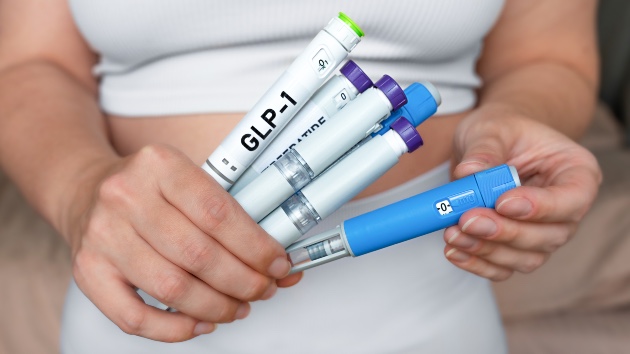
Close-up of a woman holding several GLP-1 injection pens used for weight loss and diabetes treatment. Modern injectable medication concept for obesity management, healthcare and pharmaceutical therapy. (Kateryna Borodina/Getty Images)

(NEW YORK) — For the first time, Medicare will cover GLP-1s for obesity-related weight loss, without any other medical conditions.

Starting Wednesday, eligible Medicare beneficiaries can receive GLP-1s for obesity for $50 per month by prescription. Medicare is the primary federal health insurance program in the U.S. for individuals 65 and older.

Federal rules ban Medicare Part D — which helps cover prescription drug costs — from covering drugs solely to treat obesity, but a new federal pilot bridge program approved by Health and Human Services Secretary Robert F. Kennedy Jr. will be in effect until Dec. 31, 2027.

This move could dramatically expand access to Eli Lilly’s Foundayo and Zepbound and Novo Nordisk’s Wegovy for seniors 65 and older as well as other eligible Medicare enrollees.

Foundayo and Wegovy Pill are daily tablets. Wegovy and Zepbound are weekly injections that require refrigeration.

A month supply of Wegovy will come in four pre-filled pens while Zepbound will be delivered in a KwikPen, which holds four weekly doses in a single device.

Single-dose Zepbound pens and Zepbound vials will not be covered by the bridge program.

“These treatments are a major medical advancement, but too many seniors are currently unable to access them due to high cost,” Dr. Mehmet Oz, administrator of the Centers for Medicare and Medicaid, said in a statement last month. “The Medicare GLP-1 Bridge changes that by making these medications more affordable and accessible, while advancing our broader goal of helping Americans live healthier lives.”

An estimated 3.8 million beneficiaries could be eligible for the program, according to a KFF analysis of 2023 Part D enrollment data that was published Monday.

The government negotiated with the manufacturers to reduce the price the government will pay to $250 for a month’s supply and in return the companies will have access to the larger patient population. Each patient will pay a $50 copay towards the cost of the medication, but that co-pay will not go toward an individual’s annual deductible.

Patients will first need prior authorization — prescribing clinicians will submit documentation proving the patient meets strict body mass index (BMI) and health condition requirements. That means patients will need to wait for the prescription to be approved before it can be filled.

Patients must have Body Mass Index (BMI) of 35 or higher. If their BMI is 30-35, they must have certain types of heart failure, hard to control blood or chronic kidney disease.

If their BMI is 27-30, they must have prediabetes, history of heart attack or stroke or blocked arteries in the arms or legs.

These requirements are more restrictive than the FDA approval language or what private insurance companies require, which is a BMI of 30 or over.

Patients must also not have type 2 diabetes, moderate-to-severe sleep apnea, or fatty liver disease because their Medicare plan may already cover GLP-1s.

“GLP-1s can be life-changing for patients managing obesity and related conditions,” Chris Klomp, director of Medicare and chief counselor at the U.S. Department of Health and Human Services, said in a statement last month.

“This demonstration is designed to make accessing those medications simpler, more predictable, and more consistent across the Medicare program, which means better quality of life for seniors and better value across the health care system,” the statement continued.

​Individuals will be able to fill their pre-approved prescriptions at local retail pharmacies and directly through Novo Nordisk or Ely Lilly’s direct to consumer mail order pharmacies.  

Copyright © 2026, ABC Audio. All rights reserved.

Rage yoga? Grief cycle? Workouts are starting to match emotional states

Before even beginning their workout, nearly every participant in Sylvia Borowska’s recent Liftonic class was crying. The instructor asked each of the 30 participants to grab the heaviest weight they could pick up. Pretend it’s on your shoulders or on your back or in your chest, Borowska told them.“Do as many deadlifts as you can for the amount of time that the person you’ve lost has passed,” Borowska said she told the class. “That can represent either the months or years you’ve been grieving.”Borowska partnered with Grief, Sweat & Tears to offer that class catering to grieving New Yorkers. Founded in December 2025, GST is an initiative that hosts pop-up workout classes across the city each month. It’s “where grief meets fitness,” read the Instagram post announcing the $30 class.Borowska has taught Liftonic weight-training classes for five years, but her pop-up grief class was the first time she opened a session by sharing how she lost her mother to lung disease.“Let’s keep going,” Borowska urged on the night of the class. “Grief is heavy, but we’re stronger than that, so let’s prove to ourselves and each other how strong we are.”A workout class mixing sweat and tears isn’t a rare event. Rage cycling sessions, anxiety yoga and dozens of similar fitness initiatives have gained traction in recent years, inviting people to choose workout classes based on experiences and emotions.Do these classes actually help people process grief, rage and heartbreak? Dr. Ryan Martin, a psychologist and author, said there isn’t much research yet available on the topic.“It’s not unusual for pop culture to be a little bit further ahead than psychologists are when it comes to advocating some of these things,” Martin said.Finding communityAmid the rise of pickleball tournaments and run clubs, fitness activities are increasingly becoming a venue for social connection. The social networking app Meetup reports more than 3 million members registered across about 2,200 fitness groups globally.The relationships built within these emotion-centered classes reflect another way adults can make friends. But the shared emotion offers participants opportunity for a more specific connection.Community is one of the most valuable parts of a workout class like this, said Martin, who is dean of the College of Arts, Humanities and Social Sciences at the University of Wisconsin – Green Bay.For someone searching for a grief community, a grief or trauma support group might seem intimidating. Walking into a grief weight-lifting class, though — that could be an easier task.“This might provide a community where you know you’re connecting with other people’s similar experiences, but you’re not just doing it over that experience, which could be too much,” Martin said.Betsy Kaplan, 29, had that idea in mind when she founded Grief, Sweat & Tears. After she lost her father to suicide eight years ago, Kaplan didn’t have a “grief space” at home in New York. She wanted to create a “no-pressure zone,” where no one felt obligated to share their grief stories.“We’re here to work out,” Kaplan said. “We’re here to meet people who get it and just make new connections.”At an early GST event, Kaplan connected with Jake Montiel, who quickly became one of her best friends. Montiel lost his mother three years ago when he was 30. As part of GST tradition, participants say the name of the person they’ve lost at the start of each workout class. Montiel said he was petrified the first time he shared his grief out loud, but he found community in the young woman standing next to him, who’d lost her mother.They clicked immediately, but they also had the workout to bond over. “It’s really an honest, open safe space to basically open up and get that weight off your chest just from saying those powerful words of who you’re grieving,” he said.Over the past six months, about 400 people have participated in a GST class, according to Kaplan.A workout for every emotionIn Westminster, Colorado, Elisa Thurston held her engagement party at E-motion Fitness, an event space that’s branded as part rage room, part gym, part sanctuary. Participants smash paint-filled glass bottles against the walls, one of which they’ve decorated with an emotion they’re feeling, such as rage or fear. Trainers then lead participants in a 45-minute full-body workout before the class moves into another room fashioned as a recovery space with art and quiet music.Thurston wanted her family to experience a session — and get out last- minute wedding jitters, she said. After all, the class was her sanctuary through a breakup, during feelings of inadequacy and when she was frustrated with work.She needed “to sit and reflect with a group of people that I know care about me, and to be able to talk about that together, and then to be able to express that in a really fun and cathartic way,” Thurston said. “Talk therapy is great to talk through things with somebody, but I do feel like this workout class is just a different way of engaging my whole self in that experience.”Exercise isn’t the one-size-fits-all solutionParticipants often describe “releasing” negative emotions during a workout class, but Martin, the Wisconsin-based psychologist, cautions against saying this. The emotion isn’t going anywhere.“It keeps the heart elevated at a time when the goal is typically to decrease the heart rate,” he explained, referring to the physical activity. “It keeps your muscles tense at a time when the goal is often to decrease that muscle tension.”While the concept of choosing to box or run when you’re on the brink of an emotional breakdown might seem like a positive outlet, it isn’t for everyone, according to Martin.“Be wary. One of the things that cardiovascular activity does is it simulates panic in a lot of ways,” Martin said. “For a person who is prone to panic disorders or has difficulty with panic, simulating that in some settings might be dangerous.”Among refugees who’ve experienced significant trauma, a 10-week physical activity program led to “significant reductions” in PTSD, depression and anxiety, a March study found. Yet researchers still don’t understand specifics around the effects of exercise on people in adverse emotional states.“What we don’t know yet is exactly why it worked so well — whether it was the exercise itself, feeling safe and supported while exercising, connecting with other people, or some combination of all of those things,” Martin said of the study.Those considering emotion-centered workout classes should ensure they are able to opt out of a workout whenever they need to, said Dr. Ethan Kross, professor of psychology and management at the University of Michigan in Ann Arbor. He said he encourages people to “self-experiment.”How to deal with emotionsWhat’s Martin’s biggest piece of advice? Don’t just rely on workout classes to process adverse emotions. If you’re dealing with profound trauma or grief, work with therapists or in group therapy, he said.There are other ways to process negative emotions, Martin said. In addition to therapy and exercise, he recommends speaking to your doctor about medication, spending time in nature and reading books about grief.Kross said he advises participants to first recognize there are multiple tools to deal with their experiences. If you’re someone who engages in negative self-talk, think about how you’d talk to a friend in the same situation, he said.He also suggests “adopting a more detached perspective on what’s happening, becoming an observer, a fly on the wall, thinking about what’s happening to you from a distance.”Kross said the community component of a workout class is “just the tip of the iceberg.” These classes could do more to help people process their emotions, but there isn’t much science informing the class workout structure, he said. For instance, venting anger might seem like a good idea, but it could sustain it, a 2024 study by The Ohio State University found.In Borowska’s Liftonic class though, it’s a Friday night — and no one is concerned about the science. Participants gathered outside the studio, mixing laughs at weekend plans with the tears of grief and deadlift-induced sweat.Montiel and Kaplan, who both attended the session, carried the class’ momentum into a local bar.“I now have a boatload of friends who, if I’m having a ‘grief moment,’ I can pick up the phone and call. … I can ask if they want to meet for coffee, and I’m seeing it with other people, too,” Kaplan said. “It sucks that we’re all in this club, but it’s really great to know we have this.”The-CNN-Wire™ & © 2026 Cable News Network, Inc., a Warner Bros. Discovery Company. All rights reserved.
Read Next Story