El Nino is strengthening: Here’s what it means for the US

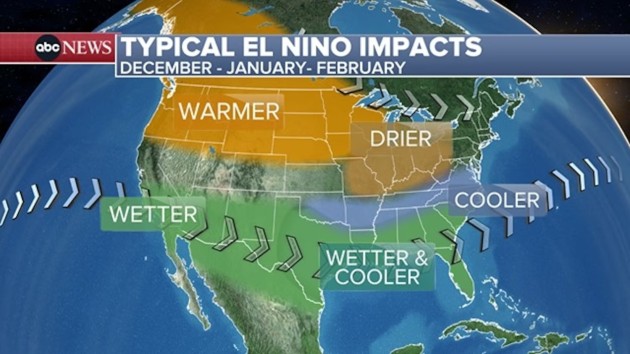
Typical El Nino Impacts. (ABC News)

(NEW YORK) — El Nino conditions continue to intensify and are likely to be a strong event in the coming months, significantly influencing our weather, the hurricane season and global temperatures, according to the latest forecast from the National Oceanic and Atmospheric Administration (NOAA).

There is very high confidence that El Nino will continue through early spring 2027.

NOAA’s latest forecast calls for a strong El Nino to develop by the fall, with an 81% chance of a very strong El Nino between October and December, which could also end up being one of the strongest events on record. Historical records go back to 1950.

Stronger El Nino events only make certain impacts more likely and do not always guarantee strong impacts, NOAA noted.

El Nino refers to the warmer-than-average phase of the El Nino–Southern Oscillation (ENSO), a natural cycle where sea surface temperatures across the central and eastern equatorial Pacific Ocean rise and fall. The cooler-than-average phase is called La Nina, while near-average conditions are known as ENSO-neutral.

NOAA ranks the strength of El Nino events by measuring the sea surface temperature departure from average (anomaly) across this region, classifying events as weak, moderate, strong or very strong.

“El Nino conditions are already underway and are forecast to strengthen rapidly into a strong event,” WMO Secretary-General Celeste Saulo said in a statement. “This will intensify the chances of drought and heavy rainfall and the risk of heatwaves on land and marine heatwaves in many regions of the world.”

While adjectives such as “super” and “extreme” are popular ways of describing the strength of an El Nino event on social media, NOAA and the WMO classify by strength. The WMO noted in a recent statement that “the term [[super]] is not part of standardized operational classifications.”

Typical El Nino impacts across the United States

Impacts from El Nino, similar to La Nina, tend to be most consistent and pronounced from late autumn through early spring following the event’s onset, NOAA says. There is usually a delay between the onset of the event and many of the associated effects.

“The more consistent impacts on precipitation and temperature don’t occur until the winter months — so for 2026-27,” Michelle L’Heureux, physical scientist at NOAA’s Climate Prediction Center, said.

Experts caution that the impacts on weather patterns are nuanced. Each season is different, and typical El Nino conditions don’t always materialize.

“Every El Nino is different in terms of timing, magnitude, and geographic extent, and such differences lead to variability in the impacts — on temperatures and rainfall, for example — on a global scale,” Andrew Kruczkiewicz, senior staff researcher at Columbia Climate School, said.

Northeast: Warmer-than-average temperatures are favored across the northern half of the U.S. during meteorological winter (December to February), however its influence is less pronounced in the Northeast, compared to the Upper Midwest and Northwest.

El Nino typically increases the odds of above-average snowfall in the mid-Atlantic and coastal areas of the Northeast as storms often move up the coast. Farther inland, drier-than-average conditions and less snow are more likely.

South: During the winter months, near- to below-average temperatures are favored along the southern tier of the U.S., especially from Texas to the Southeast.

For precipitation, wetter-than-average conditions are typically observed across Texas, the Gulf Coast and Southeast. Below-average precipitation is frequently observed across parts of the south-central Mississippi Valley.

Midwest: Warmer-than-average temperatures are favored from the northern Plains into the Great Lakes in the winter. Drier-than-average conditions are frequently observed across parts of the Ohio Valley and Great Lakes regions.

El Nino typically increases the odds of above-average snowfall in the south-central Plains with below-average snowfall favored in northern Plains and Great Lakes regions.

West: During the winter months, warmer-than-average temperatures are likely across much of the Northwest. For precipitation, wetter-than-average conditions are typically observed across southern California and much of the Southwest, with below-average precipitation frequently observed across parts of the northern Rockies.

El Nino typically increases the odds of above-average snowfall in the southern Rockies, with below-average snowfall favored in the northern Rockies.

Meanwhile, above-average tropical activity in the eastern Pacific increases the likelihood of indirect impacts to the southwestern U.S., such as sending more rain to the region and more frequent flash flood concerns.

Alaska: El Nino impacts in Alaska tend to be more pronounced than across much of the contiguous U.S., with the strongest effects typically occurring during the winter and spring months. During winter, warmer- and drier-than-average conditions are more likely, with less snowfall and reduced snowpack.

Above average temperatures often persist into spring, while precipitation trends closer to average. However, warmer conditions typically mean more precipitation falls as rain rather than snow, prolonging snow deficits.

Hawaii: Rainfall is typically above average across Hawaii the year an El Nino event develops before conditions become drier during the winter months and remain dry well into the following year. The shift toward drier weather can increase the likelihood of drought and elevate the risk of wildfires.

Meanwhile, above-average tropical activity in the eastern Pacific increases the risk of impacts from tropical systems across the Hawaiian Islands.

El Nino’s influence on hurricane season activity

While El Nino is only one of several key factors that influence tropical activity, forecasts now indicate it will be a strong event during the peak of the hurricane season, making it the primary driver of activity in both the Atlantic and eastern Pacific in the coming months.

El Nino conditions often suppress tropical activity during the Atlantic hurricane season by producing unfavorable atmospheric winds. In the Eastern Pacific, the opposite occurs, with favorable conditions supporting above-average hurricane season activity.

As a result, NOAA’s May 21 hurricane outlook is predicting below average tropical activity for the 2026 Atlantic hurricane season with above average activity likely in the eastern Pacific.

“El Nino increases convection (thunderstorms) across the eastern and central Pacific, which causes downstream wind shear over the Atlantic from strong upper-level winds,” Andy Hazelton, an associate scientist at the University of Miami’s Cooperative Institute for Marine and Atmospheric Studies, said.

Vertical wind shear, which refers to changes in wind speed and direction with height in the atmosphere, is often a primary factor in below-average hurricane season activity. Strong vertical wind shear can tear a developing tropical system apart or even prevent it from forming, NOAA says.

“The rising motion over the Pacific also leads to increased subsidence (sinking air) over the Atlantic, which suppresses thunderstorms and tropical cyclone development,” Hazelton added.

Other factors, such as sea surface temperatures, also play an important role in tropical cyclone development and strength. Unseasonably warm ocean waters can partially offset the effects of unfavorable atmospheric winds, according to forecasters.

Copyright © 2026, ABC Audio. All rights reserved.
A Los Angeles neighborhood was terrorized by a raging warehouse inferno. Now it’s tormented by the suffocating stench

Los Angeles (CNN) — For eight brutal days, residents of Boyle Heights watched smoke billow from a burning warehouse and prayed the flames would spare their homes.There was no escaping the black pollution that choked the neighborhood then, and no reprieve now, even five weeks after the fire was extinguished. The smell of burning plastic has been replaced by something else: the pungent odor of rotting food, and everything that comes with it.The inescapable stench – equal parts sour and cloying – has settled like a thick haze over the neighborhood, baked by the Southern California heat.Boyle Heights locals say the stink is making them physically sick, and that swarms of flies and giant rats have followed the noxious odor into their neighborhood.When it went up in flames in mid-June, the warehouse contained 88 million pounds of frozen food, some of which burned in the blaze and some liquified. That amount of waste would fill roughly 440,000 curbside trash bins. Lined up wheel-to-wheel, they would stretch more than 200 miles, roughly the distance between Washington, DC and New York City.Now, cleanup crews are racing against the clock to remove what the fire left behind, including waste so toxic it needs to be sealed in hazmat containers. The City of Los Angeles has directed Lineage Logistics, the largest owner of cold-storage facilities in the world and operator of the repository, to clear the waste by August 13 — a timeline one company executive called “very aggressive” at a town hall last month.When the wind shifts, the smells from the warehouse waft miles away, even weeks after the fire was extinguished.But in Boyle Heights, the putrid scent of fermented food is a fetid constant. It lingers in the air and coats the mouth. 90% of residents in the predominantly Latino neighborhood said they noticed constant odors in a recently released county public health survey.In an effort to stymie the foul smell, part of the facility is wrapped in plastic sheeting while large fans spray odor-control mist around the warehouse. The food waste is sprayed with bleach, deodorizer and water before it’s covered and hauled to a landfill in Riverside County, east of Los Angeles.The near-tangible odor has infiltrated every corner of Alicia Naranjo’s home, which is six houses down from the warehouse. At first, the smell permeated the bedrooms, bringing with it sleepless nights. Then came anxiety and trouble breathing, followed by headaches, congestion, coughing and throat pain, she said in a raspy voice she attributes to the pollution in the air.“And then,” her sister Elsa Naranjo chimed in, “we got infested with rats.”“You see them jumping around from the walls,” she said. “Outside our house, in our property.”Rat traps, black plastic boxes with holes in the side, can be seen almost every ten feet along the ground, usually sitting underneath a hanging fly trap filled with dark clusters of dead and drowning flies.There’s one right outside Lisset Navarrete’s house, but she’s not convinced they’re effective for one main reason: the rats she’s seen are bigger than the traps laid for them.Navarrete said her physical symptoms began with pressure on her chest that moved to her stomach. She said the rotting scent permeates so much of daily life she loses her appetite. Her mother-in-law also fell ill while waiting in line at a nearby clinic, she said.“She just started throwing up, feeling dizzy,” Navarrete said, as she swatted a fly off her arm. “It’s just catching up to us.”Her family can’t turn on the air conditioning without it sucking in the odor, but on a 90-degree day, the aggressive Los Angeles sun only serves to thicken the stench enveloping the neighborhood.Lineage has helped to distribute almost 600 air purifiers and over 650 air conditioning units to households in the immediate neighborhood, a spokesperson told CNN. The company has also offered assistance for temporary relocation, utility bills and pest-control supplies.“Community support efforts to date total more than $3.3 million,” the spokesperson said in a statement.The City of Los Angeles has also pitched in to relief efforts, with Mayor Karen Bass declaring a state of emergency and sending mobile health care clinics to the neighborhood.“No company chooses to experience a catastrophic fire. But every company chooses how it responds,” Bass said in an open letter to shareholders. “Unfortunately, Lineage’s response has fallen short.”The smell of rotting food follows Juan Canil like a second shadow. Even when he leaves his home in Boyle Heights, it’s waiting for him at his auto shop located directly across from the Lineage warehouse.He described the same symptoms as the others: headaches, nausea, discomfort. But the stench is also seeping into his pocketbook. The strong smell and remediation work has continued to stall business for the auto shop owner.“Since the street is closed, I’ve lost a lot of work,” he said. “A lot of money.”As of Thursday, over 4,200 complaints about the odor have been reported to the air pollution regulatory agency, South Coast Air Quality Management District. The agency issued Lineage public nuisance violations for 25 days in a row.The regulators sent Lineage a letter last month, demanding additional odor control measures. In its response, the company said it had already implemented some of the measures and agreed to implement others but argued some AQMD demands would add “several months” to cleanup and worsen the odors.A Lineage spokesperson said the company’s top priority is completing the cleanup quickly and safely and it plans to rebuild the warehouse.With a pivotal election looming this fall, Bass has turned up the pressure on Lineage, directing city agencies to block the company’s plans.“The application is for a permit to repair the damage from the fire, which was not caused by the cold storage operations at the facility. This is normal course in the repair process and will not impact or distract us from the important work of cleanup,” the Lineage spokesperson said.Cold storage facilities are “critical infrastructure,” Lineage said. “Communities around the region have depended on them for over 100 years.”Boyle Heights is not the first time Lineage has faced allegations of community harm after a warehouse fire. Nearly 1,000 miles north of Los Angeles, legal action has already been taken against the company for its response to a different blaze.A Lineage Logistics warehouse caught fire in the small town of Finley, Washington, in 2024. It burned for nearly two months, more than six times longer than in Boyle Heights. Lineage believes the California fire began when solar panel contractors were working on the roof, while the Washington fire’s cause is undetermined.Finley residents sued Lineage on June 18 – one day after the Los Angeles fire broke out – alleging the company cut corners on safety and failed to act quickly enough after the catastrophic warehouse fire, allowing toxic smoke and contamination to devastate the community.“We are sympathetic that the Kennewick community faced a fire that was unique in many ways,” a Lineage spokesperson said in a statement. “While we cannot comment on the specifics of ongoing litigation, we vigorously dispute the lawsuit’s characterization of our safety record.”The spokesperson added, “there was no indication Lineage was at fault for the fire.”Residents near the Washington fire reported many of the same ailments now being described in Boyle Heights, including burning eyes, throat irritation, coughing, difficulty breathing, headaches, nausea and dizziness – symptoms attorney Will Sykes said persist for many of his clients today, some two years after that fire first broke out.Lineage reported a $51 million net gain from the Washington fire from insurance payouts, the company noted in a 2025 SEC filing. The company’s webpage dedicated to the fire response has since been taken down.As of Wednesday, Lineage has removed approximately 80% of the food waste from the Boyle Heights warehouse. The company has said the cleanup is complex and requires patience.But for people living around the warehouse, the concern is not just how long the cleanup will take, but how far its effects have already reached: into their homes, their routines and the air they breathe.During hours of public testimony Wednesday, dozens of Boyle Heights residents spoke about how the fire has affected their lives in front of the South Coast AQMD hearing board, which approved an abatement order Thursday requiring Lineage to conduct specific odor mitigation actions.The mayor urged the board to leverage its full enforcement authority to issue the order, including maximum financial fines against Lineage.“Massive headaches have impeded me from living my daily normal life,” Carla Martinez, a local, testified. “It has prevented me from going to work, going to the grocery store for supplies, and just overall daily activities. Being stuck inside with no A/C in this heat is unbearable, not to mention the cost of having the air purifiers running for a semblance of fresh air.”“If the headaches and the heat don’t get you,” she continued, “It’s the putrid smell…”“…the smell of death and decay that’ll get you.”The-CNN-Wire™ & © 2026 Cable News Network, Inc., a Warner Bros. Discovery Company. All rights reserved.
Read Next Story