
El Mayo, the infamous Mexican drug lord, to be sentenced on federal charges

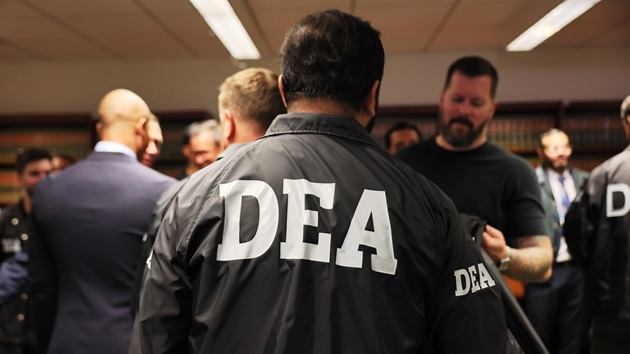
Members of the DEA attend a press conference at the U.S. Attorney’s Office on August 25, 2025 in the Brooklyn Heights neighborhood of the Brooklyn borough in New York City. (Michael M. Santiago/Getty Images)

(NEW YORK) — Ismael Zambada Garcia, known as “El Mayo,” was sentenced Monday to life in prison on drug trafficking charges that accused him of being one of the most prolific and powerful narcotraffickers in the world, according to federal prosecutors in New York City.

Together with Joaquín Guzmán Loera, known as “El Chapo,” he founded the Sinaloa cartel and oversaw the shipment of millions of kilograms of lethal drugs, including cocaine, fentanyl, and methamphetamine. He employed armed sicarios who assaulted, tortured, and murdered and he paid millions in bribes at all levels of the Mexican government, officials said.

In federal court in Brooklyn, U.S. District Judge Brian Cogan sentenced him to life in prison without the possibility of parole.

“Ismael Zambada Garcia spent nearly four decades poisoning American communities to make billions of dollars in profit and ordering the murders of anyone who stood in his way. Today, that chapter closes for good,” U. S. Attorney for the Eastern District of New York Joseph Nocella Jr. said in a statement.

The sentence was not in doubt. El Mayo pleaded guilty last August to a charge of committing a continuing criminal enterprise, a catch-all that included 85 violations of the law, and agreed to the mandatory life imprisonment along with a $15 billion forfeiture.

“It would be difficult to overstate the magnitude of the defendant’s crimes and scale of the corruption, violence, and other harm he spread throughout Mexico, the United States, and the world,” federal prosecutors in Brooklyn said in a sentencing memo that called for life in prison.

As part of his plea, El Mayo, 76, admitted he was responsible for at least 1.5 million kilograms of cocaine and vast quantities of heroin and fentanyl.

Federal prosecutors said El Mayo represents “serious security concerns” that must be considered when the judge recommends a prison where he will serve his sentence.

“The defendant is the co-founder of one of the world’s most violent criminal organizations, and for decades directed its operations, including its violence. Moreover, many members of the Cartel remain loyal to the defendant, including one of the defendant’s sons, who remains a key leader of the defendant’s faction of the Cartel in the defendant’s absence,” federal prosecutors said.

The defense noted that El Mayo spared the judicial system a trial and “helped protect the safety of potential witnesses who will not need to be disclosed or called to testify.”

In a statement ahead of his sentencing, El Mayo said he recognized the “grave harm that illegal drugs have done to the people of the United States, of Mexico and elsewhere.” He also said he recognized the “human toll of the violence and lawlessness that my criminal organization engaged in.”  

El Mayo said he took responsibility for his role in all of it and apologized to “everyone who has suffered or been affected by my actions.”

Copyright © 2026, ABC Audio. All rights reserved.

US Army attack helicopters crashing at historically high rate amid mechanical issues

(CNN) — The US Army’s Apache helicopters are crashing at a historically high rate amid a widespread problem with the model’s transmission, according to a CNN analysis of military accident data.The helicopter type has experienced five major crashes since October, and a deadly mishap earlier this month in Texas killed two soldiers, sparked a wildfire and led the Army to temporarily bar Apache pilots from conducting routine training flights. With that crash, fiscal year 2026 is on pace to be the second worst for Apache flight accidents since a new model of the AH-64 was rolled out in 2011.The Army announced that the pause in training flights, which exempted units deployed to the Middle East, ended Wednesday.This year’s rate of major Apache crashes — known as Class A mishaps in Army parlance, meant to represent any accident that kills or permanently disables a person or results in the loss of an aircraft or $2.5 million in damage — surpasses typical years and rivals that of the service’s most severe rate in the 2024 fiscal year, according to CNN’s review of data. The accident rate is based on the number of incidents compared to the total hours the aircraft spent flying, calculated using data that has been publicly released and flight hour estimates for the current year provided to CNN by the Army.In Fiscal year 2024 there were nine major Apache crashes amid a spike in accidents across all Army helicopter models. Army leaders ordered a special safety training initiative that year and attributed the accidents to human errors stemming from decreased experience among its pilots and an increase in training intensity and complexity after Russia’s invasion of Ukraine inspired a new focus on preparing for major conflicts.But the causes of this year’s spike are murkier. The July issue of an official Army flight safety newsletter said that just over half of this year’s Apache accidents, including more minor incidents, are primarily attributable to human error. It’s unclear how many of the most-severe crashes are due to equipment failures, but the magazine said that “a catastrophic transmission failure was noted in one Class A mishap.”CNN estimated this year’s major Apache crash rate to be approximately 6.24 per every 100,000 flying hours. Thus far in fiscal year 2026, five Class A flight mishaps involving the attack helicopter have occurred. The Apache, through August 15, had flown approximately 80,171 hours. That number combines 42,971 hours through March 31 that were listed in the internal Army safety newsletter and an estimate provided to CNN by an Army safety spokesperson that pilots had logged approximately 37,200 additional flight hours through August 15.Fiscal year 2024, by comparison, had a rate of 7.02 major crashes per 100,000 hours for the aircraft.The E-model Apache, introduced in 2011, has faced significant problems this year with its transmission that could knock out the aircraft’s tail rotor, electrical power and hydraulics, according to a pair of internal safety messages obtained by CNN. The loss of those systems can put a helicopter into a sudden spin and potentially knock out its flight controls. As of mid-July, the cause of the problems remained “under investigation,” according to a safety message released at the time.Army spokesperson Maj. Montrell Russell declined to answer questions regarding the transmission investigation or disclose any “preliminary findings” regarding the causes of this month’s deadly Texas crash at Fort Hood.“We express our deep sadness over the loss of the two Soldiers near Fort Hood,” Russell said in a statement to CNN.He said that “special controls and release protections” prevent the service from providing detailed “technical aviation information,” to include how many of this year’s crashes are related to the helicopters’ transmission.The initial April safety message, first reported by trade publication Defense One, identified 70 potentially faulty transmissions and ordered all units to stop flying affected Apaches pending repair. A follow-up message sent in mid-July said the root cause remains “under investigation” and added 10 more suspect transmissions to the no-fly list.The two safety messages combined to impact roughly a tenth of the Army’s attack helicopter fleet. In early June, an Army official told CNN that all affected Apaches remained grounded, and the Army did not answer CNN’s questions about how many, if any, have returned to flight since then.Meanwhile, the Apache’s transmission issues continue to be mentioned in Army flight documents. CNN obtained an August 14 internal Army order that formally cited the two transmission safety messages in its references for the service’s training flight pause after the Texas crash. Russell cautioned that “including these messages in safety reviews does not imply causation for any individual mishap.”The Apache’s manufacturer, Boeing, has deployed teams to Army maintenance depots to assist with inspecting and fixing the transmissions, according to the Army order.The Army and Boeing did not answer questions on how they identified the potentially faulty parts.A Boeing spokesperson confirmed to CNN that the company is “supporting the U.S. Army’s investigation to ensure the operational readiness and safety of any affected aircraft,” but referred additional questions to the Army.Davis Winkie’s work at CNN is supported by a partnership between Outrider Foundation and Journalism Funding Partners (JFP). CNN retains full editorial control of the reporting.The-CNN-Wire™ & © 2026 Cable News Network, Inc., a Warner Bros. Discovery Company. All rights reserved.
Read Next Story