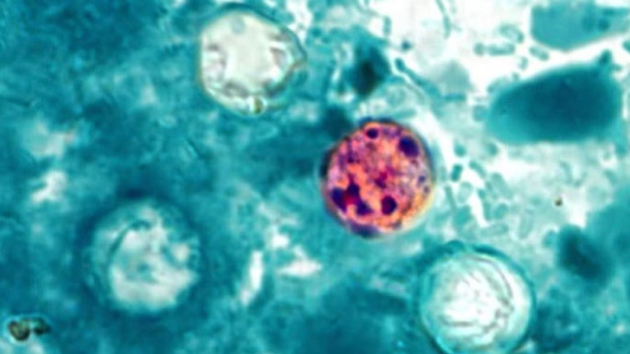
(DETROIT) — Cases of a parasitic infection are continuing to rise in at least two states, local health officials said.
As of July 6, nearly 700 cases of cyclosporiasis, an intestinal infection, were confirmed, an official from the Michigan Department of Health and Human Services (MDHHS) told ABC News on Monday. This is an increase from the roughly 300 cases reported on Thursday.
The 678 cases have predominantly been confirmed the southeast region of Michigan including Wayne County, where Detroit is located.
Typically, the state has 50 cases per year, meaning cases are currently about 13.5 times higher than on average.
Dr. Natasha Bagdasarian, an infectious disease physician, epidemiologist and the chief medical executive for the state of Michigan, described the 678 figure as a “moving target,” meaning that cases are likely to continue rising.
“There is a significant lag time between exposure to contaminated produce or contaminated materials and development of symptoms,” she told ABC News. “So it can take a week, sometimes even two weeks between exposure and development of symptoms.”
She added that there may be some infected individuals who are only now reading news reports and getting tested, so there may be even more delayed diagnoses.
Additionally, in Ohio, there were 177 cases of cyclosporiasis as of July 2, Ken Gordon, press secretary for the Ohio Department of Health’s communications office, confirmed to ABC News.
Cases have been confirmed across 43 counties in Ohio so far this year, according to Gordon. Most of those cases — 171 — were reported since June 20.
Meanwhile, the Centers for Disease Control and Prevention (CDC) reports 145 cases have been detected in 17 states since May 1, excluding Michigan, as of June 16, with at least 20 people hospitalized. No deaths have been reported.
The CDC said cases ranged between age 5 and 86, with a median age of 42, and 61% were female.
So far, no cases have been linked between states and health officials are still investigating if there is a common source of the outbreak in Michigan.
The parasite usually spreads through food or water contaminated with feces, according to the CDC.
Foodborne outbreaks of cyclosporiasis have been linked to various types of imported fresh produce, such as raspberries, basil, snow peas, mesclun lettuce and cilantro, according to the CDC. The agency further said it takes about one week from the time of infection to become symptomatic, but that time can range from two days to two weeks.
Bagdasarian said MDHHS’s working hypothesis is that the outbreak is linked to contaminated produce, but it’s unclear which produce, how long it has been on the shelf or where it’s been distributed.
“We are making sure that we’re issuing guidance to the public as well as to restaurants and commercial kitchens so that folks know the safest way to eat produce right now,” she said. “If folks are making the switch and consuming all of these products as safely as possible, that could mean that we are still seeing cases where people were exposed.”
Some patients do not experience any symptoms but, for those who do, the most common symptom is “explosive watery diarrhea,” doctors previously told ABC News. Other symptoms can include cramping, bloating, low-grade fever, nausea and vomiting, the doctors said.
Since cyclosporiasis symptoms can resemble other illnesses, it may be hard for a patient to determine what they are infected with.
While a traditional stomach bug will have symptoms that typically disappear within 24 to 48 hours, cyclosporiasis symptoms may last for days or even weeks, Bagdasarian noted.
“If you believe that you could have cyclosporiasis, it’s really important to see your healthcare provider and to mention cyclosporiasis, just in case they haven’t heard about this outbreak happening right now, and ask for stool testing, because not all stool testing routinely will include cyclosporiasis,” she said.
The CDC said the infection is very unlikely to spread from person to person because it takes at least one to two weeks outside the body for the parasite to become infectious after someone passes a bowel movement.
Local and federal authorities are working to find the cause of cases in various states and to see if there are any connections. So far none have been identified.
Cyclosporiasis is treated with the oral antibiotic trimethoprim-sulfamethoxazole (TMP-SMX), commonly sold as Bactrim, Septra and Cotrim, taken for 10 days, according to the CDC.
The CDC recommends that people can prevent infection by thoroughly washing produce, cutting away bruised or damaged parts of fruits and vegetables and refrigerating pre-prepared or pre-cut produce.
“Grabbing a scrub brush can also be helpful,” Dr. Darien Sutton, an emergency medicine physician and ABC News medical correspondent, said on “Good Morning America Weekend” on Sunday. “And an important note here, this type of parasite doesn’t easily go away with alcohol-based hand sanitizer. So, good old handwashing is really key here.”
ABC News’ Megan Fahrney contributed to this report.
Copyright © 2026, ABC Audio. All rights reserved.