Canadian wildfire smoke descends on US, spreading from Great Lakes to New England

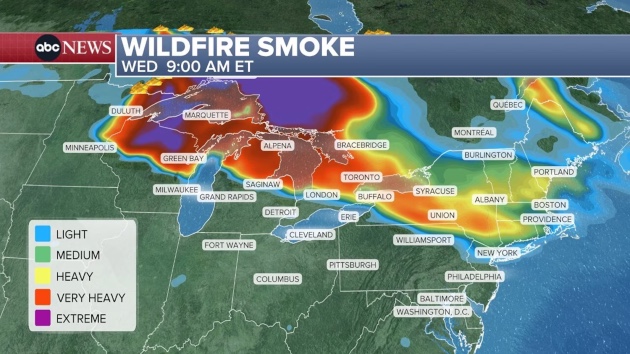
An ABC News graphic shows the forecast for Wednesday, July 15, 2026. (ABC News)

(NEW YORK) — More than 830 wildfires were burning on Wednesday in Canada, along with more than a dozen in northern Minnesota, near the border, growing with little or no containment and forcing mandatory evacuations.

Some of the largest wildfires are burning in west-central Ontario, and those fires are burning through thick forests, releasing an incredible amount of smoke.

The wind is now directing that very heavy smoke into America, creating dangerous air quality for millions across the upper Midwest and Northeast on Wednesday and through the end of the week

Rain on Friday over the upper Midwest and on Saturday for the Northeast should help disperse smoke.

Very heavy smoke is over Duluth, Minnesota, and Marquette, Michigan, on Wednesday morning, and extreme smoke is over northern Wisconsin.

Some heavy smoke will move over New York State and New England by mid-morning, potentially reaching New York City to Boston by 2 p.m. ET.

By sunset on Wednesday, very heavy smoke may reach from Buffalo to New York City and Philadelphia — streaming through Green Bay, Milwaukee, Grand Rapids, Detroit and Toronto.

Conditions in New York City are not expected to be as intense as they were in June 2023.

Hazy skies are expected and air quality will likely become unhealthy.

Conditions could, however, be that bad — Mars-like and smelling like a campfire — and some of the worst air quality in the world, on Thursday from Duluth to Green Bay and Marquette through much of northern Michigan.

Cleveland, Columbus, Baltimore and D.C. will likely see heavy smoke on Thursday.

The smoke will be serious for millions and may reach a dangerous level for everyone — not just those with respiratory issues.

Air quality alerts are in place from Minnesota to New York City, including the entire states of Wisconsin and Michigan.

Copyright © 2026, ABC Audio. All rights reserved.

How Canada’s retaliation could hurt American businesses and consumers

(CNN) — Canada has a number of arrows in its quiver as it prepares to retaliate against the United States, and they could land hit American consumers and businesses.Already, Ottawa has vowed to match Washington’s latest tariffs dollar for dollar. But Canada also has other tools at its disposal, including restrictions on key exports to the United States.Here’s what Canada could do next — and what each move could mean for Americans.The first move: tariffsCanada’s first move in the brewing trade war is likely to be a straightforward eye-for-an-eye response.Retaliatory tariffs “will be concentrated in sectors such as steel, dairy, appliances, agricultural equipment, pulp and paper, and electronics,” Prime Minister Mark Carney said over the weekend, adding that more details would be shared “in the coming days.”With the exception of steel, all of those industries are also covered by President Donald Trump’s new tariffs. Canada is an important market for US exporters in those sectors: Last year, it ranked as either the largest or second-largest destination for American exports across most of those industries, according to US trade data.Carney also said Canada is considering tariffs aimed at industries Trump has already targeted with separate duties, including cars, steel, aluminum, lumber and copper.The risk for Americans here is that steep Canadian tariffs could weaken demand for these goods, which could force employers to cut workers’ hours or, in some cases, resort to layoffs.The bigger weaponsTrump already signaled he may go beyond the latest tariffs in his trade fight with Canada, threatening on Monday to double tariffs on Canadian cars and auto parts to 50% starting January 1.If Trump follows through — or escalates in other ways — Ottawa could use other ammunition.Canada could restrict key exports to the US, such as energy and a key fertilizer ingredient known as potash, said Diamond Isinger, a policy strategist and former special advisor on Canada-US relations to Prime Minister Justin Trudeau.Another vulnerable area is electricity. Ford said in an interview published Monday that Canada should be prepared to cut off electricity exports to the United States if the trade war worsens, putting a potentially powerful weapon on the table. Ontario supplies electricity to several US states, including New York, Michigan and Minnesota.Carney echoed Ford on Monday, telling reporters that “nothing is off the table.”Any such moves could add to the price pressures Americans have faced this year. Altogether the cost of living is up 3.4% from a year ago, according to July Consumer Price Index data. Gas prices, up almost 25% compared to last year, have weighed heavily on consumers’ finances. The cost of powering homes is also up, with electricity and piped gas both costing around 4% more annually.How badly will it hurt?Tariffs could make it harder for US companies to sell their goods in Canada.Restrictions on energy, electricity or critical minerals, something Ford also floated, could instead raise costs for American companies and consumers by making key inputs more expensive or harder to obtain.For instance, last year, Ontario briefly applied a 25% surcharge on electricity imports to the United States. The Ontario government estimated at the time that it would affect 1.5 million American homes, costing up to $400,000 CAD (around $280,000 USD) “every day the surcharge remains in place.”Restrictions on these key Canadian goods could quickly be felt by US businesses and consumers, making it harder to stay afloat, Isinger said.The-CNN-Wire™ & © 2026 Cable News Network, Inc., a Warner Bros. Discovery Company. All rights reserved.
Read Next Story