Bird strike likely caused New York City helicopter crash in Hudson River: NTSB

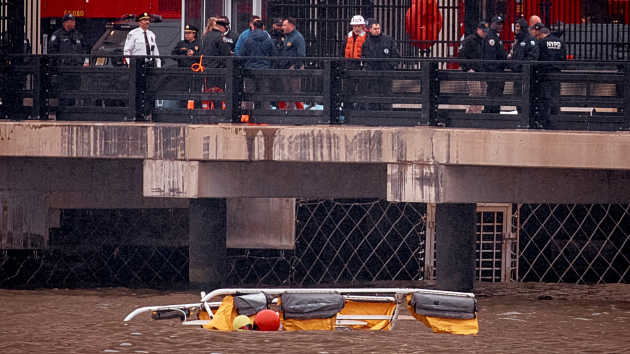
Police and firefighters work on the site after a helicopter crashed in the Hudson River on April 10, 2025, in Jersey City, New Jersey. All six people on board were killed when a helicopter plunged into the Hudson River off of Lower Manhattan. (Photo by Andres Kudacki/Getty Images)

(NEW YORK) — A bird strike likely caused last year’s tourist helicopter crash in New York City’s Hudson River that killed all six people on board, according to the National Transportation Safety Board.

The more than 2,000 pages of information released by the NTSB is not the final report and does not state the probable cause, but the documents show the chopper slammed into multiple large birds before the crash.

The birds hit the rotor blades and the horizontal stabilizer, according to an analysis by the Smithsonian Institution’s Feather Identification Lab. Samples of “mixed species” of birds were found, including Canada Geese and black-backed Gull. Canadian Geese can sometimes weigh more than 10 pounds each.

Videos showed the rotors flying off the helicopter as it plummeted to the water. 

The chopper crashed into the Hudson in April 2025 while carrying a pilot and a family from Spain: Siemens executive Agustin Escobar, his wife Merce Camprubi Montal, and their three children.

One witness told ABC News she watched the helicopter “fall out of the sky” from her apartment window.

“I heard five or six loud noises that sounded almost like gunshots in the sky and saw pieces fall off, then watched it fall into the river,” she said.

Bird strikes are common; there were 20,876 bird strikes to civilian aircraft in the U.S. in 2024, according to the Wildlife strikes to Civil Aircraft report

It is not clear when the NTSB’s final report — which will list the probable cause of the crash — will be released.

ABC News has reached out to the helicopter company for comment. New York Helicopter Charter inc. shutdown following the crash.  

Copyright © 2026, ABC Audio. All rights reserved.

How Canada’s retaliation could hurt American businesses and consumers

(CNN) — Canada has a number of arrows in its quiver as it prepares to retaliate against the United States, and they could land hit American consumers and businesses.Already, Ottawa has vowed to match Washington’s latest tariffs dollar for dollar. But Canada also has other tools at its disposal, including restrictions on key exports to the United States.Here’s what Canada could do next — and what each move could mean for Americans.The first move: tariffsCanada’s first move in the brewing trade war is likely to be a straightforward eye-for-an-eye response.Retaliatory tariffs “will be concentrated in sectors such as steel, dairy, appliances, agricultural equipment, pulp and paper, and electronics,” Prime Minister Mark Carney said over the weekend, adding that more details would be shared “in the coming days.”With the exception of steel, all of those industries are also covered by President Donald Trump’s new tariffs. Canada is an important market for US exporters in those sectors: Last year, it ranked as either the largest or second-largest destination for American exports across most of those industries, according to US trade data.Carney also said Canada is considering tariffs aimed at industries Trump has already targeted with separate duties, including cars, steel, aluminum, lumber and copper.The risk for Americans here is that steep Canadian tariffs could weaken demand for these goods, which could force employers to cut workers’ hours or, in some cases, resort to layoffs.The bigger weaponsTrump already signaled he may go beyond the latest tariffs in his trade fight with Canada, threatening on Monday to double tariffs on Canadian cars and auto parts to 50% starting January 1.If Trump follows through — or escalates in other ways — Ottawa could use other ammunition.Canada could restrict key exports to the US, such as energy and a key fertilizer ingredient known as potash, said Diamond Isinger, a policy strategist and former special advisor on Canada-US relations to Prime Minister Justin Trudeau.Another vulnerable area is electricity. Ford said in an interview published Monday that Canada should be prepared to cut off electricity exports to the United States if the trade war worsens, putting a potentially powerful weapon on the table. Ontario supplies electricity to several US states, including New York, Michigan and Minnesota.Carney echoed Ford on Monday, telling reporters that “nothing is off the table.”Any such moves could add to the price pressures Americans have faced this year. Altogether the cost of living is up 3.4% from a year ago, according to July Consumer Price Index data. Gas prices, up almost 25% compared to last year, have weighed heavily on consumers’ finances. The cost of powering homes is also up, with electricity and piped gas both costing around 4% more annually.How badly will it hurt?Tariffs could make it harder for US companies to sell their goods in Canada.Restrictions on energy, electricity or critical minerals, something Ford also floated, could instead raise costs for American companies and consumers by making key inputs more expensive or harder to obtain.For instance, last year, Ontario briefly applied a 25% surcharge on electricity imports to the United States. The Ontario government estimated at the time that it would affect 1.5 million American homes, costing up to $400,000 CAD (around $280,000 USD) “every day the surcharge remains in place.”Restrictions on these key Canadian goods could quickly be felt by US businesses and consumers, making it harder to stay afloat, Isinger said.The-CNN-Wire™ & © 2026 Cable News Network, Inc., a Warner Bros. Discovery Company. All rights reserved.
Read Next Story