
Atlantic hurricane season is coming up. Here’s what NOAA predicts.

▶ Watch Video: 2026 Atlantic hurricane season predicted to be “below-average,” but don’t let your guard down

The 2026 Atlantic hurricane season begins June 1, and as coastal residents watch the forecast and wait to see what nature has in store, the National Oceanic and Atmospheric Administration is releasing its outlook for the months ahead.

NOAA is predicting a below-average season this year, with eight to 14 named storms. Of them, three to six are expected to become hurricanes, including one to three major hurricanes of Category 3 strength or higher, agency officials announced Thursday.

They stressed that a below-average forecast should not keep people in hurricane-prone areas from taking it seriously and getting prepared.

“Even though we’re expecting a below-average season in the Atlantic, it’s very important to understand that it only takes one,” said NOAA administrator Neil Jacobs. “We have had Category 5 storms make landfall in the past during below average seasons.”

Jacobs and National Weather Service director Ken Graham praised technological advancements that, they said, will take storm preparedness to the next level.

“We’ve never been as prepared for hurricane season as we are now,” said Graham. NOAA encompasses the Weather Service, which directly handles hurricane forecasts.

NOAA estimates there’s currently a 55% chance that activity during hurricane season will be below-normal, a 35% chance it will be near-normal, and a 10% chance it will be above-normal, Jacobs added.
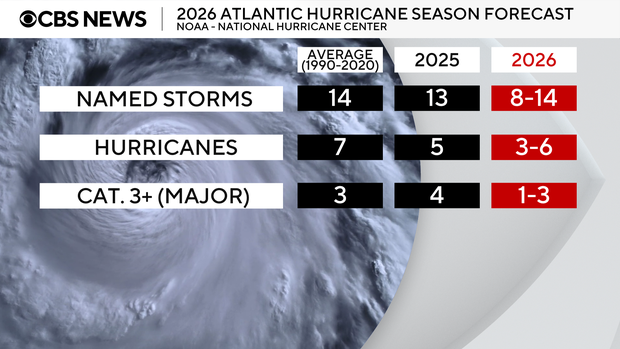
2026-nhc-forecast.png

Nikki Nolan/CBS News

A storm receives a name if its maximum sustained wind speeds reach at least 39 mph, and it becomes a hurricane if those winds climb to 74 mph. Hurricanes are classified as “major” when they reach wind speeds of at least 111 mph. That strength places them in Category 3 or higher on the Saffir-Simpson Scale used to rate storm intensity.

The Atlantic hurricane season runs through Nov. 30, with activity typically peaking between August and October. That window tends to see the greatest number of storms develop, and a season’s most intense storms often develop in those months, too.

NOAA’s outlook will be updated several times throughout the summer to reflect any changes in the forecast over time.

How accurate was NOAA’s 2025 hurricane forecast?

NOAA’s hurricane predictions are generally fairly accurate, although not always exact. 

The agency’s 2025 outlook originally predicted last year’s hurricane season would include 13 to 19 named storms, six to 10 hurricanes and three to five major hurricanes. The forecast was adjusted slightly downward in August to predict 13 to 18 named storms, five to nine hurricanes and two to five major hurricanes. 

In the end, there were 13 named storms overall in 2025, including five hurricanes, four of which were major. 
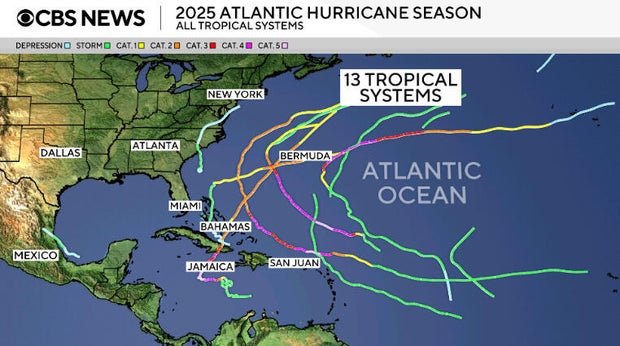
Map shows the path of storms from the 2025 Atlantic hurricane season.

CBS News

That was a bit quieter than an average season, which has 14 named storms, seven hurricanes and three major hurricanes.

Impact of El Niño on 2026 hurricane season

The upcoming hurricane season may be influenced by the transition into El Niño, an oscillating climate pattern that affects weather conditions in the United States and has historically been associated with fewer Atlantic storms. 

However, as CBS News meteorologist Nikki Nolan wrote in a recent El Niño forecast, its emergence “does not necessarily mean that we won’t see any Atlantic hurricane systems — just statistically, there may be less than average.”

On the West Coast, the effect goes in the other direction: the warmer Pacific waters in an El Niño help enable tropical storms and hurricanes in the Pacific to develop and stay fully structured vertically. 

NOAA’s Climate Prediction Center said last week that there’s at least an 82% chance El Niño will arrive by July. Scientists are still monitoring conditions that will help them determine how strong it will be.

NOAA’s 2026 outlook is being released about six weeks after another major hurricane forecast from Colorado State University’s Tropical Cyclones, Radar, Atmospheric Modeling and Software Team. The CSU forecast predicted slightly less activity than usual in the Atlantic basin this year, with researchers estimating that the upcoming season would see 13 named storms, including six hurricanes and two major hurricanes. Like NOAA, they will release updated forecasts periodically in the coming months.
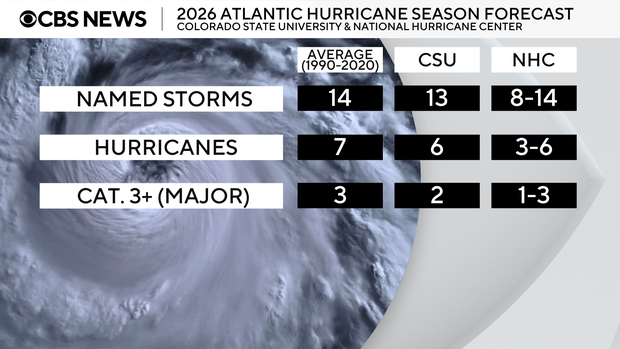
2026-nhc-csu-forecast.png

Nikki Nolan/CBS News

2026 Atlantic hurricane season storm names

Every year, the World Meteorological Organization preemptively compiles a list of names that will be assigned to tropical storms and hurricanes that develop during the upcoming Atlantic season. The roster includes 21 names, each starting with a different letter of the alphabet. If more than 21 storms form in a single year, which happens occasionally, then a supplemental list of names will also be used.

Here’s the main list of names for 2026:

  • Arthur
  • Bertha
  • Cristobal
  • Dolly
  • Edouard
  • Fay
  • Gonzalo
  • Hanna
  • Isaias
  • Josephine
  • Kyle
  • Leah
  • Marco
  • Nana
  • Omar
  • Paulette
  • Rene
  • Sally
  • Teddy
  • Vicky
  • Wilfred

US Army attack helicopters crashing at historically high rate amid mechanical issues

(CNN) — The US Army’s Apache helicopters are crashing at a historically high rate amid a widespread problem with the model’s transmission, according to a CNN analysis of military accident data.The helicopter type has experienced five major crashes since October, and a deadly mishap earlier this month in Texas killed two soldiers, sparked a wildfire and led the Army to temporarily bar Apache pilots from conducting routine training flights. With that crash, fiscal year 2026 is on pace to be the second worst for Apache flight accidents since a new model of the AH-64 was rolled out in 2011.The Army announced that the pause in training flights, which exempted units deployed to the Middle East, ended Wednesday.This year’s rate of major Apache crashes — known as Class A mishaps in Army parlance, meant to represent any accident that kills or permanently disables a person or results in the loss of an aircraft or $2.5 million in damage — surpasses typical years and rivals that of the service’s most severe rate in the 2024 fiscal year, according to CNN’s review of data. The accident rate is based on the number of incidents compared to the total hours the aircraft spent flying, calculated using data that has been publicly released and flight hour estimates for the current year provided to CNN by the Army.In Fiscal year 2024 there were nine major Apache crashes amid a spike in accidents across all Army helicopter models. Army leaders ordered a special safety training initiative that year and attributed the accidents to human errors stemming from decreased experience among its pilots and an increase in training intensity and complexity after Russia’s invasion of Ukraine inspired a new focus on preparing for major conflicts.But the causes of this year’s spike are murkier. The July issue of an official Army flight safety newsletter said that just over half of this year’s Apache accidents, including more minor incidents, are primarily attributable to human error. It’s unclear how many of the most-severe crashes are due to equipment failures, but the magazine said that “a catastrophic transmission failure was noted in one Class A mishap.”CNN estimated this year’s major Apache crash rate to be approximately 6.24 per every 100,000 flying hours. Thus far in fiscal year 2026, five Class A flight mishaps involving the attack helicopter have occurred. The Apache, through August 15, had flown approximately 80,171 hours. That number combines 42,971 hours through March 31 that were listed in the internal Army safety newsletter and an estimate provided to CNN by an Army safety spokesperson that pilots had logged approximately 37,200 additional flight hours through August 15.Fiscal year 2024, by comparison, had a rate of 7.02 major crashes per 100,000 hours for the aircraft.The E-model Apache, introduced in 2011, has faced significant problems this year with its transmission that could knock out the aircraft’s tail rotor, electrical power and hydraulics, according to a pair of internal safety messages obtained by CNN. The loss of those systems can put a helicopter into a sudden spin and potentially knock out its flight controls. As of mid-July, the cause of the problems remained “under investigation,” according to a safety message released at the time.Army spokesperson Maj. Montrell Russell declined to answer questions regarding the transmission investigation or disclose any “preliminary findings” regarding the causes of this month’s deadly Texas crash at Fort Hood.“We express our deep sadness over the loss of the two Soldiers near Fort Hood,” Russell said in a statement to CNN.He said that “special controls and release protections” prevent the service from providing detailed “technical aviation information,” to include how many of this year’s crashes are related to the helicopters’ transmission.The initial April safety message, first reported by trade publication Defense One, identified 70 potentially faulty transmissions and ordered all units to stop flying affected Apaches pending repair. A follow-up message sent in mid-July said the root cause remains “under investigation” and added 10 more suspect transmissions to the no-fly list.The two safety messages combined to impact roughly a tenth of the Army’s attack helicopter fleet. In early June, an Army official told CNN that all affected Apaches remained grounded, and the Army did not answer CNN’s questions about how many, if any, have returned to flight since then.Meanwhile, the Apache’s transmission issues continue to be mentioned in Army flight documents. CNN obtained an August 14 internal Army order that formally cited the two transmission safety messages in its references for the service’s training flight pause after the Texas crash. Russell cautioned that “including these messages in safety reviews does not imply causation for any individual mishap.”The Apache’s manufacturer, Boeing, has deployed teams to Army maintenance depots to assist with inspecting and fixing the transmissions, according to the Army order.The Army and Boeing did not answer questions on how they identified the potentially faulty parts.A Boeing spokesperson confirmed to CNN that the company is “supporting the U.S. Army’s investigation to ensure the operational readiness and safety of any affected aircraft,” but referred additional questions to the Army.Davis Winkie’s work at CNN is supported by a partnership between Outrider Foundation and Journalism Funding Partners (JFP). CNN retains full editorial control of the reporting.The-CNN-Wire™ & © 2026 Cable News Network, Inc., a Warner Bros. Discovery Company. All rights reserved.
Read Next Story