At least 12 dead, 23 missing amid fast-moving wildfire in southern Spain

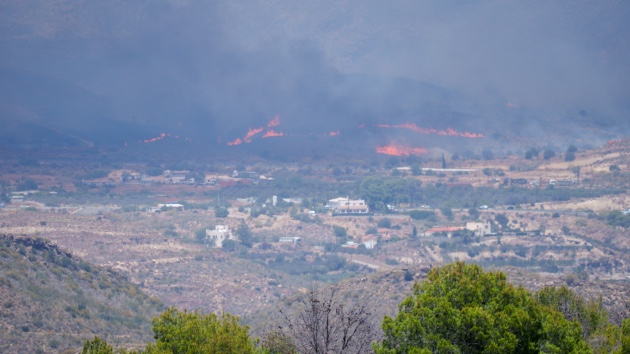
Image of the wildfire that broke out in the Los Gallardos area (Almeria) on 10 July 2026, in Los Gallardos, Almeria, Andalusia, Spain. (Photo By Francisco J. Olmo/Europa Press via Getty Images)

(LOS GALLARDOS, Spain) — At least 12 people have died and 23 others are unaccounted for as firefighters in southern Spain battle a rapidly spreading wildfire, officials said.

Emergency services in Andalusia said the death toll rose overnight amid the devastating blaze.

Andalusian regional leader Juanma Moreno said in a post on X that eight people had also been injured, including four who were in serious condition.

In an interview Friday morning on Spanish radio, Moreno said four of those killed were believed to be British nationals who became trapped in a car while trying to escape the flames.

The majority of the victims were from outside Spain, particularly British and Belgian nationals, Moreno said later Friday, but added that authorities are still working to identify the deceased.

The wildfire, burning in the municipality of Los Gallardos in Spain’s southeastern Almeria province, continued to spread rapidly, with Moreno warning that weather conditions remained unfavorable for firefighters.

“The consequences are devastating,” Moreno said in his post on X.

Speaking to reporters Friday evening in Turre, a couple of miles from the wildfire in Los Gallardos, Moreno called the blaze a “major tragedy” and warned Spain is facing a challenging summer due to heavy winter rainfall that fueled a surge in spring undergrowth which has now dried out with the heatwaves.

Emergency crews on Friday were continuing search-and-rescue operations as they worked to locate the people still reported missing.

Moreno told reporters that firefighters were battling to control one of the fastest and most complex wildfires in the Andalusia region in years.

Spanish officials cautioned that the full scale of the disaster is still emerging as rescue efforts continue and officials work to identify victims.

Earlier Friday, a regional government official said in an interview that the fire was likely caused by an electric poll which had fallen.

The regional minister for emergencies in Andalusia, Antonio Sanz Cabello, said on Friday that last night was “a truly tragic night” with “terrible consequences.”

He said fighting the fire has been made more complicated by the remote terrain and the lack of access for heavy machinery. Sixteen aircraft are being used to fight the wildfire.

Cabello urged people to take maximum care and said teams are still fighting the wildfire in Los Gallardos “with all their strength.”

Andalusia’s government has urged people to be careful and follow all evacuation instructions from officials.

ABC News’ Claire Bower contributed to this report.

Copyright © 2026, ABC Audio. All rights reserved.

How Canada’s retaliation could hurt American businesses and consumers

(CNN) — Canada has a number of arrows in its quiver as it prepares to retaliate against the United States, and they could land hit American consumers and businesses.Already, Ottawa has vowed to match Washington’s latest tariffs dollar for dollar. But Canada also has other tools at its disposal, including restrictions on key exports to the United States.Here’s what Canada could do next — and what each move could mean for Americans.The first move: tariffsCanada’s first move in the brewing trade war is likely to be a straightforward eye-for-an-eye response.Retaliatory tariffs “will be concentrated in sectors such as steel, dairy, appliances, agricultural equipment, pulp and paper, and electronics,” Prime Minister Mark Carney said over the weekend, adding that more details would be shared “in the coming days.”With the exception of steel, all of those industries are also covered by President Donald Trump’s new tariffs. Canada is an important market for US exporters in those sectors: Last year, it ranked as either the largest or second-largest destination for American exports across most of those industries, according to US trade data.Carney also said Canada is considering tariffs aimed at industries Trump has already targeted with separate duties, including cars, steel, aluminum, lumber and copper.The risk for Americans here is that steep Canadian tariffs could weaken demand for these goods, which could force employers to cut workers’ hours or, in some cases, resort to layoffs.The bigger weaponsTrump already signaled he may go beyond the latest tariffs in his trade fight with Canada, threatening on Monday to double tariffs on Canadian cars and auto parts to 50% starting January 1.If Trump follows through — or escalates in other ways — Ottawa could use other ammunition.Canada could restrict key exports to the US, such as energy and a key fertilizer ingredient known as potash, said Diamond Isinger, a policy strategist and former special advisor on Canada-US relations to Prime Minister Justin Trudeau.Another vulnerable area is electricity. Ford said in an interview published Monday that Canada should be prepared to cut off electricity exports to the United States if the trade war worsens, putting a potentially powerful weapon on the table. Ontario supplies electricity to several US states, including New York, Michigan and Minnesota.Carney echoed Ford on Monday, telling reporters that “nothing is off the table.”Any such moves could add to the price pressures Americans have faced this year. Altogether the cost of living is up 3.4% from a year ago, according to July Consumer Price Index data. Gas prices, up almost 25% compared to last year, have weighed heavily on consumers’ finances. The cost of powering homes is also up, with electricity and piped gas both costing around 4% more annually.How badly will it hurt?Tariffs could make it harder for US companies to sell their goods in Canada.Restrictions on energy, electricity or critical minerals, something Ford also floated, could instead raise costs for American companies and consumers by making key inputs more expensive or harder to obtain.For instance, last year, Ontario briefly applied a 25% surcharge on electricity imports to the United States. The Ontario government estimated at the time that it would affect 1.5 million American homes, costing up to $400,000 CAD (around $280,000 USD) “every day the surcharge remains in place.”Restrictions on these key Canadian goods could quickly be felt by US businesses and consumers, making it harder to stay afloat, Isinger said.The-CNN-Wire™ & © 2026 Cable News Network, Inc., a Warner Bros. Discovery Company. All rights reserved.
Read Next Story