
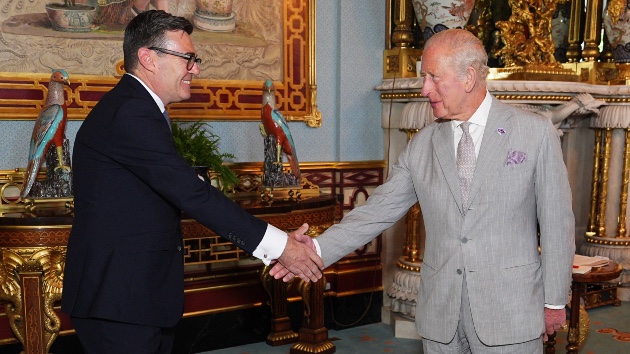
Andy Burnham becomes UK’s next prime minister after meeting with King Charles III

King Charles III welcomes Andy Burnham, during an audience at Buckingham Palace, London, where he invited the leader of the Labour Party to become Prime Minister and form a new government, on July 20, 2026 in London, England. (Photo by Aaron Chown – Pool/Getty Images)

(LONDON) — Andy Burnham officially became British prime minister on Monday — the country’s seventh leader in 10 years — having already been elected as the leader of the country’s Labour Party last week.

Burnham, who until recently was serving as the mayor of Greater Manchester, succeeded outgoing Prime Minister Keir Starmer.

Speaking outside the prime minister’s official residence — 10 Downing Street — on Monday morning, Starmer said, “Today I am here to offer my resignation and close the book on my time as prime minister. My work is done.”

“I thank the British people for the opportunity to serve. I go with good grace, I go with a smile, and I go proud of everything that we have achieved. Thank you very much,” Starmer added.

Of his successor, the outgoing prime minister said, “I now pass the baton to Andy Burnham, I wish him every success. He has my full support.”

After his address, Starmer traveled the short distance to Buckingham Palace to formally inform King Charles III of his resignation. Burnham then also traveled to palace where the king asked him to form a government.

The new prime minister then traveled to Downing Street to give his first address, telling the assembled press that Britain must show “that we can regain our stability.”

Burnham said his appointment will serve as “a circuit-breaker” for the country, pledging to deliver a new political and economic model and a 10-year plan.

Among the new prime’s commitments were to address cost of living concerns, help young people into work, end homelessness, re-industrialize the country, put “life’s essentials back under public control” and push for more local powers.

Through the rest of Monday, Burnham is expected to begin appointing cabinet ministers from Number 10.

Starmer announced that he would step down in June, following months of domestic political turmoil. Despite leading Labour to a historic majority in parliament in the 2024 general election, Starmer faced persistent external and internal criticism over his perceived failure to deliver rapid change after 14 years of Conservative Party rule in Britain.

Many in Starmer’s party had written to the prime minister asking him to step down following local elections in May, which saw the party lose more than 1,000 seats on local councils, results that were widely interpreted as a repudiation by British voters of Labour’s performance under the prime minister’s leadership.

Starmer long said he intended to see out his full five-year. Announcing his resignation in June, Starmer said, “The question my party is asking now is whether I am best placed to lead us into the next general election. I have heard the answer of my parliamentary party to that question, and I accept that answer with good grace.”

Burnham was the only candidate in the subsequent leadership election, ultimately winning nominations from 379 of the 403 Labour members of parliament — of the 650 MPs in total — in the House of Commons.

In accepting the leadership of Labour last week, Burnham said his mission was “to bring back hope” and address decades of economic inequality plus falling living standards.

“We must recognize that this generation of politicians — myself included — have failed to challenge a political culture and an economic model that simply doesn’t work well enough for ordinary people,” he said.

Burnham will become the seventh leader to take the reins of the country in 10 years, a reflection of the political and economic turbulence that has beset the country since the Brexit vote in 2016.

The incoming prime minister said he would also make British politics “less toxic, adding, “I will work to build a new politics. The country is crying out for it.”

Burnham, 56, was born in the Lancashire region of northern England. Burnham started out as a journalist, writing for trade magazines, before transitioning to work as a Labour parliamentary researcher while in his early 20s.

Burnham rose through the party ranks before being elected as the MP for his hometown of Leigh, in Greater Manchester, in 2001. He held that seat for 16 years, during which time he was appointed to several cabinet positions under Prime Ministers Tony Blair and Gordon Brown.

During Labour’s years in opposition, Burnham bid to become Labour leader twice, but was defeated by — and then served in shadow cabinets of — Labour leaders Ed Miliband and Jeremy Corbyn.

In 2017, Burnham left parliament to become the mayor of Greater Manchester. In his victory speech, Burnham heralded what he called “the dawn of a new era, not just for this city region but for politics in our country. It has been too London-centric for too long. The old political and party structures haven’t delivered for all people and for all places.”

Burnham is associated with the center left of the Labour Party, and has described himself as a socialist. Burnham’s time as Manchester mayor saw him emerge as a major proponent of shifting investment and political power out of London, and earned him the nickname “the King of the North.”

ABC News’ Kevin Shalvey contributed to this report.

Copyright © 2026, ABC Audio. All rights reserved.

US Army attack helicopters crashing at historically high rate amid mechanical issues

(CNN) — The US Army’s Apache helicopters are crashing at a historically high rate amid a widespread problem with the model’s transmission, according to a CNN analysis of military accident data.The helicopter type has experienced five major crashes since October, and a deadly mishap earlier this month in Texas killed two soldiers, sparked a wildfire and led the Army to temporarily bar Apache pilots from conducting routine training flights. With that crash, fiscal year 2026 is on pace to be the second worst for Apache flight accidents since a new model of the AH-64 was rolled out in 2011.The Army announced that the pause in training flights, which exempted units deployed to the Middle East, ended Wednesday.This year’s rate of major Apache crashes — known as Class A mishaps in Army parlance, meant to represent any accident that kills or permanently disables a person or results in the loss of an aircraft or $2.5 million in damage — surpasses typical years and rivals that of the service’s most severe rate in the 2024 fiscal year, according to CNN’s review of data. The accident rate is based on the number of incidents compared to the total hours the aircraft spent flying, calculated using data that has been publicly released and flight hour estimates for the current year provided to CNN by the Army.In Fiscal year 2024 there were nine major Apache crashes amid a spike in accidents across all Army helicopter models. Army leaders ordered a special safety training initiative that year and attributed the accidents to human errors stemming from decreased experience among its pilots and an increase in training intensity and complexity after Russia’s invasion of Ukraine inspired a new focus on preparing for major conflicts.But the causes of this year’s spike are murkier. The July issue of an official Army flight safety newsletter said that just over half of this year’s Apache accidents, including more minor incidents, are primarily attributable to human error. It’s unclear how many of the most-severe crashes are due to equipment failures, but the magazine said that “a catastrophic transmission failure was noted in one Class A mishap.”CNN estimated this year’s major Apache crash rate to be approximately 6.24 per every 100,000 flying hours. Thus far in fiscal year 2026, five Class A flight mishaps involving the attack helicopter have occurred. The Apache, through August 15, had flown approximately 80,171 hours. That number combines 42,971 hours through March 31 that were listed in the internal Army safety newsletter and an estimate provided to CNN by an Army safety spokesperson that pilots had logged approximately 37,200 additional flight hours through August 15.Fiscal year 2024, by comparison, had a rate of 7.02 major crashes per 100,000 hours for the aircraft.The E-model Apache, introduced in 2011, has faced significant problems this year with its transmission that could knock out the aircraft’s tail rotor, electrical power and hydraulics, according to a pair of internal safety messages obtained by CNN. The loss of those systems can put a helicopter into a sudden spin and potentially knock out its flight controls. As of mid-July, the cause of the problems remained “under investigation,” according to a safety message released at the time.Army spokesperson Maj. Montrell Russell declined to answer questions regarding the transmission investigation or disclose any “preliminary findings” regarding the causes of this month’s deadly Texas crash at Fort Hood.“We express our deep sadness over the loss of the two Soldiers near Fort Hood,” Russell said in a statement to CNN.He said that “special controls and release protections” prevent the service from providing detailed “technical aviation information,” to include how many of this year’s crashes are related to the helicopters’ transmission.The initial April safety message, first reported by trade publication Defense One, identified 70 potentially faulty transmissions and ordered all units to stop flying affected Apaches pending repair. A follow-up message sent in mid-July said the root cause remains “under investigation” and added 10 more suspect transmissions to the no-fly list.The two safety messages combined to impact roughly a tenth of the Army’s attack helicopter fleet. In early June, an Army official told CNN that all affected Apaches remained grounded, and the Army did not answer CNN’s questions about how many, if any, have returned to flight since then.Meanwhile, the Apache’s transmission issues continue to be mentioned in Army flight documents. CNN obtained an August 14 internal Army order that formally cited the two transmission safety messages in its references for the service’s training flight pause after the Texas crash. Russell cautioned that “including these messages in safety reviews does not imply causation for any individual mishap.”The Apache’s manufacturer, Boeing, has deployed teams to Army maintenance depots to assist with inspecting and fixing the transmissions, according to the Army order.The Army and Boeing did not answer questions on how they identified the potentially faulty parts.A Boeing spokesperson confirmed to CNN that the company is “supporting the U.S. Army’s investigation to ensure the operational readiness and safety of any affected aircraft,” but referred additional questions to the Army.Davis Winkie’s work at CNN is supported by a partnership between Outrider Foundation and Journalism Funding Partners (JFP). CNN retains full editorial control of the reporting.The-CNN-Wire™ & © 2026 Cable News Network, Inc., a Warner Bros. Discovery Company. All rights reserved.
Read Next Story