
WHO says Ebola risks high for region, but not a ‘pandemic emergency’

▶ Watch Video: Details on Ebola outbreak as Americans urged to avoid travel to Congo, Uganda, South Sudan

Geneva — The World Health Organization on Wednesday said the risk of the Democratic Republic of Congo’s deadly Ebola outbreak was currently high at the national and regional levels but low worldwide.

WHO experts said that while investigations into its origins were ongoing, given the scale of the situation in the eastern DRC, the outbreak probably began a couple of months ago.

But the UN health agency’s emergency committee said it did not currently meet the pandemic emergency threshold.

“WHO assesses the risk of the epidemic as high at the national and regional levels, and low at the global level,” said the organization’s chief Tedros Adhanom Ghebreyesus.

So far, 51 cases have been confirmed in the DRC, in the eastern provinces of Ituri and North Kivu, “although we know the scale of the epidemic in DRC is much larger,” he told a press conference at the WHO’s headquarters in Geneva.
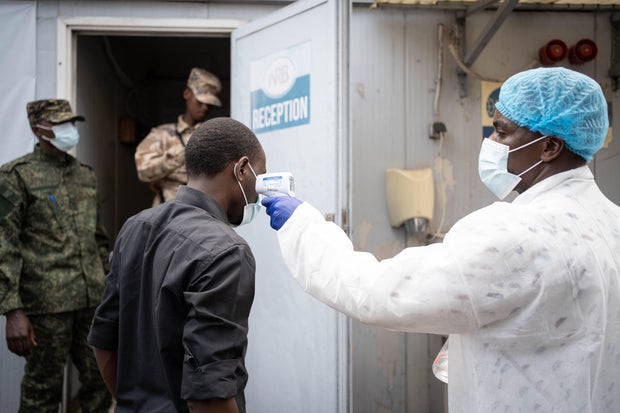
DR CONGO-GOMA-EBOLA OUTBREAK
A medical worker checks the temperature of a local resident as part of Ebola screening in Goma, Democratic Republic of the Congo, May 19, 2026.

Stringer/Xinhua/Getty

He said Uganda had also reported two confirmed cases in the capital Kampala, including one death, while a U.S. national working in the DRC has been confirmed positive and transferred to Germany. American doctor Peter Stafford, whose family lived with him in the DRC, was evacuated to Germany and was receiving treatment, the missionary group Serge said Tuesday.   

“There are several factors that warrant serious concern about the potential for further spread and further deaths,” said Tedros.

“Beyond the confirmed cases, there are almost 600 suspected cases and 139 suspected deaths,” he said. “We expect those numbers to keep increasing, given the amount of time the virus was circulating before the outbreak was detected.”

Ebola outbreak not “a pandemic emergency”

On Sunday, Tedros declared the situation a public health emergency of international concern — the second-highest level of alarm under the legally binding International Health Regulations (IHR) — triggering emergency responses in countries worldwide.

The WHO emergency committee convened to assess the outbreak met on Tuesday.

“The current situation and criteria for a public health emergency of international concern have been met, and we agree that the current situation does not satisfy the criteria for a pandemic emergency,” the committee’s chair, Lucille Blumberg, told reporters from South Africa.

Anais Legand, WHO technical officer on viral hemorrhagic fevers, said investigations were under way to pinpoint how long Ebola has been spreading in the eastern DRC.

“Given the scale, we are thinking that it has started probably a couple of months ago, but investigations are ongoing and our priority is really to cut the transmission chain by implementing contact tracing, isolating and caring for all suspect and confirmed cases,” she said.

WHO responds to U.S. criticism

U.S. Secretary of State Marco Rubio on Tuesday said the WHO was “a little late” in identifying a deadly outbreak.

President Trump, in one of his first acts on returning to office last year, set in motion a U.S. withdrawal from the WHO, which he attacked bitterly over its response to the COVID-19 pandemic. Numerous public health officials and experts warned at the time that, as one of the world’s largest funders of global health through both international and national agencies, including the WHO, America’s step back from such programs could impact efforts to provide lifesaving healthcare and combat deadly outbreaks, especially in lower-income countries.

Asked about Rubio’s criticism, Tedros said that “maybe what the secretary said … could be from lack of understanding of how IHR work, and the responsibilities of WHO and other entities,” he said, explaining that the agency acted in support of countries rather than replacing them in outbreak responses.

Chinese government ships spotted in record numbers off Taiwan in July

(CNN) — China is ramping up pressure on Taiwan, with Beijing sending a record number of government vessels to waters around the island last month, according to figures provided by Taiwan’s coast guard.The 244 sightings of Chinese government vessels – ships belonging to the China Coast Guard, scientific research agencies and others – was more than four times the number seen in July 2025, Taiwan’s coast guard said.That amounts to about eight ships a day, the official figures show.China “is escalating its campaign to bring Taiwan’s surrounding waters under its jurisdiction and may be testing the willingness of foreign vessels to comply with (Chinese) authorities in disputed waters,” the Institute for the Study of War (ISW) think tank said in an analysis earlier this month.The numbers do not include Chinese vessels in waters near Taiwan’s offshore islands, including Kinmen, Matsu and Pratas, the coast guard said. If those are added, the number almost doubles, to 425. That compares to 233 Chinese ships last July.The number of Chinese People’s Liberation Army Navy warships in waters around Taiwan is also not included in the tally.A Taiwanese official said last month that the activity points to a critical wartime risk: that Beijing may be rehearsing how to sever Taiwan’s Pacific supply lines.“If the situation escalates to a blockade — which would amount to a quasi-war — we have plans to work with the navy to jointly protect Taiwan’s lifeline sea routes,” the official told CNN.Though Taiwan is a self-ruled democracy, Beijing has vowed to bring the island under its control – by force if necessary.Earlier this summer, the movement of ships from China’s Maritime Safety Agency (MSA) – a law enforcement rather than military organization – to Pacific waters east of Taiwan was noted by analysts and Chinese state media.China’s state-run tabloid Global Times called the movement of the MSA ships “a sovereignty declaration with both legal significance and political signaling.”Taiwan’s coast guard said at the time that the Chinese law enforcement ships were issuing radio challenges to the vessels heading to Taiwan.A Taiwanese official last month said that while the Chinese coast guard vessels have so far not boarded merchant ships passing through waters around Taiwan, they have broadcast questions to these vessels about port entry and exit information to create the false impression that Beijing has jurisdiction over waters around Taiwan.Such broadcasts have “already put pressure on these commercial ships,” although none of these vessels had changed course,” the official said.According to the Institute for the Study of War, China earlier this month used a typhoon in the region to try to test MSA control of ships in the area.“The MSA announcement said that passing ships must ‘strictly comply with traffic control requirements’ and ‘obey the instructions of on-site maritime management agencies,’” the ISW report said.And they are just the latest application of China’s gray-zone tactics, it says.China “likely intends to expand its de facto control around Taiwan as much as possible through means short of war, which erodes Taiwan’s sovereignty, strains Taiwan’s resources, and sets favorable conditions for future (Chinese) military operations against Taiwan,” it says.Taiwan legislature approves $7 billion for dronesTaiwan’s opposition-controlled legislature approved a plan on Thursday to spend more than $7 billion on unmanned systems (including UAV, USV and UUV) over the next six year.The planned purchase indicates Taiwan’s learning lessons from the armed conflicts in Ukraine and Iran to hopefully deter an attack by China, while at the same time turbocharging its domestic drone industry.Taiwan has launched an islandwide effort to bolster its drone production with an aim to become world leader.In just the first seven months of this year, it exported roughly 2.6 times more drones in value than the entire 2025, according to Taiwan’s official trade data.The-CNN-Wire™ & © 2026 Cable News Network, Inc., a Warner Bros. Discovery Company. All rights reserved.
Read Next Story