▶ Watch Video: Is your phone listening to you?
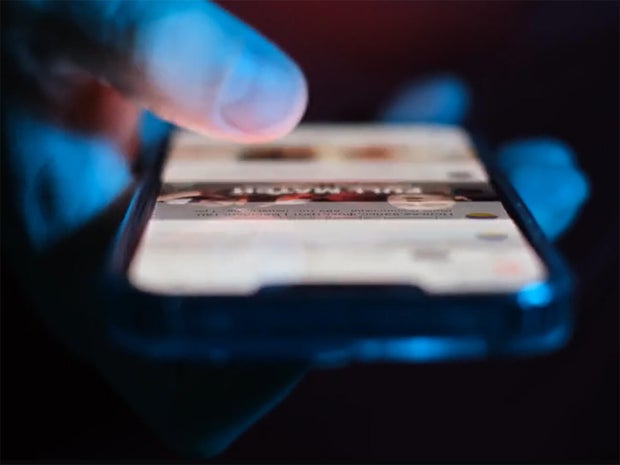
A lot of people have had a very creepy experience with their phones. One woman told us, “Sometimes when I talk about something with my friends, then I’ll, like, look on TikTok 30 minutes later – and the same thing will show up.”
One visitor to New York told us, “We were talking about this trip before we came, and then my Instagram reel was just full of New York content for weeks.”
Another woman described talking about trying a type of food with her friends. “And then the second you open the app, it shows you exactly that,” she said. “It’s a bit strange!”
CBS News
So, is your phone listening to you? “It is not,” said Ari Paparo, an ad industry veteran, consultant and author. “I’ve been asked about this a million times. And I can guarantee you that your phone is not passively listening to you for advertising purposes.”
Paparo has been asked this before. “Oh, my whole family thinks it’s true!” he laughed.
Paparo says that there is no way anyone could process audio from billions of phones. “Listening to every conversation around the world, and interpreting them and looking for certain words, and then matching them to the ads is impossible,” he said.
So, why does it seem like the phone is listening? First, because advertisers do target you with ads tailored to your interests. But they don’t need to listen to what you say to do that. Paparo said, “They can infer or deduce things about you, like where you live, and your age, and probably what you’re interested in, based on what’s websites you went to or what apps you’ve used. And that whole combination can get pretty precise.”
Secondly, because you might live with someone who searched for a product online.
Why did Facebook show me an ad for a carrot peeler, after I told my wife we should get a better peeler? “Your wife could have looked for a peeler, and then the ad company couldn’t really tell the difference between her and you, because you’re using the same internet in the same household,” Paparo said. “That happens a lot.”
David Choffnes, a professor of Computer Science at Northeastern University, wanted to test whether your smartphone is spying on you. “We did a study with thousands of apps on an Android device, and wanted to see, as you interact with these apps, are they recording your audio and sending it off?
“We didn’t see any surreptitious recording of information,” he said. “But these companies are very good at watching everything you’re doing online.”
And what you’re doing in your home. Choffnes has set up a fake apartment filled with online devices – smart appliances, cameras, smart speakers – to study how much data they send. “We try to identify, are they sending data to places we’re not comfortable with?” he said.
Now, advertisers do not know who you are; they don’t have your name or address. But they do know what categories you fit into.
And many states require data collection companies to give you your advertising on request. Choffnes, for example, got a copy of his data report, which clocks in at more than 300 pages: “Just filled wall-to-wall with inferences about me,” he said.
Although it’s not especially accurate. For example, it says he has an Xbox (“I do not have an Xbox,” he said), and that he’s extremely likely to go on a cruise (“Which is interesting, ’cause I never want to go on a cruise!” he laughed).
If you’d like to minimize the data you’re feeding advertisers, there are a few steps you can take.
Choffnes also said, “You can push your lawmakers to come up with laws that are favorable for consumers and not just favorable for the businesses that are collecting data from us.”
And Ari Paparo says your choice of web browser matters, too. “The Safari browser doesn’t allow a lot of this,” he said. “Advertisers are not big fans of Apple and Safari.”
To confirm, he doesn’t believe smartphones are eavesdropping: “I’m sure the phone is not overhearing you,” he said.
And he’s equally sure of something else: “I’m positive that no one will believe me!”
For more info:
- Ari Paparo
- David Choffnes, professor and executive director, Cybersecurity and Privacy Institute, Northeastern University
Story produced by Mark Hudspeth. Editor: Karen Brenner.
See more: