Hay House
We may receive an affiliate commission from anything you buy from this article.
Mel Robbins’ podcasts, TED Talk and bestselling books, including “The 5 Second Rule,” have made her one of the most successful motivational speakers.
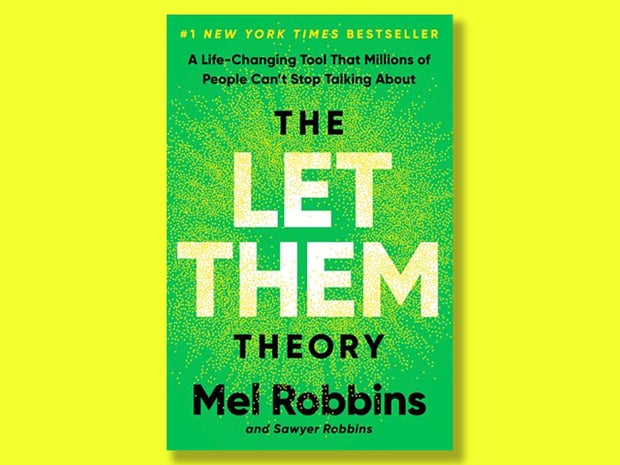
In her latest bestseller, “The Let Them Theory” (Hay House), she discusses how personal growth is only possible when you stop pouring energy into things you cannot control – which includes changing other people.
Read an excerpt below, and don’t miss Norah O’Donnell’s conversation with Mel Robbins on “CBS Sunday Morning” February 1!
“The Let Them Theory” by Mel Robbins
Prefer to listen? Audible has a 30-day free trial available right now.
I’ve spent the last two years researching the Let Them Theory: why it works, and how you can use it to transform your life and improve your relationships with other people.
In writing this book, I’ve spoken to many of the world’s leading experts in psychology, neuroscience, behavioral science, relationships, stress, and happiness. You’ll meet them as you read the book, and their research will help you apply the theory in countless situations in your life. As you’ll soon see, the science is clear: This thing works. And it works really well.
But this book isn’t just about introducing you to the Let Them Theory. It’s about a fundamental law of human nature: All human beings have a hardwired need for control.
We all have an innate desire to control everything about our lives: our time, our thoughts, our actions, our environment, our plans, our future, our decisions, and our surroundings. Feeling in control makes you feel comfortable and safe, so naturally you try to control everyone and everything around you—oftentimes, without even realizing it.
But the fact is, there is one thing you will never be able to control. No matter how hard you try, you will never be able to control or change another person. The only person you are in control of is you. Your thoughts, your actions, your feelings.
For too long you’ve been working against this fundamental law of human nature. You’ve been fighting to change people, battling to control situations, worrying about what people say, think, or do; and in doing so, you’ve created unnecessary stress, tension, and friction for yourself and in your relationships. I did too.
The Let Them Theory has transformed my entire approach to life and how I deal with other people. Instead of resisting the natural flow of human nature, I learned to embrace it. Instead of wasting my energy on something I can’t control—what others say, think, and do—I poured my energy into what I can control: me.
The result? I gained more control over my own life than I have ever had before. It was freeing. I stopped making other people the problem, and in doing so, my relationships improved in ways I never thought possible. It was like unlocking a door that had been sealed shut for years. And behind it? A life where I’m no longer weighed down by the need to manage other people.
In the coming pages, you’ll learn all about the theory, the easiest way to start using it, and how awesome it feels when you do. You’ll also learn about a surprising discovery I made early in our research. The Let Them Theory isn’t just … Let Them. Yes, it begins with these two words, but that’s not the whole story. Let Them is just the first half of the equation. There is a second, even more crucial step to this theory: Let Me.
In the next chapter, we’ll unpack both Let Them and Let Me and explore the science and psychology behind each one of the two steps. Then, you’ll learn about the eight core areas of your life where the theory will have the biggest positive impact. We’ll talk about your relationships, career, emotions, opinions, stress, love life, struggles, chronic comparison, friendship, and most importantly, your relationship with yourself.
Over and over, you’ll learn how you’ve been trying to control the wrong things and unknowingly made other people a problem. The truth is, other people should be one of the greatest sources of happiness, support, and love in your life. But they can’t be if you keep trying to control what they feel, say, and do. That ends with this book.
Master the Let Them Theory, and you’ll stop exhausting yourself trying to control the uncontrollable. This isn’t just about feeling better. It’s about redesigning how you live your entire life. I can’t wait for you to discover the space and freedom to experience your life the way you’ve always wanted—on your terms.
Let’s begin.
From “The Let Them Theory” by Mel Robbins. Copyright © 2024 by Mel Robbins. All rights reserved. This excerpt, or any parts thereof, may not be reproduced without permission.
Get the book here:
“The Let Them Theory” by Mel Robbins
Buy locally from Bookshop.org
For more info:
- “The Let Them Theory: A Life-Changing Tool That Millions of People Can’t Stop Talking About” by Mel Robbins (Hay House), in Hardcover, eBook and Audio formats
- melrobbins.com
- Mel Robbins (Podcast)