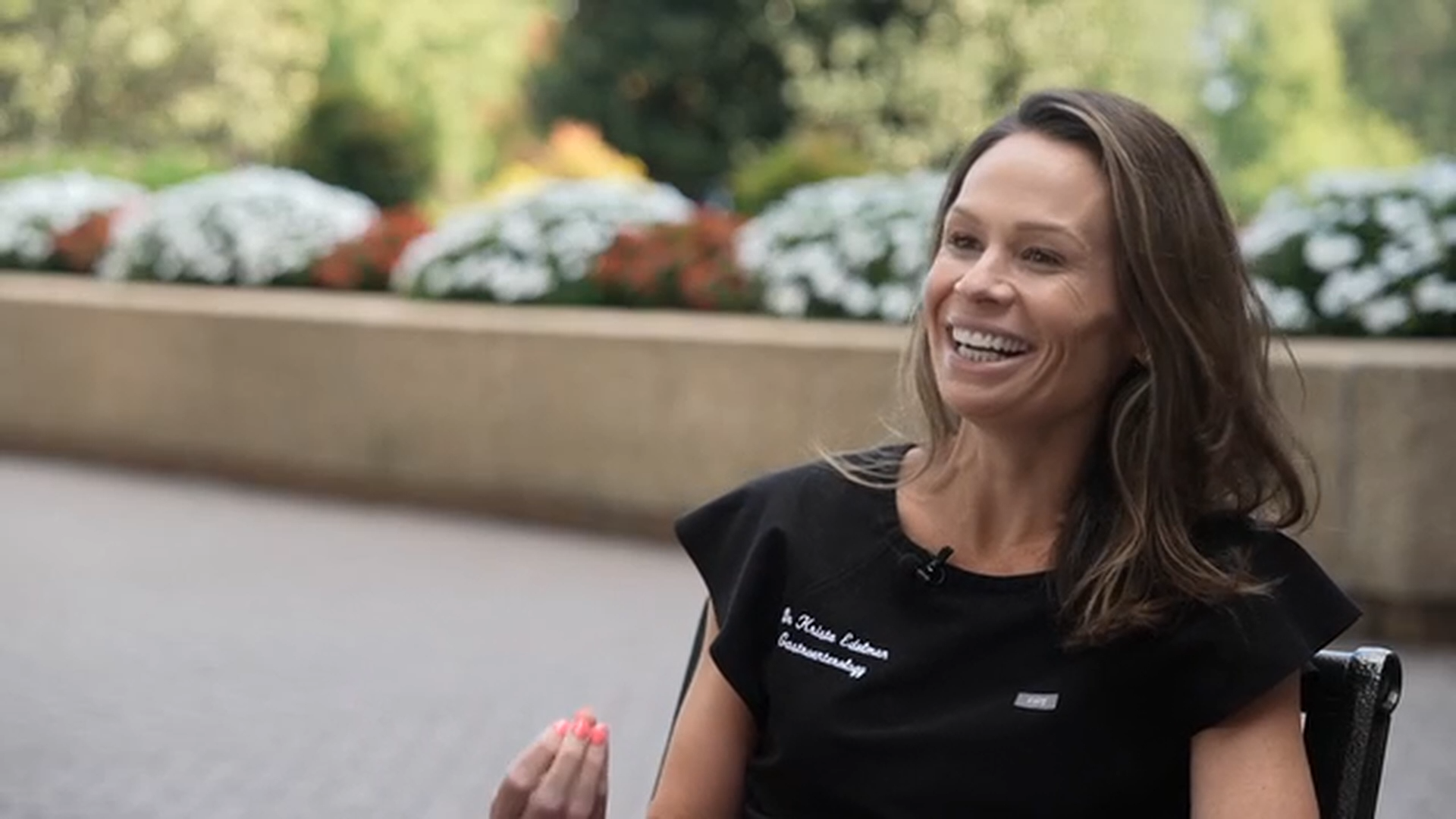
▶ Watch Video: Facing a Monster
On Jan. 27, 1996, C.C. Opanowski was home alone from college in Hudson Falls, New York, house-sitting for her mother when her ex-boyfriend, Shawn Doyle, knocked on the door. Opanowski had grown up with Doyle and dated him in high school and into her freshman year of college.
Once inside, Opanowski says Doyle became violent. “He pushed me onto the couch, started holding me down, restraining me, yelling at me. And he picked me up and pushed me against the French doors,” she says. Then, she said, Doyle took scissors and cut off her ponytail. “He picked me up, held me up and cut off my hair, just all of it.”
“48 Hours” correspondent Anne-Marie Green asks Opanowski, “What was it like to have your hair cut off in this way?” Opanowski answers, “Demeaning.” Green continues, “You think that is why he did it?” Opanowski answers, “Probably. Just to make sure he could knock me down somewhere.”
Opanowski says Doyle had gone in and out of violent rages, and at one point, he held scissors to her throat. “I thought he was gonna stab me,” she tells Green.
For the first time, Opanowski shares her powerful story with “48 Hours,” speaking out about the attack, her long road to healing, and the strength it took to face her attacker in court. Green reports on a case that spans nearly three decades in “Facing a Monster,” streaming now on Paramount+.

CBS News
Opanowski says she didn’t think she would make it out alive until her college roommate and close friend, Shannon McCauliffe, called. Doyle allowed Opanowski to answer the phone, but she says he was watching her every move. “And by the grace of God, just within a few words, she (Shannon) figures out, based on the tone of my voice and how I’m answering her, that he’s there,” says Opanowski.
McCauliffe knew Doyle had a history of harassing Opanowski and feared for her friend’s safety. She hung up the phone and immediately called police. When authorities arrived, Opanowski was initially relieved. But she says Hudson Falls police officers “did not put him (Doyle) in handcuffs … They put us in the back of the same police car.” To make matters worse, when they arrived at the police station, instead of separating them, she says police interviewed them together. Opanowski says she felt the police did not take the matter seriously. “They made it seem like it was some fight between two young kids, that turned, slightly dark,” she tells Green.
When “48 Hours” reached out to the Hudson Falls Police Department, they acknowledged that law enforcement’s response to domestic violence has evolved over the past several decades to better work with and support victims. Police arrested Doyle and charged him with menacing, harassment and trespassing. He would eventually plead guilty to menacing in the second degree and he was sentenced to three years’ probation. Opanowski says she was terrified of Doyle. She transferred colleges and moved far away from Hudson Falls.

Jennifer Leonard
Opanowski had put her past behind her until the summer of 2005 — nine years after the attack — when she learned that Doyle had been arrested for murdering 33-year-old Lori Leonard, a young mother of two boys. Opanowski says, “I couldn’t believe what I was hearing … I felt for her entire family and her two young children.”
Lori Leonard had met Doyle in 2003 on the dating website Cupid.com. She lived three hours from Doyle in Chittenango, New York, a small town outside Syracuse. Lori Leonard’s older sister, Jennifer Leonard, says they only dated a short time because of Doyle’s violent temper. Jennifer Leonard says, “I had called her one night, and he was over there, and all I could hear in the background was him yelling at her. And that was like, what is this?”
Despite being broken up, Lori Leonard told Jennifer Leonard that they agreed to be friends and that Doyle was fine with it. Jennifer Leonard says she was skeptical. “And I was like, no, he is not. Nope. People like that aren’t just OK with being friends,” she says.

Det. Wade Irwin
On April 29, 2005, just days before Lori Leonard disappeared, Shawn Doyle helped her move into a new rental apartment. Doyle had offered up use of his truck. Jennifer Leonard says, “She had asked a couple people before that. So he was a last resort. He was still playing the ‘I’m your friend.'” According to Jennifer Leonard, the move went smoothly, except for the fact that Doyle decided to hang around. She said his presence was getting on her sister’s nerves. But five days later, on May 4, Lori Leonard told her Doyle was finally leaving. Lori Leonard had plans to drive to Albany that day to pick up Yankees tickets from someone she met at work. Later in the afternoon on May 4, Jennifer Leonard called her sister, hoping to catch her on her way to Albany. Instead, Lori Leonard’s phone kept going to voicemail. Jennifer Leonard says she thought that was weird. She says, “Her phone never went straight to voicemail. It was never off.”
Twenty-four hours later, when Lori Leonard never called or returned home, Jennifer Leonard called the Chittenango Police Department. Detective Wade Irwin searched her rental property. There were no signs of a break-in or that a crime had been committed in the home. He said when they interviewed the man Lori Leonard was supposed to meet to get Yankees tickets from, his alibi checked out. When they interviewed Doyle, Irwin says, “he just always, had said all along … that he left her, and she was alive at the apartment.”
Irwin says when they checked out his alibi they couldn’t clear him. Yet, Doyle was cooperative and even allowed investigators to search his truck and take photos. When they searched Doyle’s glove compartment, they found something curious: a key with a serial number on it. At the time it did not mean anything to investigators. But it would later become important to the case.

Kevin Kortright
On July 24, 2005, three months after Lori Leonard went missing, there was a break in the case. Lori Leonard’s body was discovered in a metal toolbox found in the Lake Champlain Canal. Irwin says, “She was handcuffed behind her back. There was duct tape around the handcuffs. Her feet were bound together, and duct taped. Her face, from head to chin had duct tape. And then once that duct tape was removed there was a bandana tied to her mouth.” Irwin says the investigation quickly came together and it all led to Shawn Doyle. The key they found in Doyle’s glove compartment matched the lock of the toolbox, tying him directly to the crime. When investigators searched Doyle’s residence, Irwin says they found “similar handcuffs, bandanas, duct tape and other means that he used that matched what was used on Lori.” One day after discovering Lori Leonard’s body, Doyle was arrested and charged with second-degree murder.
On Jan. 23, 2006, Doyle’s trial began. Washington County District Attorney Kevin Kortright says central to his case was getting Opanowski to testify. He says her testimony was important because “it shows what he (Doyle) is capable of … it’s his modus operandi. It’s strong proof.” But Opanowski was not the only ex-girlfriend that Doyle had attacked. Five years after Doyle attacked Opanowski he allegedly tried to kill another young woman. The judge ruled both women could take the stand. Kortright says he chose to call Opanowski as his last witness. He says, “You always put the best for the last.”
Opanowski bravely faced her attacker after so many years and told the jury about the long-lasting mental anguish Doyle caused her. She says she was determined. “I need to make sure that he is put away for murdering Lori,” she says. On Jan. 26, 2006, the jury came back with a verdict: Shawn Doyle was found guilty of second-degree murder.
Opanowski says after all these years, it’s still difficult to process the fact that a person she once loved was convicted of murder. She hopes that others can learn from her story. She says, “Be vigilant. Look at what’s happening in front of you and make sure someone knows. Don’t keep it quiet. Pay attention and when you have that feeling, that one that doesn’t go away, you know, the one that you try to push down, that’s the one you should listen to the most.”