
Wildfires rage, force evacuations in western U.S., Canada amid drought

▶ Watch Video: Fast-moving fires rip through West

Spokane, Washington — More than 40 large wildfires are burning in the West, fueled by severe drought, as over 100 blazes scorch parts of western Canada. 

The Bug Fire near Reno, Nevada, has burned more than 15,000 acres, getting dangerously close to homes and forcing thousands of residents to evacuate over the weekend. 

In Utah, two pilots were killed after their helicopter crashed on Friday while fighting the Widemouth 2 Fire, which has grown to more than 100,000 acres. 

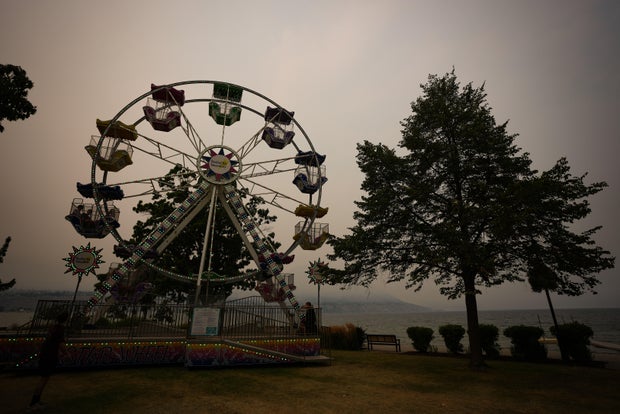
And in British Columbia, Canada, which borders Washington, the Bald Range Fire burned out of control, nearly doubling overnight as residents raced out. More than 20,000 people were ordered to evacuate the area of Summerland — 150 miles east of Vancouver — and officials say some residents had to be rescued. 

“Aerial response teams were converted to emergency evacuation personnel,” said Ravi Parmar, minister of forests of British Columbia. “Eighteen of our aircraft were used to rescue more than 50 individuals.”

British Columbia declared a province-wide state of emergency Saturday as more than 100 wildfires burned across the province amid windy weather and prolonged drought. 
Canada Wildfires
People ride a Ferris wheel as smoke from the Bald Range wildfire envelops Okanagan Lake, in Penticton, British Columbia, on Aug. 9, 2026.

Darryl Dyck/The Canadian Press via AP

Last week, fires near Spokane, Washington, showed how quickly conditions can escalate. Blazes there destroyed nearly 1,000 structures. 

Some evacuations in Spokane eased Sunday, but the hardest-hit neighborhoods remain closed while crews check for hot spots. 

Spokane County Sheriff John Nowels said authorities were doing everything they could to get people back in their homes “as soon and as safe as possible.”

Officials have not said exactly when families in the hardest-hit areas can go home. Crews are still monitoring for hot spots and removing hazardous materials.

Democrats like AOC are trying to shrug off their ‘woke’ era. That’s bad for our politics

(CNN) — Democrats would very much like to figure out how to explain away some of the far-left things they said circa 2019 and 2020 — a period often referred to as “peak woke,” “woke 1.0” or “woke 1.”Kamala Harris struggled with this during her 2024 presidential campaign (think: some transgender policies), and now it looms over some key 2026 races.Rep. Alexandria Ocasio-Cortez on Sunday offered a prescription: Laugh it off.“I have a local city councilman that has this saying: ‘Woke 1 was crazy,’” the New York congresswoman said on ABC’s “This Week,” before laughing.Ocasio-Cortez, who once supported defunding the police, went on to suggest Covid had expanded the range of acceptable political discourse. But she said that it’s “not rhetoric that we would use today.”This might be a politically deft explanation for Ocasio-Cortez and her ilk. But it’s a bad one for the body politic. It continues a troubling trend of major politicians asking Americans not to take the things they say — or more specifically, that they once said — at face value.It’s a perfect recipe for a continued decline in honesty and accountability.An increasingly common argument from DemocratsOcasio-Cortez was quoting New York City Council Member Chi Ossé. Back in May, he responded to a critic who unearthed a 2021 comment of his by saying simply, “Woke 1 was crazyyyy.”The same week, former Biden White House aide Yemisi Egbewole credited Texas Senate candidate James Talarico for distancing himself from his past woke comments. “Peak woke got weird. It’s okay to say that!” Egbewole said.And this weekend, perhaps the one 2026 Democratic candidate with the biggest “peak woke” problem echoed Ocasio-Cortez’s comment.Francesca Hong is the favorite in Tuesday’s Wisconsin gubernatorial primary, but her past statements about abolishing police and canceling Thanksgiving, among others, have a lot of Democrats freaked out about her potential nomination.“I had some hot takes, some bad takes on Twitter, but when you’re a business owner running a restaurant during Covid, trying to pay bills as a student, you’re putting feelings out there into the world,” Hong told Politico. “But I’ve evolved, I’ve learned.”A growing epidemicAppearing after Ocasio-Cortez on “This Week,” Republican former New Jersey Gov. Chris Christie took exception to her explanation.“After listening to the congresswoman, why should anyone trust her?” Christie said. He added that Republicans would “hold people like” Ocasio-Cortez and Hong “to what they’ve said over their careers, not what they’re trying to conveniently evolve into now.”But Christie is, to put it lightly, an imperfect messenger on this.Not only has he repeatedly changed his stance on President Donald Trump, but he has basically acknowledged having said things about Trump for political expediency.After running hard against Trump and then embracing him in 2016, Christie explained: “Yes, I disagreed with Donald Trump at the time. Big shock. I was running against him. … Of course I disagreed with him, because I was running against him.”Then, after Christie broke with Trump in 2021, the New Jersey Republican tried to disown the compliments he paid to Trump by saying he reasoned Trump would be the GOP nominee, and that he wanted to make the best of the situation.But it’s hardly just Christie. This has become an epidemic in US politics, on both sides of the aisle.The late GOP Sen. Lindsey Graham had repeatedly suggested his pro-Trump conversion was about getting things accomplished rather than what he truly believed. “If you know anything about me, it’d be odd not to do this,” he said at one point.Vice President JD Vance in both private messages and public comments has cited political calculations for his Trump stances. He told Time magazine when launching his Ohio Senate campaign in 2021: “If I actually care about these people and the things I say I care about, I need to just suck it up and support him.”Secretary of State Marco Rubio has explained comments like calling Trump a “con man” in 2016 by saying, “I didn’t know him when I ran in 2016, didn’t know him as a person.”And in 2020, Harris explained her personal attacks on Joe Biden’s past position on busing by saying, “It was a debate.” When asked if that meant she didn’t mean what she said, Harris repeated, “It was a debate,” and suggested that those kinds of comments are what you say in that forum.The most prominent example of this in recent years is Trump’s years-long assault on the truth — and his supporters defense of it. When confronted with his tens of thousands of false and misleading claims, some allies have repeatedly urged people to take Trump “seriously” rather than “literally.”Why it’s so bad for politicsImplicit in these arguments is that maybe these politicians didn’t believe what they said in real time — that they were just saying stuff. But the question then becomes: Does that also apply to what they’re saying today?Seriously-not-literally is a great set up for Trump because he can decide retroactively which comments he meant and what he was just saying for political effect.But that arrangement removes the onus on politicians to be studied stewards of the public interest — to do the hard work of coming to their positions through a sober review of the issues. And it makes it virtually impossible to hold them accountable.And once that accountability is out the window and Americans no longer demand it, politicians are liable to say whatever they think is most advantageous at the time.That’s what they do now, to some extent. But formalizing a system where comments from five days or five years ago can be explained away as unimportant ramblings from another political moment feels like a bad idea.It would be better to reward politicians who have the foresight and wisdom to take positions that they actually believe in and can stick to — and can stand the political test of time.The-CNN-Wire™ & © 2026 Cable News Network, Inc., a Warner Bros. Discovery Company. All rights reserved.
Read Next Story