
Trump issues new executive orders aimed at birthright citizenship

▶ Watch Video: Trump signs executive orders targeting “birth tourism,” automatic citizenship eligibility

Washington — President Trump on Thursday signed two executive orders in his latest effort to refuse citizenship to some children born in the United States, after the Supreme Court struck down his earlier executive order aiming to end birthright citizenship. 

“We had a very unfortunate decision in the Supreme Court concerning birthright, it was close,” Mr. Trump said in an Oval Office signing on Thursday. “But a very, very unfortunate decision. So we’re making adjustments.”

One order the president signed Thursday targets commercial “birth tourism,” White House deputy chief of staff Stephen Miller said, while the other expands the definitions of people ineligible for birthright citizenship, such as children of foreign citizens who lobby on behalf of foreign governments. The White House has not yet released the text of the orders. 

“This has been something that people have talked about, not only for years, but for decades,” Miller said of “birth tourism.”

“The idea that people come here pretending to be a tourist, pretending to be a visitor, saying they want to go to Disneyland or they want to go visit a monument or go to a national park, but the real reason they’re here is to have a child, to make that child an automatic citizen, leave our country, and then have a U.S. citizen child,” Miller said. “It gives them access, under this broken system, to welfare benefits, ultimately to the voting booth, and all the other rights and privileges that belong solely to Americans.” 

Axios first reported Mr. Trump would be signing the orders. 

Mr. Trump has long voiced his frustration with birthright citizenship, and he and his allies have sought to make the case that the amendment was only intended to address the aftermath of slavery. 

“This was done right after the Civil War,” Mr. Trump said Thursday. “This was for the babies of slaves.” 

The 14th Amendment, ratified in 1868, states “all persons born or naturalized in the United States, and subject to the jurisdiction thereof, are citizens of the United States and of the state wherein they reside.” 
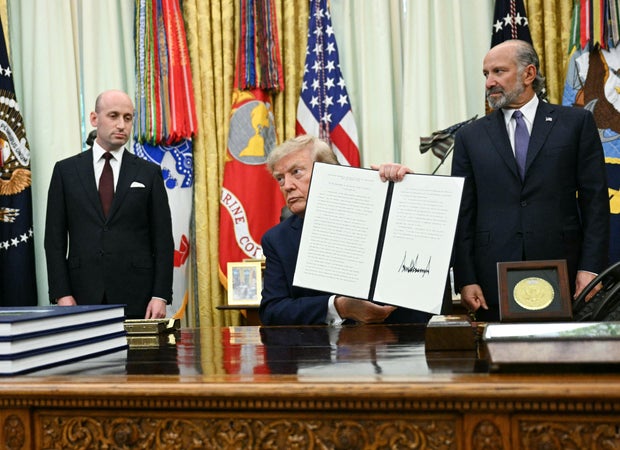
President Trump in the Oval Office
President Trump holds up a newly signed executive order in the Oval Office, alongside deputy chief of staff Stephen Miller, left, and Commerce Secretary Howard Lutnick, on Aug. 7, 2026.

Jim WATSON /AFP via Getty Images

The Supreme Court ruled 6-3 that the president’s first executive order, which he issued on his first day in office in 2025, was unlawful and out of step with the 14th Amendment. 

Asked if he thinks these new executive orders will pass constitutional muster, the president said, “I think it will.”

“Birth tourism” came up during Supreme Court oral arguments. In regard to that issue, Chief Justice John Roberts told the U.S. solicitor general, John Sauer, “You do agree that that has no impact on the legal analysis before us.” Sauer said that such tourism is evidence of the negative effects of the prevailing interpretation of the Citizenship Clause. 

“We’re in a new world now … where 8 billion people are one plane ride away from having a child who is a U.S. citizen,” Sauer said. 

“Well, it’s a new world. It’s the same Constitution,” Roberts replied.

Trump again tries to curb birthright citizenship and ‘birth tourism’ through executive action

(CNN) — President Donald Trump is taking another swing at limiting so-called birth tourism and birthright citizenship, citing a “very unfortunate decision” in the Supreme Court this year that struck down his earlier attempt to curb birthright citizenship.He signed executive orders on the subject Thursday, which appear to largely tighten laws already in place and narrow recognized exceptions.It’s a seemingly more limited attempt compared to an executive order Trump signed last year that sought to broadly end the right for children born in the country to people who are not US citizens. The Supreme Court rejected that effort in June, citing the 14th Amendment of the Constitution, which grants citizenship to anyone born on American soil.“We had a very unfortunate decision in the Supreme Court concerning birthright,” Trump told reporters in the Oval Office Thursday.One of the executive orders signed by Trump Wednesday targets “alien enemies,” members of foreign terrorist organizations and categories of people who lobby and act on behalf of foreign governments — making children born to people in those groups ineligible for birthright citizenship, said White House deputy chief of staff Stephen Miller, the architect of the administration’s immigration policies.The second executive order focuses on so-called birth tourism, which has been a focal point for immigration hawks. US law already bans people from obtaining a visa “for the primary purpose of obtaining U.S. citizenship for a child by giving birth in the United States.”Miller described the executive order as a ban on birth tourism, though it’s unclear how it would advance what is already in US code.Axios first reported on the executive actions.The Supreme Court’s decision on June 30 included a full-throated defense of birthright citizenship as it has been understood in the United States for more than a century. Children born on American soil, the court ruled, are US citizens even if their parents are in the country illegally or temporarily.A five-justice majority held that the 14th Amendment to the Constitution guarantees that right, over dissents from conservative justices who complained that the decision did nothing to stop the kind of birth tourism Trump initially targeted.A sixth justice, Brett Kavanaugh, concluded that Trump’s initial executive order limiting birthright citizenship was barred by federal law rather than the 14th Amendment.“Citizenship, then and now, was the right to have rights — to freely participate in our political community,” Chief Justice John Roberts, a conservative, wrote for the court. “The Framers of the Fourteenth Amendment extended that promise to ‘every free-born person in this land.’ We keep that promise today.”The court has long recognized some exceptions to the rule, and it did so again in its blockbuster decision this summer. But those are limited to children born to diplomats and “enemies” during a “hostile occupation.”Still, several members of the court’s conservative wing complained at the time that the June 30 decision would allow the kind of birth tourism Trump was concerned about.“The court has repurposed the Fourteenth Amendment to protect its own set of preferred rights that the Reconstruction Congress never contemplated and that cannot find support in its text,” Justice Clarence Thomas wrote in a dissent. “Today, the court does so again by recognizing a constitutional right to citizenship for the children of all foreign birth tourists and illegal aliens.”That opinion was joined by only one other member of the court: Justice Neil Gorsuch.“As interpreted by the court today, the Fourteenth Amendment confers citizenship on virtually everyone who happens to be born in this country, including the children of ‘birth tourists,’ women who come here solely for the purpose of giving birth to a child and then promptly return home,” Justice Samuel Alito wrote in a solo dissent.The-CNN-Wire™ & © 2026 Cable News Network, Inc., a Warner Bros. Discovery Company. All rights reserved.
Read Next Story